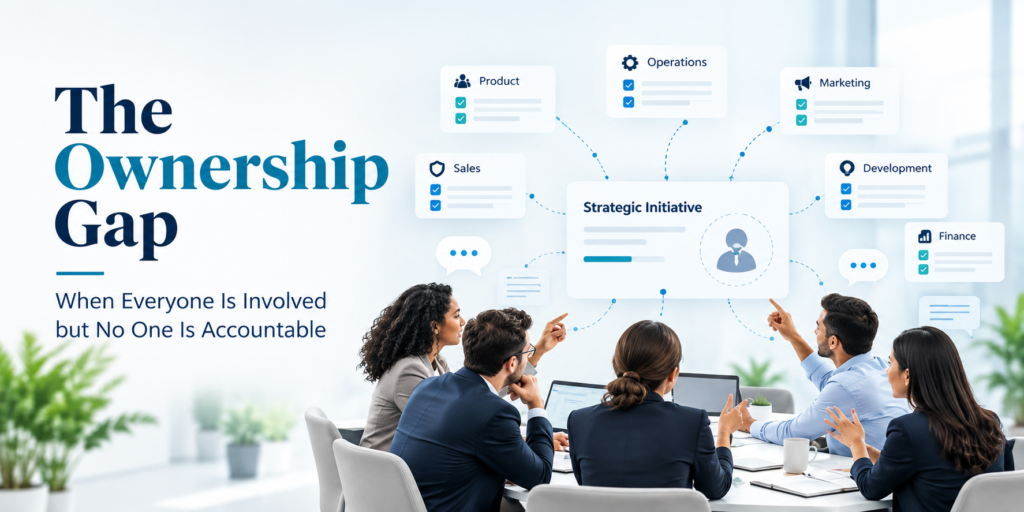
Strategic initiatives rarely fail because people are not working. They fail because too many people are involved, but no one is clearly accountable for the final outcome.
In most enterprises, one initiative touches multiple teams business, IT, finance, operations, compliance, vendors, and leadership. Everyone contributes. Everyone joins reviews. Everyone shares updates. But when decisions are delayed, dependencies are blocked, or progress slows down, one question becomes difficult to answer:
Who owns the outcome?
This is the ownership gap. It appears when responsibility is distributed across teams, but accountability is not clearly visible.
The Problem: Involvement Is Confused with Ownership.
Many organizations assume that if all stakeholders are included, ownership is covered. But involvement only means people are participating. Ownership means someone is accountable for progress, decisions, risks, and final business impact.
When every team owns a small part, the larger initiative can become ownerless. Delivery may continue, but direction becomes weak.
Solution: Define One Clear Initiative Owner.
Every strategic initiative needs one clear owner responsible for the end-to-end outcome. This owner should track progress, dependencies, risks, approvals, and alignment with business goals.
This strengthens collaboration because teams still contribute, but one person ensures that the initiative does not lose direction.
Read more on why enterprise strategy fails without initiative ownership and explore leadership insights from Dr. Vishwas Mahajan.
The Problem: Decisions Get Stuck Between Teams.
Cross-functional initiatives need decisions from different stakeholders. A business team may wait for IT. IT may wait for compliance. Finance may wait for updated numbers. In the meantime, execution slows down.
The issue is not always lack of effort. It is lack of clarity on who can approve, who should escalate, and who must unblock the next step.
Solution: Make Decision Rights Visible.
Ownership must include decision clarity. Every initiative should clearly show who approves, who contributes, who escalates, and who is accountable for closure.
A governance platform like Initiatives.app helps bring owners, approvals, risks, and execution signals into one connected view.
The Problem: Dependencies Are Not Actively Owned.
Dependencies often sit between teams. One group may need inputs, approvals, data, or completion from another group. But if no one owns that dependency, it becomes visible only after timelines slip.
This creates delays that could have been avoided with earlier visibility.
Solution: Assign Owners to Critical Dependencies.
Every major dependency should have an owner, due date, impact level, and escalation path. This ensures blockers are tracked before they become delivery risks.
For related reading, explore The Cost of Invisible Dependencies in Strategic Initiatives and The Dependency Blind Spot.
The Problem: Status Updates Show Activity, Not Accountability.
Most reviews focus on status green, amber, red, percentage complete, next milestone, and expected closure date. But status alone does not explain who owns the delay, which decision is pending, or what business outcome is now at risk.
This turns reporting into a description of the past instead of a tool for better execution.
Solution: Move from Status Reporting to Ownership Governance.
Organizations need governance that connects progress with owners, decisions, risks, dependencies, and outcomes. When ownership is visible, leaders do not need to chase updates. They can focus on where intervention is needed.
Read more about the governance gap between leadership decisions and team execution.
Closing the Ownership Gap.
The ownership gap is not a people problem. It is a governance problem.
Most teams want to contribute. Most leaders want visibility. But without clear ownership, even active initiatives can lose momentum.
The solution is not more meetings. It is a continuous governance layer where every initiative has a clear owner, visible accountability, tracked dependencies, timely decisions, and measurable outcomes.
Initiatives.app helps organizations move from scattered involvement to accountable execution by connecting initiatives, owners, approvals, risks, dependencies, and progress in one place.
When ownership is clear, decisions move faster, risks surface earlier, and strategic initiatives stay connected to business outcomes.
FAQs
What is the ownership gap?
The ownership gap happens when many teams are involved in an initiative, but no single person is clearly accountable for the final outcome.
Why does unclear ownership slow down initiatives?
Because decisions, dependencies, risks, and escalations do not have clear owners. Work continues, but blockers remain unresolved.
How can enterprises fix the ownership gap?
By defining initiative owners, assigning decision rights, tracking dependencies, and connecting execution progress with business outcomes.
Why is ownership important in governance?
Ownership ensures that strategic initiatives do not become scattered across teams and remain focused on measurable results.
Want to create clearer ownership across strategic initiatives?
Explore Initiatives.app to move from scattered involvement to accountable execution.
👉 Book a Demo | 🌐 Visit Initiatives.app
📥 Learn more about features, benefits, and use cases at:
👉 www.initiatives.app
Contact Us : info@whizible.com | +91 855-498-3315
Address : Mrugank, Level 3, Kothrud, Pune, Maharashtra, 411038