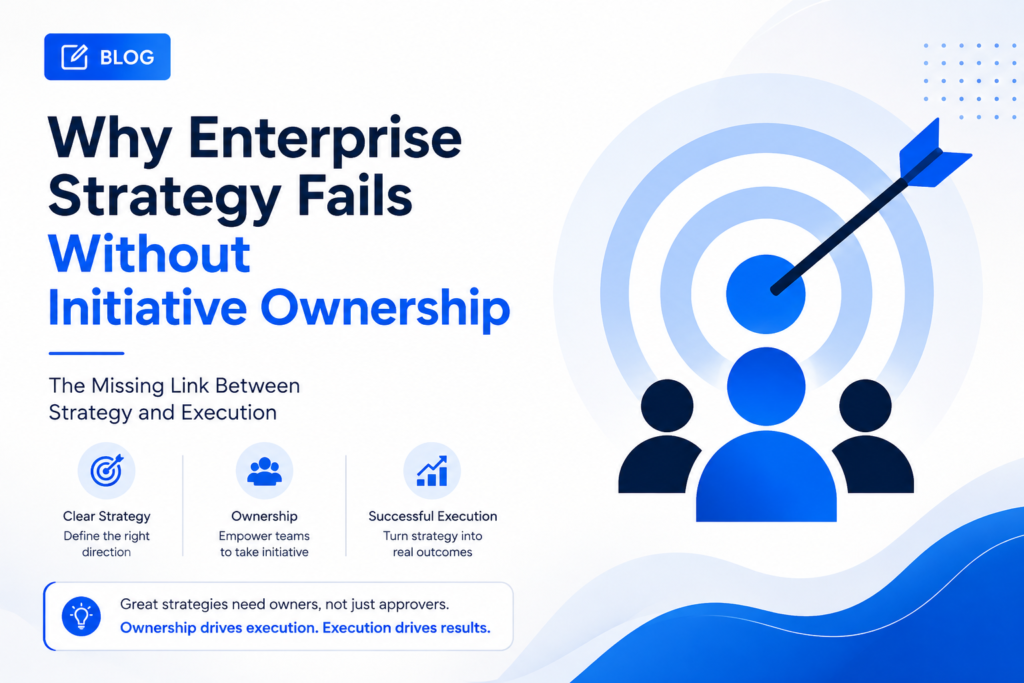
Every year, enterprises invest months defining strategic priorities, securing leadership alignment, and approving transformation initiatives. Roadmaps are created, budgets are sanctioned, and executive presentations generate optimism across the organization. Yet, months later, leadership meetings are filled with questions instead of answers.
"Who owns this initiative?"
"Why has the milestone slipped?"
"Which dependency is causing the delay?"
"Are we still on track to achieve the intended business outcome?"
The problem rarely lies in the strategy itself. Most organizations have capable leadership teams and well-defined business objectives. What consistently breaks down is initiative ownership the discipline of assigning clear accountability for driving execution, removing roadblocks, and delivering measurable outcomes.
Without ownership, strategy gradually transforms into a collection of disconnected projects where everyone participates, but no one is ultimately accountable for success.
The Problem: Strategy Creates Direction, Ownership Creates Execution.
Strategic initiatives almost never fail because organizations lack ideas. They fail because execution becomes fragmented across departments, tools, and reporting structures.
Marketing owns one workstream.
Technology owns another.
Operations manages implementation.
Finance monitors budgets.
PMOs track milestones.
Executives review dashboards.
While every function contributes, responsibility often becomes diluted. Teams assume someone else is driving overall progress while individual departments optimize only their own deliverables.
As initiatives become increasingly cross-functional, ownership becomes even more critical. Without a clearly defined initiative owner, decisions slow down, dependencies remain unresolved, risks go unnoticed, and leadership loses visibility into whether the initiative is actually moving toward its intended business objective.
The result is an organization that appears busy but struggles to convert strategic intent into measurable business value.
Why Traditional Project Ownership Isn't Enough.
Many organizations believe assigning a project manager automatically establishes ownership. In reality, project management and initiative ownership solve different problems.
A project manager focuses on schedules, resources, deliverables, and execution activities.
An initiative owner focuses on business outcomes, executive alignment, dependency resolution, stakeholder collaboration, governance, and ensuring strategic objectives are achieved.
This distinction becomes especially important in enterprise transformation programs where multiple projects collectively contribute to one strategic initiative.
Without initiative-level ownership, organizations often encounter:
- Multiple teams working toward conflicting priorities.
- Delayed executive decisions because ownership is unclear.
- Escalations that remain unresolved.
- Inconsistent reporting across business functions.
- Difficulty measuring actual strategic impact.
The absence of ownership creates governance gaps that no amount of reporting can solve.
The Solution: Make Initiative Ownership Visible and Measurable
Successful organizations treat initiative ownership as a governance capability rather than an administrative responsibility.
Every strategic initiative should have a clearly identified owner who is accountable for:
Defining measurable business outcomes
Ownership begins by establishing what success actually means—not simply completing tasks, but achieving strategic objectives tied to measurable business value.
Coordinating cross-functional execution
Initiative owners continuously align business units, technology teams, finance, HR, and operations while ensuring dependencies are proactively managed instead of reactively discovered.
Monitoring risks in real time
Rather than waiting for monthly review meetings, owners need continuous visibility into milestones, blockers, approvals, and changing execution health.
Driving executive accountability
Leadership should always know who is responsible for decisions, progress, risks, and expected outcomes.
Organizations adopting real-time initiative governance significantly reduce execution ambiguity because ownership becomes transparent across every stage of execution.
Learn how live governance improves enterprise execution:
https://initiatives.app/the-future-of-enterprise-governance-live-execution-signals/
For additional perspectives on leadership and execution, follow Dr. Vishwas Mahajan:
https://www.linkedin.com/in/vishmahajan/
Technology Should Reinforce Ownership, Not Replace It
Many organizations attempt to solve execution challenges by introducing more dashboards, reporting templates, spreadsheets, or collaboration platforms.
However, visibility without ownership simply creates better reports about existing problems.
Modern initiative governance platforms should enable organizations to:
- Assign clear initiative ownership.
- Track dependencies across multiple teams.
- Monitor approvals and decision bottlenecks.
- Surface execution risks proactively.
- Connect strategic goals with operational execution.
- Provide leadership with real-time execution visibility.
Instead of asking who owns an initiative during quarterly reviews, leadership should be able to identify ownership, status, risks, and business impact instantly.
Explore how organizations eliminate governance gaps:
https://initiatives.app/governance-gap-real-time-initiative-tracking/
Read more insights on enterprise execution:
https://www.linkedin.com/in/vishmahajan/
Conclusion
Enterprise strategy does not fail because organizations lack vision.
It fails because execution lacks ownership.
When accountability is fragmented, strategic initiatives lose momentum, cross-functional collaboration weakens, and leadership operates without reliable execution visibility.
Organizations that consistently achieve strategic outcomes establish initiative ownership as a core governance discipline. They combine accountability with real-time execution insights, enabling leaders to identify issues early, resolve dependencies faster, and maintain alignment between strategy and execution.
Strategy defines where an organization wants to go.
Initiative ownership determines whether it gets there.
Frequently Asked Questions (FAQs)
What is initiative ownership?
Initiative ownership is the responsibility assigned to an individual who is accountable for delivering the overall business outcome of a strategic initiative, coordinating stakeholders, managing dependencies, and ensuring execution remains aligned with organizational objectives.
How is initiative ownership different from project management?
Project management focuses on delivering tasks, timelines, and resources. Initiative ownership focuses on achieving strategic business outcomes across multiple projects, teams, and stakeholders.
Why do enterprise strategies fail despite good planning?
Most strategies fail because execution lacks clear accountability, cross-functional coordination, dependency management, and real-time governance—not because the strategy itself is flawed.
How can organizations improve initiative ownership?
Organizations should assign dedicated initiative owners, define measurable outcomes, establish governance processes, monitor execution in real time, and use connected platforms that provide enterprise-wide visibility into strategic initiatives.
👉 Book a Demo | 🌐 Visit Initiatives.app
📥 Learn more about features, benefits, and use cases at:
👉 www.initiatives.app
Contact Us : info@whizible.com | +91 855-498-3315
Address : Mrugank, Level 3, Kothrud, Pune, Maharashtra, 411038