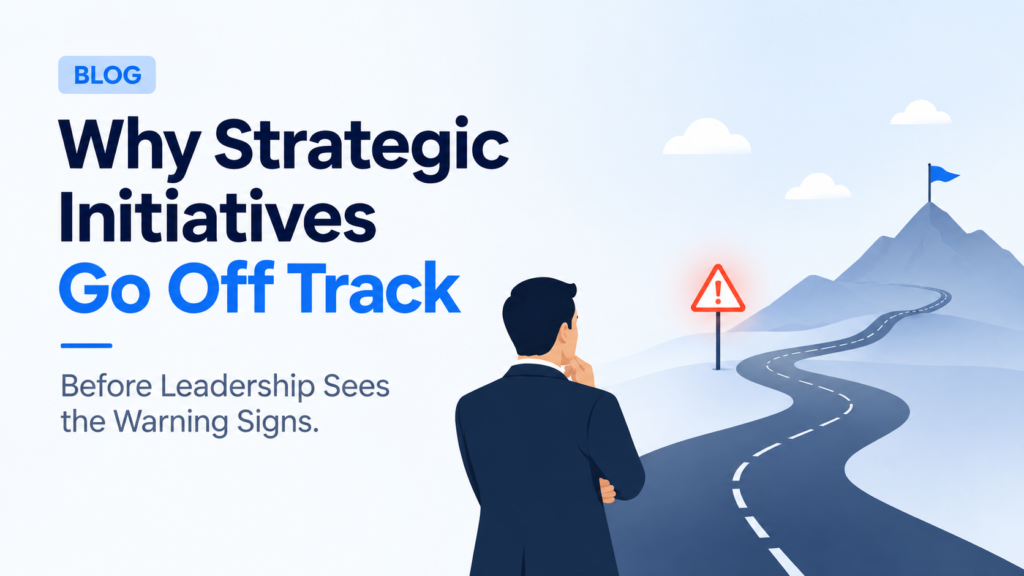
Strategic initiatives rarely fail suddenly. The warning signs usually appear much earlier a delayed approval, an unresolved dependency, a milestone that keeps moving, an unclear decision, or a change in scope. Individually, these issues may seem manageable. Together, they can gradually push an initiative away from its intended outcome.
The real problem is often not the absence of information. It is the delay between when execution begins to drift and when leadership becomes aware of it.
Small Execution Problems Stay Invisible for Too Long
The Problem
At the leadership level, an initiative may still appear “green” while teams underneath are dealing with unresolved risks, delayed decisions, dependencies, and milestone pressure. Traditional reporting tends to summarize the final status rather than expose the signals creating that status.
By the time the initiative turns amber or red, the opportunity for simple corrective action may already have passed.
The Solution: Make Early Signals Visible
Leadership needs visibility into leading indicators such as overdue approvals, unresolved dependencies, milestone movement, ownership gaps, risks, and repeated changes. The objective is not to expose every operational detail but to surface the signals that indicate an initiative is beginning to drift.
This creates an opportunity to intervene before execution problems become business problems.
Read more about this challenge in The Governance Gap: Why Leaders Struggle to Track Business Outcomes in Real Time.
Periodic Reporting Creates a Leadership Blind Spot
The Problem
Weekly reviews, steering meetings, and monthly reports are important, but strategic execution continues between those meetings. A critical dependency can change on Tuesday even if the next governance review is scheduled for Friday.
When leadership visibility depends primarily on periodic reporting, organizations create a natural delay between what is happening and when decisions are made.
The Solution: Shift Towards Continuous Governance
Leadership should be able to see meaningful changes as they happen rather than waiting for the next reporting cycle.
The governance model needs to shift from:
Report → Review → Discover → React
to:
Signal → Understand → Decide → Act
Continuous governance makes formal reviews more effective because leaders already have visibility into what changed, where intervention is required, and which decisions remain unresolved.
Explore From Annual Planning to Continuous Strategy Execution for more on building continuous visibility into execution.
Fragmented Execution Hides the Complete Picture
The Problem
Strategic initiatives often span multiple functions, systems, and stakeholders. One team may know that an approval is delayed, another that a dependency has moved, while another sees pressure on the milestone.
The information exists—but nobody sees the complete picture.
This fragmentation makes it difficult for leadership to understand how individual execution issues are affecting the broader strategic outcome.
The Solution: Connect Execution with Governance
Organizations need a connected governance layer where strategic objectives, ownership, milestones, approvals, risks, dependencies, decisions, and changes can be viewed together.
The objective is not to replace every operational tool. It is to give leadership enough connected context to recognize when an initiative is moving away from its intended outcome.
Read Why Strategy Execution Fails After Approval to understand why the gap between strategy approval and execution governance matters.
Unclear Ownership Delays Corrective Action
The Problem
Even when a warning sign becomes visible, action can still be delayed if ownership is unclear. Who owns the dependency? Who approves the change? Who makes the decision? Who escalates the risk?
Without clear accountability, issues can remain visible without actually being resolved.
The Solution: Connect Visibility with Accountability
Every strategic initiative needs clear ownership of outcomes, decisions, approvals, risks, dependencies, and escalation paths. When leadership can see both what requires attention and who owns the next action, intervention becomes faster.
Read more in Why Every Strategic Initiative Needs Ownership, Visibility, and Accountability from Day One.
For more perspectives on strategy execution and enterprise governance, follow Dr. Vishwas Mahajan on LinkedIn.
H2: Leadership Needs Earlier Signals, Not More Reports
The biggest opportunity in strategic execution is not producing more status information. It is reducing the time between a warning signal appearing and leadership acting on it.
Strategic initiatives rarely go off track without warning. Delayed approvals, unresolved dependencies, changing milestones, unclear ownership, and emerging risks usually tell the story much earlier.
The question is whether leadership can see those signals while there is still time to act.
Initiatives.app helps organizations connect strategic initiatives, ownership, approvals, risks, dependencies, decisions, and execution visibility within Microsoft Teams—helping leadership move from retrospective reporting toward continuous governance.
See the warning signs earlier. Make the decisions sooner. Keep strategic initiatives connected to the outcomes they were created to deliver.
👉 Book a Demo | 🌐 Visit Initiatives.app
📥 Learn more about features, benefits, and use cases at:
👉 www.initiatives.app
Contact Us : info@whizible.com | +91 855-498-3315
Address : Mrugank, Level 3, Kothrud, Pune, Maharashtra, 411038