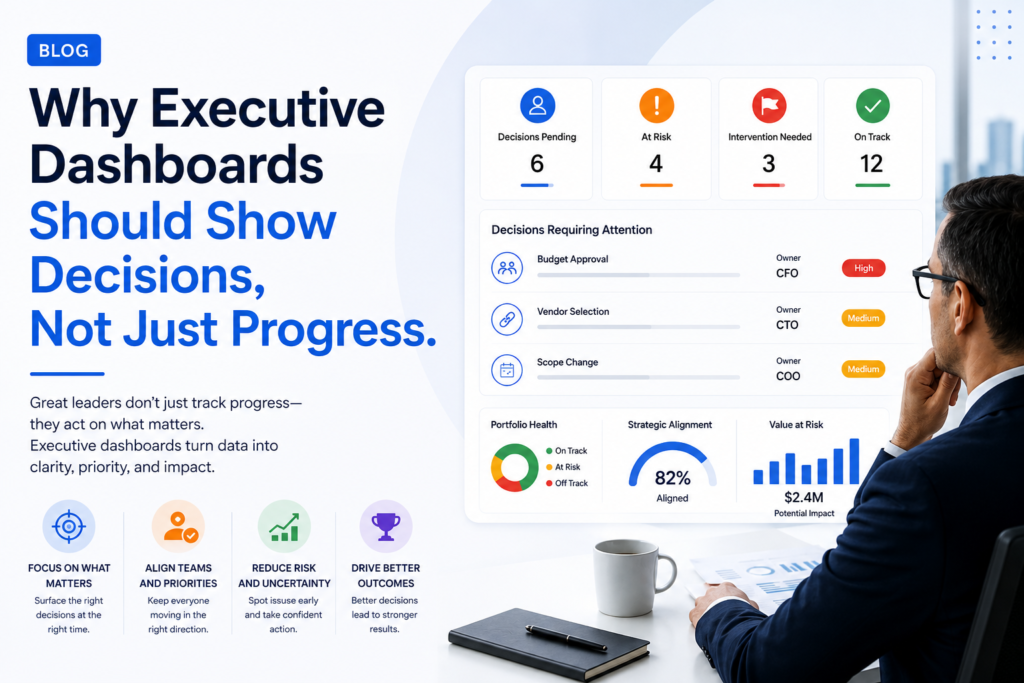
Executive dashboards are meant to give leadership clarity. Yet many dashboards primarily show progress percentages, milestone status, budget consumption, timelines and RAG indicators.
These metrics explain what is happening, but they often fail to answer the question executives actually need answered:
What requires my decision right now?
An initiative may appear green while a critical approval is pending. Another may be 80% complete but have an unresolved dependency threatening its business outcome. When dashboards focus only on progress, leadership can see activity without seeing where intervention is required.
The Problem: Progress Does Not Always Reveal Execution Risk.
Traditional dashboards are largely descriptive. They tell executives whether initiatives are on track, delayed or over budget. But the underlying reason behind a problem may remain hidden.
A delayed milestone could actually be caused by a pending decision, unresolved change request, resource conflict or cross-functional dependency. By the time these issues become visible as red indicators, valuable intervention time may already have been lost.
The Solution: Turn Progress Indicators into Decision Signals
Executive dashboards should connect status with decisions, risks, dependencies, approvals and ownership.
Instead of simply showing that an initiative is delayed, the dashboard should explain what is blocking it, who owns the next action, what decision is required and what happens if the decision is delayed.
This shifts executive conversations from "What is the status?" to "What needs to happen next?"
Read more about how leaders can track strategic initiatives without chasing updates.
For more perspectives on enterprise execution and governance, connect with Dr. Vishwas Mahajan on LinkedIn.
The Problem: Too Much Data Can Hide What Matters
Executive dashboards often grow into collections of charts and KPIs. More information may appear to create greater visibility, but it can also make important signals harder to identify.
Executives do not need to investigate every task or milestone. They need their attention directed toward exceptions that require intervention.
The Solution: Design Dashboards Around Exceptions
Routine execution can remain summarized. Pending approvals, critical risks, delayed decisions, unresolved dependencies and strategic deviations should receive greater visibility.
Platforms such as Initiatives.app help connect initiative progress with governance workflows so leadership can identify where intervention is required instead of manually searching through status information.
Explore real-time initiative intelligence vs. traditional PMO reporting for a deeper view of this shift.
You can also follow Dr. Vishwas Mahajan for insights on strategy execution and enterprise governance.
The Problem: Delayed Decisions Become Execution Delays
Projects do not always fall behind because teams fail to execute. Sometimes a budget approval waits, a scope change remains unresolved or a dependency requires leadership intervention.
If dashboards only report the resulting schedule delay, executives see the consequence rather than the cause.
The Solution: Make Decisions Part of Governance
A stronger executive dashboard should make it immediately clear what decision is pending, who owns it, how long it has been waiting and which outcome could be affected.
This enables leadership to intervene before a governance issue becomes an execution problem.
Read Why Strategy Execution Fails After Approval to understand why continuous visibility between strategy and execution matters.
For additional leadership perspectives, visit Dr. Vishwas Mahajan on LinkedIn.
From Reporting Dashboards to Decision Dashboards
The future of executive dashboards is not about adding more charts. It is about making the information more actionable.
The best dashboard should quickly answer:
Where is leadership attention required? What decision is pending? Who owns the next action? What business outcome is at risk?
When dashboards answer these questions, executive reviews move away from collecting updates and toward resolving blockers and protecting outcomes.
Read more about continuous initiative governance and enterprise execution.
Conclusion
Progress visibility remains important, but executives need more than progress.
By connecting initiative status with decisions, risks, dependencies, approvals and outcomes, organizations can transform executive dashboards from passive reporting tools into active governance systems.
Explore Initiatives.app to see how real-time initiative governance can create stronger visibility between strategy, decisions and execution.
Connect with Dr. Vishwas Mahajan for more insights on enterprise governance and strategy execution.
👉 Book a Demo | 🌐 Visit Initiatives.app
📥 Learn more about features, benefits, and use cases at:
👉 www.initiatives.app
Contact Us : info@whizible.com | +91 855-498-3315
Address : Mrugank, Level 3, Kothrud, Pune, Maharashtra, 411038