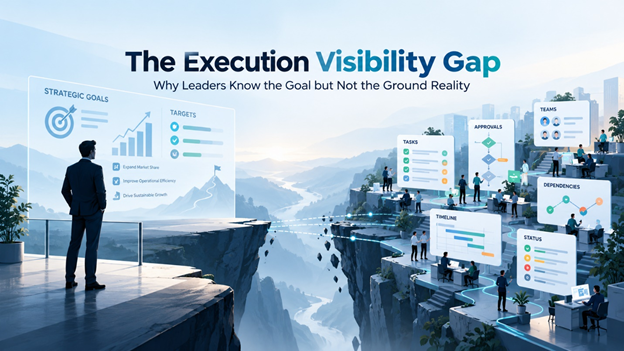
Every organization begins its strategic initiatives with clear objectives, defined priorities, and expected outcomes. Leadership knows what needs to be achieved, but as execution progresses, visibility into ground-level activities often becomes fragmented.
The execution visibility gap emerges when leaders understand strategic goals but lack real-time clarity about progress, dependencies, delayed decisions, and emerging risks. This disconnect creates uncertainty, slows decision-making, and puts business outcomes at risk.
1. Strategic Planning Does Not Guarantee Execution Visibility
The Problem: Leadership Sees Plans, Not Ground Reality
Strategic plans define direction, but execution involves multiple teams working across different systems. Leadership often relies on periodic updates that may not reflect current challenges. An initiative might appear on track while critical approvals or dependencies remain unresolved.
The Solution: Connect Strategy With Execution Signals
Organizations need continuous visibility into initiative progress, ownership, dependencies, and pending decisions. Instead of relying only on status reports, leaders should identify execution risks as they develop.
Initiatives.app enables structured initiative governance within Microsoft Teams, helping connect strategic priorities with execution activities.
Related Reading: The Governance Gap Between Leadership Decisions and Team Execution
2. Fragmented Updates Hide Cross-Functional Dependencies
The Problem: Teams Report Progress, but the Bigger Picture Is Missing
Different departments track their responsibilities independently. Technology may complete its milestones while operations waits for approvals or finance faces unresolved dependencies. Individually, teams appear productive, but the overall initiative remains delayed.
Without connected visibility, leadership struggles to understand how one team's progress affects another.
The Solution: Establish Unified Execution Governance
A centralized governance framework connects teams, responsibilities, interdependencies, and decisions within one structured environment. This helps leaders identify bottlenecks before they affect strategic milestones.
Initiatives.app supports initiative interlinking and governance workflows, improving coordination across teams.
Related Reading: The Dependency Blind Spot: Why One Delayed Team Can Put an Entire Initiative at Risk
3. Delayed Reporting Leads to Reactive Decision-Making
The Problem: Leaders Discover Risks Too Late
Traditional governance depends heavily on weekly updates and monthly review meetings. By the time an unresolved issue reaches leadership, it may already have affected timelines, resources, or expected outcomes.
This turns leadership reviews into escalation management rather than proactive decision-making.
The Solution: Shift Toward Continuous Governance
Organizations should move from periodic reporting toward continuous monitoring of initiative progress, exceptions, and pending approvals.
Initiatives.app helps structure governance workflows and decision visibility, allowing leadership to identify areas requiring intervention earlier.
Related Reading: The Future of Enterprise Governance: Live Execution Signals
For more perspectives on strategic execution and enterprise governance, connect with Dr. Vishwas Mahajan on LinkedIn.
Closing the Execution Visibility Gap
Execution visibility is not about generating more reports. It is about ensuring leaders understand what is happening, where progress is slowing, and which decisions require attention.
Initiatives.app bridges the gap between strategic intent and execution reality through connected governance, structured approvals, and cross-functional visibility within Microsoft Teams.
When leaders understand both the goal and ground reality, organizations can move from reactive problem-solving to proactive execution governance.
Frequently Asked Questions (FAQs)
1. What is the execution visibility gap?
It is the disconnect between strategic objectives and leadership's visibility into actual execution progress, dependencies, decisions, and risks.
2. Why do organizations struggle with execution visibility?
Fragmented systems, disconnected departmental updates, delayed reporting, and unclear ownership often prevent leaders from seeing the complete execution picture.
3. How does Initiatives.app help?
Initiatives.app supports connected initiative governance, dependency visibility, structured approvals, and improved coordination within Microsoft Teams.
Turn Strategic Goals Into Visible Execution
Leadership should not discover execution challenges only when milestones are missed.
Bring clarity, accountability, and continuous governance to your strategic initiatives.
👉 Explore Initiatives.app and bridge the gap between strategy and execution.
👉 Book a Demo | 🌐 Visit Initiatives.app
📥 Learn more about features, benefits, and use cases at:
👉 www.initiatives.app
Contact Us : info@whizible.com | +91 855-498-3315
Address : Mrugank, Level 3, Kothrud, Pune, Maharashtra, 411038