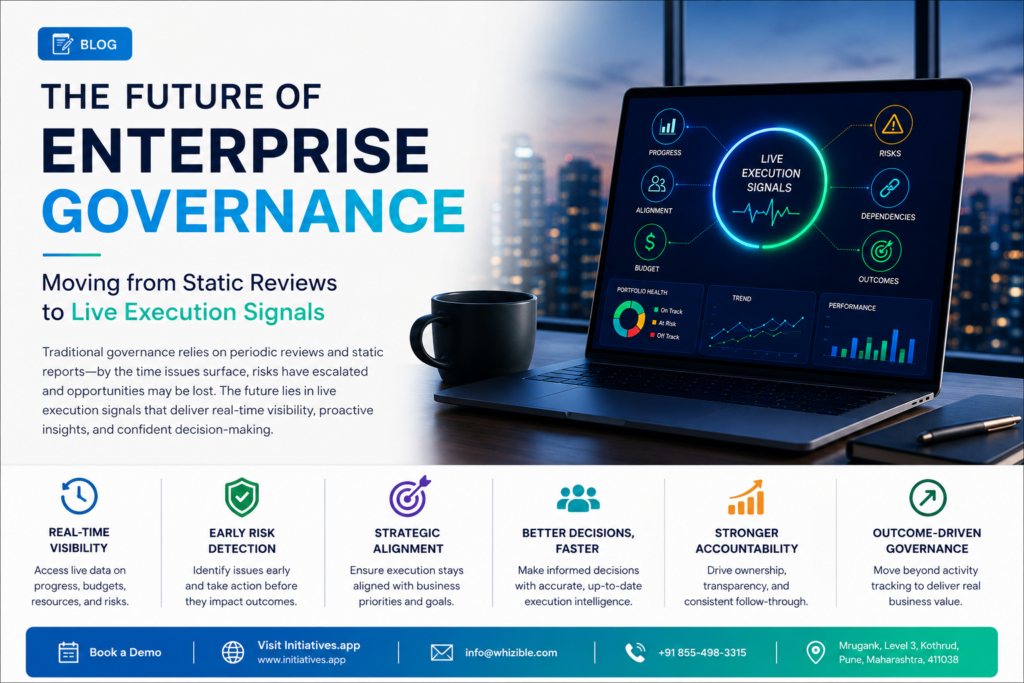
Enterprise governance has long relied on periodic reviews, status meetings, steering committees and executive dashboards to monitor progress and ensure accountability. While these methods served organizations reasonably well in slower business environments, today's digital enterprises operate at a speed that renders static governance increasingly ineffective. By the time issues appear in a monthly review meeting, project risks have often escalated, budgets have already been impacted and strategic objectives may have drifted significantly from their intended outcomes.
The future of governance is no longer about reviewing what happened. It is about continuously understanding what is happening right now. This shift is driving organizations toward a new model built on live execution signals real-time indicators that provide immediate visibility into project health, strategic alignment, resource constraints, budget consumption and delivery risks.
The Problem with Traditional Governance Reviews
Governance Often Operates on Outdated Information
Most organizations depend on weekly reports, monthly steering meetings and manually compiled dashboards. The challenge is that these mechanisms provide a historical snapshot rather than a real-time view of execution. Leaders frequently make decisions using information that is already days or weeks old.
As a result, risks are identified late, corrective actions are delayed and governance becomes reactive rather than proactive.
The Solution: Real-Time Visibility into Execution
Modern governance requires continuous monitoring of execution activities as they occur. Live execution signals automatically capture progress, dependencies, budget variances, resource utilization and emerging risks, enabling leaders to intervene before issues become business problems.
Organizations adopting platforms such as Bridging Strategy & Execution: How Initiatives.app Enables the CIO’s Office are moving toward governance models where executives can access accurate information without waiting for formal review cycles.
For additional perspectives on execution leadership and enterprise governance, explore Vish Mahajan's insights on LinkedIn.
The Growing Visibility Gap in Enterprise Execution
Leaders Often Discover Problems Too Late
One of the most common governance failures occurs when leadership teams assume initiatives are progressing according to plan because status reports indicate "green" health. However, underlying issues such as resource bottlenecks, delayed approvals, unresolved dependencies or budget overruns may remain hidden until they become critical.
The visibility gap between strategic planning and operational execution continues to widen as organizations manage increasingly complex portfolios.
The Solution: Governance Driven by Live Signals
Instead of relying on subjective status updates, governance frameworks should leverage objective execution data. Real-time indicators can immediately highlight schedule slippage, missed milestones, approval delays, resource conflicts and financial risks.
Organizations implementing approaches described in From Spreadsheets to Strategic
Execution: The Future of Initiative Management gain the ability to identify risks while they are still manageable rather than after they have already affected outcomes.
For broader industry perspectives on strategy execution and operational leadership, visit Vish Mahajan's LinkedIn profile.
Why Static Dashboards Are No Longer Enough
Dashboards Show Data but Not Execution Reality
Many organizations have invested heavily in reporting and analytics tools. Yet dashboards often provide lagging indicators rather than actionable insights. They answer what happened but rarely explain why it happened or what action should be taken next.
Consequently, executives spend significant time interpreting reports instead of driving outcomes.
The Solution: Intelligent Governance Signals
The next generation of governance platforms focuses on intelligent signals rather than passive reporting. These signals proactively notify stakeholders about deviations, emerging risks, missed commitments and execution bottlenecks.
Rather than waiting for reports, leaders receive timely insights that support immediate decision-making.
Organizations exploring concepts outlined in Real-Time Governance: How CIOs Can Monitor Execution Without Micromanaging are already shifting toward this model.
Aligning Governance with Strategic Outcomes
Activity Tracking Does Not Guarantee Business Value
Many governance frameworks focus heavily on project activities, milestone completion and budget adherence. However, completing tasks does not necessarily mean strategic objectives are being achieved.
This disconnect creates a dangerous situation where projects appear successful while business outcomes remain unmet.
The Solution: Outcome-Oriented Governance
Future-ready governance frameworks connect execution activities directly to strategic objectives, ensuring leaders can continuously measure progress against intended business outcomes.
When execution signals are linked to organizational goals, governance becomes a mechanism for driving value rather than simply monitoring activity.
Organizations seeking stronger alignment between strategy and execution can learn from How CIOs Use Initiatives.app to Align Strategy and Delivery Without Leaving Microsoft Teams.
To understand how executive leaders are approaching modern governance challenges, visit Vish Mahajan on LinkedIn : https://www.linkedin.com/in/vishmahajan/
The Future of Governance Is Continuous, Not Periodic
The organizations that will excel in the coming decade are those that replace retrospective governance with continuous governance. Instead of waiting for scheduled reviews, leaders will leverage live execution signals to understand performance, identify risks, allocate resources and make informed decisions in real time.
Governance is evolving from a reporting function into a strategic capability. Enterprises that embrace this shift will achieve faster decision-making, improved accountability, greater transparency and stronger execution outcomes.
The future of enterprise governance is not another dashboard, another meeting or another report. It is a continuous stream of actionable execution intelligence that empowers leaders to act before risks become realities and before opportunities are lost.