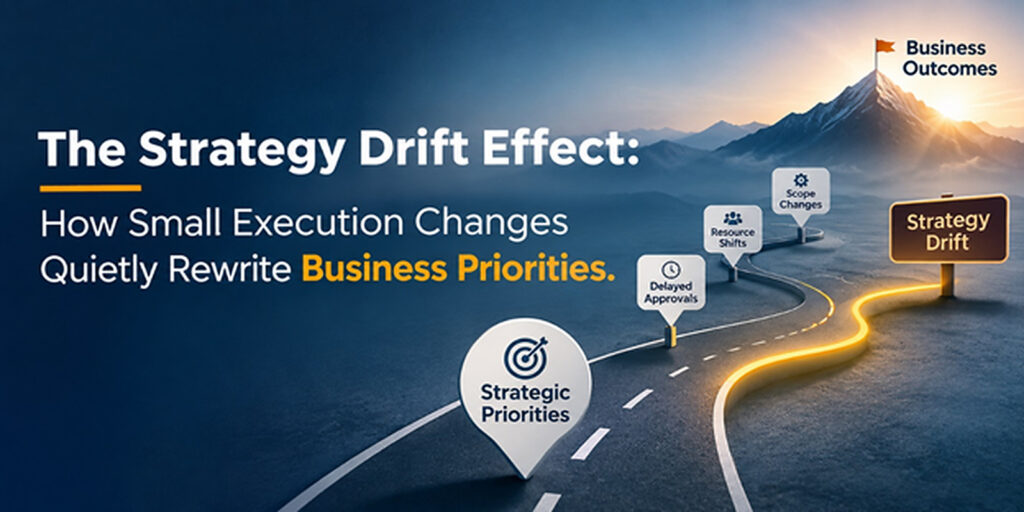
Business strategies begin with clear objectives, defined priorities, and expected outcomes. However, as execution progresses, small changes begin to accumulate. A delayed approval, shifting resources, or changing departmental priorities may seem insignificant individually, but together they can gradually move an organization away from its original strategy.
This phenomenon is known as Strategy Drift, where everyday execution decisions quietly reshape business priorities without formal leadership approval.
1. Small Changes Create Major Strategic Misalignment.
Problem: Execution Decisions Slowly Change Business Direction..
Strategic drift rarely happens overnight. Teams adjust timelines, redistribute resources, and modify deliverables to address immediate challenges. While these decisions may solve short-term problems, their combined impact can weaken long-term strategic objectives.
Solution: Connect Execution Changes with Strategic Goals
Organizations need continuous visibility into how operational changes affect approved business outcomes. Structured governance ensures that significant adjustments are evaluated, documented, and aligned with strategic priorities.
Initiatives.app helps organizations connect initiative execution with strategic governance, improving accountability and decision visibility.
Related Blog: The Governance Gap Between Leadership Decisions and Team Execution
H2. Departmental Priorities Replace Enterprise Objectives.
Problem: Teams Focus on Individual Success.
Finance prioritizes cost reduction, IT concentrates on delivery, and operations focuses on efficiency. Although these goals are important, disconnected decisions can cause departments to move in different directions, weakening overall business alignment.
Solution: Establish Cross-Functional Governance..
A centralized governance framework ensures every department understands shared priorities, dependencies, and responsibilities. Transparent approvals and clear ownership help prevent local decisions from unintentionally affecting enterprise objectives.
Related Blog: The Dependency Blind Spot: Why One Delayed Team Can Put an Entire Initiative at Risk
3. Progress Reports Can Hide Strategic Drif
Problem: Projects Look Successful but Miss Business Outcomes.
A project might be 90% complete, on schedule, and within budget, yet fail to deliver its original strategic value. Traditional reporting often measures activities and milestones rather than whether execution still supports business priorities.
Solution: Monitor Outcomes Alongside Execution.
Leadership needs visibility into changing priorities, delayed decisions, unresolved dependencies, and their impact on expected outcomes.
Continuous governance helps identify early warning signals and enables timely corrective action.
Related Blog: The Future of Enterprise Governance: Live Execution Signals
For more perspectives on enterprise governance and strategy execution, follow Dr. Vishwas Mahajan on LinkedIn.
Conclusion: Strategy Should Change by Decision, Not by Accident.
Strategic flexibility is essential, but uncontrolled execution changes can quietly undermine business priorities.
Organizations need more than periodic reviews. They need continuous governance that connects strategic intent, execution decisions, and business outcomes.
With Initiatives.app, enterprises can bring structured approvals, accountability, and initiative visibility into Microsoft Teams, helping leadership maintain alignment as priorities evolve.
Ready to prevent strategy drift?
Explore Initiatives.app and discover how continuous governance can keep your strategic initiatives aligned with business outcomes.
Frequently Asked Questions (FAQs)
1. What is Strategy Drift?
Strategy Drift occurs when accumulated execution changes gradually move business initiatives away from their original strategic objectives.
2. What causes Strategy Drift?
Common causes include changing priorities, delayed approvals, resource reallocations, disconnected teams, and limited governance visibility.
3. How can organizations prevent Strategy Drift?
Organizations can reduce strategic drift through continuous governance, transparent decisions, clear ownership, and regular monitoring of strategic outcomes.
4. How does Initiatives.app help?
Initiatives.app supports structured initiative governance, approvals, prioritization, and execution visibility within Microsoft Teams.
👉 Book a Demo | 🌐 Visit Initiatives.app
📥 Learn more about features, benefits, and use cases at:
👉 www.initiatives.app
Contact Us : info@whizible.com | +91 855-498-3315
Address : Mrugank, Level 3, Kothrud, Pune, Maharashtra, 411038