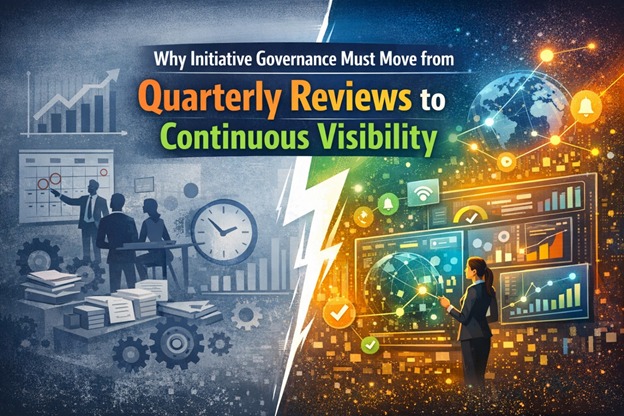
Why Initiative Governance Must Move from Quarterly Reviews to Continuous Visibility
In most enterprises today, initiative governance still operates on a rhythm that belongs to a different era. Quarterly Business Reviews (QBRs), monthly steering committees, and periodic status reports continue to serve as the primary mechanisms for evaluating progress, tracking outcomes and aligning strategy with execution. While these frameworks once worked in relatively stable environments, they are increasingly becoming a bottleneck in high-velocity, digitally driven organizations.
The problem is not that governance is absent. In fact, most organizations have too much governance, but in the wrong format. Governance that is periodic instead of continuous creates blind spots. Governance that is retrospective instead of real-time delays decisions. Governance that relies on manually consolidated data introduces inaccuracies that compound over time.
This is where the shift becomes critical. Initiative governance must evolve from being event-driven to being visibility-driven. Continuous visibility is not just a technological upgrade, it is a structural shift in how organizations perceive execution, measure progress, and respond to change.
The Problem with Quarterly Reviews in a Real-Time World
Governance Lag: Decisions Made Too Late
Quarterly reviews are inherently backward-looking. By the time leadership reviews initiative performance, the data being presented is already outdated. In many cases, what is discussed in a QBR reflects decisions, risks and progress from weeks or even months prior.
This delay creates a dangerous gap between reality and perception. Teams may have already deviated from original plans, resources may have been misallocated and risks may have escalated beyond control before they are even visible at the leadership level.
The result is not just delayed decision-making but ineffective decision-making. Leaders are forced to act on stale insights, often reacting to problems instead of proactively managing them.
Solution: Real-Time Governance Through Continuous Visibility
Continuous visibility eliminates the lag between execution and insight. Instead of waiting for scheduled reviews, leaders gain access to real-time data across initiatives covering progress, risks, dependencies and outcomes.
This enables a shift from reactive governance to proactive intervention. Decisions are made when they matter, not when they are reported.
👉 Explore how continuous governance frameworks are redefining execution models:
https://www.whizible.com/real-time-delivery-governance-eliminate-surprises/
👉 Learn how leaders are embedding real-time visibility into execution strategy:
https://www.linkedin.com/in/vishmahajan/
Fragmented Data Across Systems Creates a False Narrative
Another fundamental limitation of quarterly reviews is the reliance on fragmented data sources. Project updates may come from Jira, financial data from ERP systems, resource allocation from HR tools and status summaries from spreadsheets. These disconnected systems create multiple versions of truth.
When this fragmented data is manually consolidated for quarterly reviews, it often results in inconsistencies, inaccuracies, and selective reporting. Leaders end up reviewing a curated version of reality rather than the actual state of execution.
This fragmentation undermines trust in governance processes and makes it difficult to align strategy with outcomes.
Solution: Unified Visibility Across All Initiatives
Continuous governance requires a unified data model where all execution signals projects, resources, financials and outcomes are connected in real time. This eliminates the need for manual aggregation and ensures that leadership is always looking at a single, consistent version of truth.
With unified visibility, organizations move from fragmented reporting to integrated intelligence, enabling better alignment across teams and functions.
👉 See how unified initiative visibility eliminates data silos:
https://www.whizible.com/the-real-reason-digital-transformation-slows-down-after-year-one/
👉 Understand how modern leaders are approaching execution intelligence:
https://www.linkedin.com/in/vishmahajan/
Static Reviews Cannot Keep Up with Dynamic Priorities
In today’s environment, priorities change rapidly. Market conditions shift, customer expectations evolve and internal dependencies constantly fluctuate. However, quarterly governance models assume a level of stability that no longer exists.
By the time a quarterly review is conducted, the original priorities may no longer be relevant. Initiatives that were critical at the start of the quarter may have lost strategic importance, while emerging opportunities may remain underfunded or overlooked.
This mismatch between governance cadence and business reality leads to misaligned execution.
Solution: Adaptive Governance with Continuous Reprioritization
Continuous visibility enables dynamic prioritization. Leaders can continuously evaluate initiative performance, resource utilization and strategic alignment, allowing them to reallocate focus and investment in real time.
This creates an adaptive governance model where priorities evolve alongside business needs, ensuring that execution remains aligned with strategy at all times.
👉 Discover how continuous prioritization improves execution outcomes:
https://www.whizible.com/real-time-delivery-governance-eliminate-surprises/
👉 Explore leadership perspectives on adaptive governance:
https://www.linkedin.com/in/vishmahajan/
The Hidden Cost of Periodic Governance
Execution Debt Accumulates Between Reviews
When governance is periodic, issues do not pause between review cycles. Risks continue to grow, dependencies continue to shift and inefficiencies continue to compound. This leads to what can be described as execution debt the accumulated impact of unresolved issues that remain invisible until the next review cycle.
By the time these issues are surfaced, they often require significant effort to resolve, increasing both cost and complexity.
Solution: Continuous Risk Detection and Early Intervention
Continuous visibility enables early detection of risks and inefficiencies. Instead of waiting for quarterly reviews, organizations can identify deviations as they occur and take corrective action immediately.
This reduces execution debt and ensures that initiatives remain on track without requiring large-scale interventions later.
👉 Learn how early visibility prevents execution breakdowns:
https://www.whizible.com/the-anatomy-of-a-failed-project-early-warning-signs-you-should-never-ignore/
👉 Gain insights into proactive governance strategies:
https://www.linkedin.com/in/vishmahajan/
Leadership Bandwidth is Consumed by Manual Reporting
Quarterly governance processes often require extensive preparation. Teams spend weeks compiling reports, aligning data and creating presentations. This not only consumes valuable time but also shifts focus away from actual execution.
Instead of driving outcomes, teams are busy preparing to report outcomes.
Solution: Automated Governance with Embedded Visibility
Continuous governance eliminates the need for manual reporting by embedding visibility directly into execution workflows. Data is captured automatically, insights are generated in real time, and dashboards reflect the current state of initiatives without additional effort.
This frees up leadership bandwidth to focus on decision-making and value creation rather than administrative tasks.
👉 See how automation transforms governance efficiency:
https://www.whizible.com/real-time-delivery-governance-eliminate-surprises/
👉 Explore how leaders are reducing reporting overhead:
https://www.linkedin.com/in/vishmahajan/
Continuous Visibility as the New Governance Standard
From Reporting to Real-Time Intelligence
The fundamental shift from quarterly reviews to continuous visibility is a shift from reporting to intelligence. Instead of summarizing what has already happened, organizations gain the ability to understand what is happening now and predict what will happen next.
This transition transforms governance from a passive activity into an active capability.
Solution: Building an Execution Intelligence Layer
Modern organizations are adopting platforms that act as an execution intelligence layer connecting strategy, initiatives, resources and outcomes in real time. This enables leaders to move beyond dashboards and into actionable insights.
👉 Explore how execution intelligence is shaping modern enterprises:
https://www.whizible.com/from-hours-to-outcomes-metrics-framework-value-delivery/
👉 Learn from leadership insights on execution intelligence:
https://www.linkedin.com/in/vishmahajan/
Governance Embedded Where Work Happens
Another critical evolution is the embedding of governance into daily workflows. Instead of being a separate activity conducted during reviews, governance becomes an integral part of how work is executed.
This ensures that visibility is not an afterthought but a continuous presence.
Solution: Integrating Governance into Collaboration Platforms
By integrating governance into collaboration tools like Microsoft Teams, organizations ensure that visibility is available where decisions are made. This reduces friction and increases adoption, making governance a natural extension of execution.
👉 See how governance is being embedded into execution environments:
https://www.whizible.com/future-trends-in-psa-and-whizible-next/
👉 Explore leadership views on embedded governance:
https://www.linkedin.com/in/vishmahajan/
The Future of Initiative Governance
The future of initiative governance is not defined by more reviews, more reports, or more oversight. It is defined by continuous visibility, real-time intelligence, and adaptive decision-making.
Organizations that continue to rely on quarterly reviews will increasingly find themselves reacting to problems instead of preventing them. They will struggle with misaligned priorities, fragmented data and delayed decision-making.
On the other hand, organizations that embrace continuous visibility will gain a significant competitive advantage. They will move faster, make better decisions and align execution with strategy in real time.
Conclusion: From Periodic Oversight to Continuous Control
The shift from quarterly reviews to continuous visibility is not optional, it is inevitable. As execution environments become more complex and dynamic, governance models must evolve accordingly.
Continuous visibility transforms governance from a periodic checkpoint into a continuous capability. It enables organizations to move from hindsight to foresight, from reporting to intelligence, and from control to clarity.
In a world where execution speed defines competitive advantage, the question is no longer whether organizations should adopt continuous governance but how quickly they can make the transition.
👉 Book a Demo | 🌐 Visit Initiatives.app
📥 Learn more about features, benefits, and use cases at:
👉 www.initiatives.app
Contact Us : info@whizible.com | +91 855-498-3315
Address : Mrugank, Level 3, Kothrud, Pune, Maharashtra, 411038