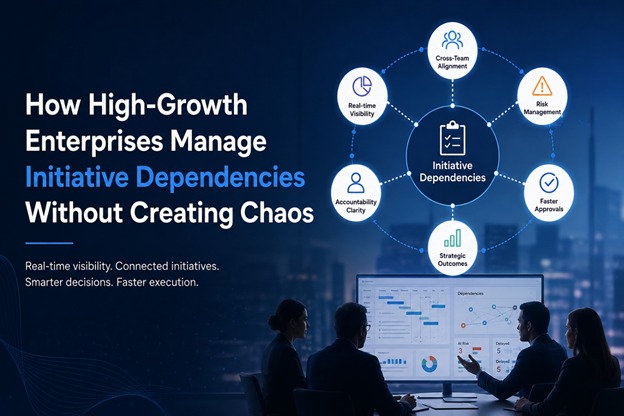
High-growth enterprises rarely struggle because they lack ideas or execution capability. The real challenge begins when multiple strategic initiatives start depending on one another across teams, departments, technologies, approvals, and leadership functions.
A delayed approval impacts another initiative. A dependency between technology and operations creates delivery gaps. Resource conflicts begin slowing strategic execution. Over time, organizations experience execution chaos without fully understanding where the bottlenecks are forming.
The issue is not having too many initiatives.
The issue is operating without connected execution visibility.
Many enterprises still manage dependencies through spreadsheets, review meetings, emails, and disconnected project management tools. This creates fragmented governance, where leadership gains visibility only after risks have already escalated.
As a result, organizations experience delayed decisions, missed timelines, duplicated efforts, and cross-functional confusion — despite having capable teams and well-defined strategies.
A deeper perspective on execution visibility can be explored here:
The Visibility Problem in Enterprise Execution: Why Leaders Discover Risks Too Late
Why Dependency Chaos Increases During Growth
As organizations scale, initiatives become increasingly interconnected. Transformation programs, compliance projects, operational improvements, digital modernization efforts, and customer-facing initiatives begin influencing one another simultaneously.
Without connected governance, enterprises lose visibility into:
- Which initiative is blocking another
- Which approvals are delayed
- Which teams are overloaded
- Which risks may impact strategic goals
- Which dependencies could derail execution later
The result is reactive governance.
Leadership teams spend more time resolving escalations than driving strategic outcomes.
Modern enterprises address this challenge by creating a connected execution environment where dependencies, ownership, milestones, and risks remain continuously visible rather than manually tracked.
This is where platforms like Initiatives.app help enterprises move from fragmented execution to real-time governance
How High-Growth Enterprises Prevent Execution Chaos
Successful enterprises focus on three critical areas.
1. Centralized Initiative Visibility
High-performing organizations centralize initiative visibility so teams, dependencies, approvals, and risks operate within a unified governance framework rather than across scattered systems.
2. Continuous Governance Instead of Delayed Reviews
Instead of relying solely on weekly or quarterly reviews, leaders gain continuous operational visibility into execution bottlenecks, dependency risks, and resource conflicts.
This enables faster decision-making and proactive risk mitigation before issues escalate.
3. Clear Accountability Across Dependencies
Every dependency requires clearly defined ownership, escalation responsibility, and execution visibility.
When accountability is transparent, organizations significantly reduce cross-functional confusion and improve execution speed.
An excellent perspective on continuous governance can also be explored here:
Why Quarterly Reviews Fail in Fast-Moving Enterprises
The Future of Enterprise Execution Is Connected Governance
High-growth enterprises can no longer manage strategic execution through disconnected coordination models.
As initiative complexity increases, organizations require:
- Real-time dependency intelligence
- Connected governance frameworks
- Proactive execution visibility
- Faster escalation management
- Cross-functional execution alignment
The enterprises that scale successfully are not the ones managing the most initiatives.
They are the ones capable of managing interconnected execution without creating operational chaos.
This shift toward continuous execution intelligence closely aligns with the leadership thinking shared by Vishwas Mahajan around real-time governance and enterprise execution visibility.
What is initiative dependency management?
Initiative dependency management is the process of tracking relationships, risks, approvals, and execution dependencies between strategic enterprise initiatives.
Why do enterprises face execution chaos?
Enterprises experience execution chaos when teams operate in disconnected systems without real-time visibility into dependencies, risks, and resource conflicts.
What is connected governance?
Connected governance is a modern execution approach where initiatives, risks, approvals, and dependencies are managed within a unified visibility framework.
How does real-time governance improve execution?
Real-time governance enables leadership teams to identify bottlenecks, risks, and delays early, allowing faster decision-making and proactive execution management.
👉 Book a Demo | 🌐 Visit Initiatives.app
📥 Learn more about features, benefits, and use cases at:
👉 www.initiatives.app
Contact Us : info@whizible.com | +91 855-498-3315
Address : Mrugank, Level 3, Kothrud, Pune, Maharashtra, 411038