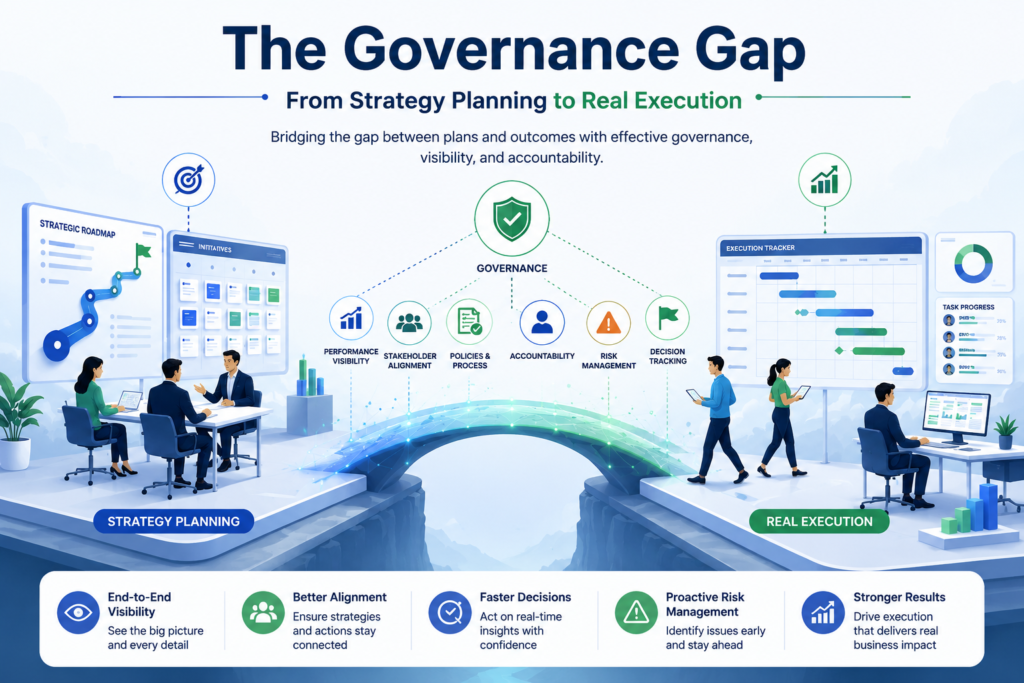
Enterprise strategy rarely fails at the planning stage. Leadership teams usually know what they want to achieve, which initiatives matter, and what outcomes the business expects. The real challenge begins after approval, when strategy moves into execution.
This is where many organizations face a governance gap. Priorities are defined, but ownership becomes unclear. Approvals move slowly. Updates are scattered across meetings, emails, spreadsheets, and reports. By the time leadership sees the real status, delays and execution drift have already started affecting outcomes.
Why Strategy Planning Does Not Guarantee Execution Success
The Problem: Strategy Creates Direction, but Not Continuous Control
A strategic plan gives the organization direction, but it does not automatically ensure execution discipline. Once multiple teams, departments, vendors, and approvers become involved, the original objective can get diluted. Teams may stay busy, but leadership may not know whether the work is still aligned with the intended business outcome.
This creates a situation where activity continues, but governance weakens.
The Solution: Build a Live Governance Layer
Organizations need a live governance layer that connects every initiative with its objective, owner, priority, approval status, risk, and progress. Instead of waiting for monthly reviews, leaders need continuous visibility into whether initiatives are moving in the right direction.
Platforms like Initiatives.app help enterprises structure initiative tracking, ownership, prioritization, and execution visibility in one place. You can also read From Planning to Performance: How Enterprises Keep Strategic Initiatives on Track for more context.
The Cost of Disconnected Execution
The Problem: Initiative Data Is Spread Across Too Many Tools
In many enterprises, initiative-related information lives across Excel sheets, emails, PowerPoint decks, Teams chats, project tools, and manual reports. Each tool may show part of the picture, but leadership rarely gets one complete view.
This makes it difficult to answer critical questions: Which initiatives are delayed? Which approvals are stuck? Which risks need escalation? Which initiatives are no longer aligned with business priorities?
When answers are delayed, decisions are delayed too.
The Solution: Create One Source of Truth for Initiatives
A single governance view helps leaders move from scattered updates to structured execution intelligence. Instead of chasing information across tools, they can see initiative status, ownership, priority, dependencies, risks, and outcomes in one place.
This is especially important for transformation leaders, CIOs, PMOs, and business heads who need faster decision-making.
How Real-Time Initiative Visibility Changes Enterprise Execution explains why live visibility is becoming essential for enterprise governance.
Why Ownership Breaks After Approval
The Problem: Cross-Functional Work Creates Accountability Gaps
Strategic initiatives usually involve multiple teams such as technology, finance, operations, compliance, HR, and business functions. While cross-functional execution is necessary, it often creates confusion when ownership and decision rights are not clearly defined.
One team waits for another team’s input. Approvals remain pending. Dependencies go unnoticed. Leadership assumes progress is happening, while execution teams are blocked.
The Solution: Define Owners, Decision Rights, and Escalation Paths
Every initiative should have a clear owner, sponsor, contributors, approval flow, success measure, and escalation path. Governance should not only track whether work is happening; it should track who is accountable for moving it forward.
Initiatives.app helps leaders structure initiative ownership and governance inside Microsoft Teams, where collaboration already happens. For leadership perspectives on governance and execution, you can also connect with Dr. Vishwas Mahajan.
The Reporting Gap Between Progress and Outcomes
The Problem: Leaders See Status, Not Strategic Impact
Traditional reporting often focuses on milestones, percentage completion, and task status. These indicators are useful, but they do not always show whether the initiative is still creating the expected business value.
An initiative can show progress and still be misaligned with business priorities. A dashboard can look green while risks are building underneath.
The Solution: Connect Execution Progress to Business Outcomes
Strategic initiatives should be tracked by progress, priority, risk, value, and business alignment. Leaders need to know whether an initiative should continue, change direction, or be reprioritized.
This requires a shift from static reviews to live execution signals. The Future of Enterprise Governance: Moving from Static Reviews to Live Execution Signals explains how enterprises can move toward proactive governance.
Final Thoughts
The governance gap between strategy planning and real execution is one of the biggest reasons enterprise initiatives lose momentum. The issue is not always poor strategy or weak teams. More often, it is the absence of a structured layer that connects strategy with ownership, approvals, risks, progress, and outcomes.
Modern enterprises need real-time initiative governance that helps leaders see what is happening, understand what is changing, and act before execution drift becomes business impact.
Initiatives.app helps organizations close this gap by creating a clear and trackable governance layer for strategic initiatives inside Microsoft Teams.
Ready to close the gap between strategy and execution? Explore Initiatives.app and bring real-time governance to your enterprise initiatives.
FAQs
What is the governance gap between strategy and execution?
The governance gap is the disconnect between approved strategy and actual execution visibility, ownership, decisions, risks, and outcomes.
Why do strategic initiatives fail after planning?
They often fail because execution data is scattered, accountability is unclear, approvals are delayed, and leadership gets visibility too late.
How can enterprises improve initiative governance?
Enterprises can improve governance by creating one structured layer to track priorities, owners, approvals, risks, dependencies, and business outcomes.
How does Initiatives.app help?
Initiatives.app helps organizations capture, prioritize, track, and govern strategic initiatives inside Microsoft Teams with better execution visibility.
Bottom of Form
👉 Book a Demo | 🌐 Visit Initiatives.app
📥 Learn more about features, benefits, and use cases at:
👉 www.initiatives.app
Contact Us : info@whizible.com | +91 855-498-3315
Address : Mrugank, Level 3, Kothrud, Pune, Maharashtra, 411038