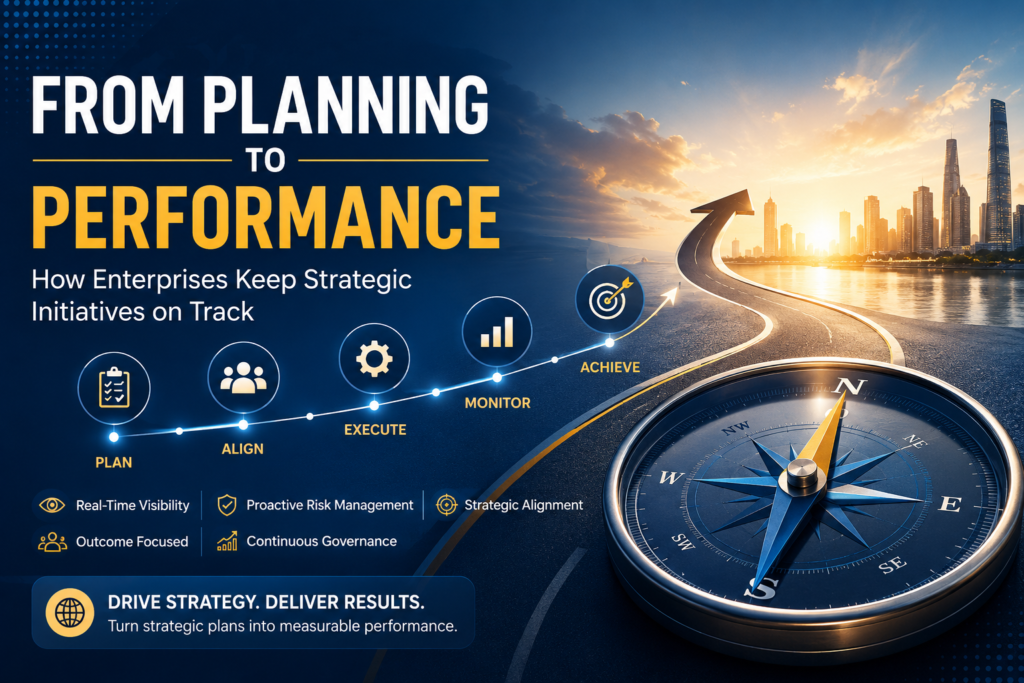
Every enterprise begins the year with ambitious strategic plans. Leadership teams define transformation goals, allocate budgets, assign ownership, and establish execution timelines designed to accelerate growth, innovation, operational excellence, and competitive advantage.
Yet despite substantial investments in strategic planning, many organizations struggle to convert vision into measurable business outcomes.
The problem is rarely the strategy itself. Most enterprises already have well-defined roadmaps, governance frameworks, transformation programs, and executive priorities. The real challenge begins after planning ends.
As initiatives move into execution, momentum often weakens. Priorities shift. Dependencies increase. Teams begin operating in silos. Ownership becomes fragmented. Visibility declines. Over time, the connection between strategic intent and operational execution gradually disappears.
This growing disconnect between planning and performance is one of the primary reasons organizations fail to achieve expected returns from strategic investments.
High-performing enterprises recognize that successful strategy execution requires far more than planning. It requires continuous alignment, execution intelligence, governance, accountability, risk visibility, and outcome tracking throughout the entire initiative lifecycle.
The Problem: Strategic Plans Often Lose Momentum After Approval
Many organizations assume that once a strategic initiative receives executive approval, execution will naturally follow.
In reality, execution complexity begins immediately after approval.
As initiatives move from planning into delivery:
- Teams operate across disconnected systems
- Project updates become fragmented
- Risks are managed in spreadsheets
- Dependencies remain hidden
- Status reporting becomes periodic instead of continuous
- Leadership receives inconsistent information from multiple sources
Over time, executives lose clear visibility into whether initiatives remain aligned with strategic objectives.
The result is a dangerous execution visibility gap.
By the time leadership identifies delays, resource bottlenecks, budget overruns, or delivery risks, the issues have often escalated into expensive business problems that are difficult to correct.
The challenge becomes even more severe when enterprises manage multiple strategic initiatives simultaneously. Hidden dependencies across portfolios create cascading delays that impact broader business goals.
Establishing Continuous Initiative Visibility
Leading organizations are replacing periodic reporting models with continuous initiative visibility.
Instead of waiting for quarterly reviews or manually compiled presentations, decision-makers gain access to real-time insights into:
- Initiative progress
- Milestones
- Dependencies
- Risks
- Resource constraints
- Delivery health
- Outcome alignment
Modern initiative management platforms empower leadership teams to detect execution issues early and take corrective action before strategic objectives are compromised.
Continuous Initiative Governance vs Quarterly Reviews
Follow for more : Dr. Vishwas Mahajan
Continuous Initiative Governance vs Quarterly Reviews
Traditional quarterly governance models no longer provide the speed or responsiveness modern enterprises require. Continuous governance enables organizations to respond to execution risks in real time while maintaining alignment with evolving business priorities.
Follow for more insights from Dr. Vishwas Mahajan
The Problem: Lack of Alignment Between Strategy and Execution
Strategic initiatives often begin with clear objectives but gradually drift away from intended business outcomes.
Execution teams become heavily focused on operational tasks, activities, and deliverables while losing visibility into the larger strategic purpose behind their work.
This phenomenon, commonly known as strategic drift, creates a dangerous illusion of progress. Initiatives appear active and productive, yet fail to generate meaningful business impact.
Leadership continues receiving updates, but those updates rarely answer the most important strategic question:
“Are we achieving the intended business outcome?”
Without continuous alignment between objectives and execution, organizations risk investing heavily in initiatives that no longer support enterprise priorities.
Aligning Execution with Strategic Objectives
Successful enterprises continuously connect execution activities to measurable strategic outcomes.
Every milestone, decision, deliverable, and initiative dependency must remain linked to defined business objectives.
Organizations that adopt outcome-based governance can quickly identify when initiatives begin drifting away from intended goals and intervene before value erosion occurs.
Strategic Drift Is Real-Time Alignment Matters
Follow : Dr. Vishwas Mahajan on Strategic Execution
Strategic Drift Is Real — Real-Time Alignment Matters
Maintaining strategic alignment requires ongoing execution intelligence, not static planning documents.
Follow Dr. Vishwas Mahajan for more leadership insights on strategic execution and governance.
The Problem: Leadership Discovers Risks Too Late
One of the biggest frustrations for executives is discovering critical risks only after they have already impacted delivery timelines, budgets, customer outcomes, or business performance.
Traditional governance models rely heavily on:
- Scheduled reviews
- Manual reporting
- Static dashboards
- Delayed escalation processes
Unfortunately, these approaches often provide outdated visibility and fail to surface emerging risks early enough for effective intervention.
As a result, leadership teams operate reactively rather than proactively.
Building Proactive Risk Governance
High-performing organizations integrate risk management directly into initiative execution workflows.
Instead of reviewing risks periodically, they continuously monitor:
- Escalations
- Dependencies
- Resource constraints
- Delivery blockers
- Budget variance
- Timeline risks
- Strategic impact indicators
This proactive governance approach enables enterprises to:
- Detect warning signals earlier
- Accelerate decision-making
- Improve execution responsiveness
- Prevent small issues from becoming strategic failures
Why Leaders Discover Risks Too Late
Follow : Dr. Vishwas Mahajan
Why Leaders Discover Risks Too Late
Delayed visibility remains one of the biggest barriers to successful enterprise execution.
Organizations that embed real-time governance into execution significantly improve initiative predictability and strategic control.
Follow insights from Dr. Vishwas Mahajan
The Problem: Too Many Initiatives, Too Little Focus
Modern enterprises frequently suffer from initiative overload.
Every department launches transformation programs, innovation projects, compliance activities, operational improvements, and technology modernization efforts — all competing for limited resources and executive attention.
Without structured prioritization:
- Teams become overwhelmed
- Execution quality declines
- Resource conflicts increase
- Strategic clarity weakens
- Delivery timelines slow down
The result is fragmented execution with diminished business impact.
Prioritization Through Initiative Governance
Organizations that consistently achieve strategic goals establish disciplined governance mechanisms to evaluate:
- Business impact
- Strategic importance
- Resource availability
- Organizational capacity
- Risk exposure
- Portfolio alignment
Rather than managing dozens of disconnected initiatives, they maintain a focused portfolio aligned with enterprise priorities.
Why QBRs Fail and Continuous Initiative Governance Wins
Leadership Perspectives by Dr. Vishwas Mahajan
Why QBRs Fail and Continuous Initiative Governance Wins
Quarterly Business Reviews (QBRs) often identify problems too late to influence outcomes effectively.
Continuous initiative governance provides ongoing visibility into execution health, enabling leadership teams to prioritize dynamically and allocate resources more intelligently.
Leadership perspectives by Dr. Vishwas Mahajan
The Problem: Measuring Activity Instead of Outcomes
Many organizations still evaluate initiative success using traditional project metrics such as:
- Task completion
- Milestone achievement
- Percentage progress
- Schedule adherence
While operational metrics provide useful execution visibility, they do not necessarily indicate whether strategic objectives are being achieved.
An initiative may be delivered on time and within budget while still failing to generate meaningful business value.
Shifting from Activity Tracking to Outcome Measurement
Forward-thinking enterprises focus on measuring outcomes rather than simply tracking activity.
They evaluate initiatives based on:
- Business impact
- Value realization
- Operational improvement
- Customer experience enhancement
- Strategic contribution
- Organizational transformation outcomes
This shift enables leadership teams to make better investment decisions and improve long-term strategic execution effectiveness.
KPIs vs KRIs: Why Measuring Outcomes Matters More Than Tracking Activity
Follow : Strategic Leadership Insights
KPIs vs KRIs: Why Measuring Outcomes Matters More Than Tracking Activity
Modern initiative governance requires balancing operational KPIs with strategic outcome indicators and risk intelligence.
Follow Strategic Leadership Insights from Dr. Vishwas Mahajan
From Planning to Performance Requires Continuous Execution Intelligence
Keeping strategic initiatives on track is not about creating more meetings, generating more reports, or adding unnecessary governance layers.
It is about building continuous execution intelligence across planning, delivery, accountability, risk management, and outcome measurement.
Organizations that successfully bridge the gap between planning and performance share several characteristics:
- Real-time initiative visibility
- Continuous governance
- Strategic alignment across execution
- Proactive risk management
- Outcome-focused measurement
- Portfolio prioritization discipline
- Faster executive decision-making
This is precisely why modern enterprises are increasingly adopting initiative management platforms that provide continuous governance and execution intelligence rather than relying solely on traditional project management systems.
Platforms such as Initiatives.app help organizations connect strategic objectives with day-to-day execution, enabling leaders to:
- Identify risks earlier
- Improve accountability
- Maintain strategic alignment
- Accelerate decision-making
- Track measurable business outcomes
- Improve initiative success rates
Conclusion
The distance between planning and performance is where most strategic initiatives succeed or fail.
While planning establishes direction, performance depends on continuous visibility, execution discipline, governance, accountability, and strategic alignment throughout delivery.
Enterprises that embrace continuous initiative management gain the ability to:
- Detect execution risks earlier
- Improve cross-functional alignment
- Prioritize strategically important work
- Measure business outcomes effectively
- Respond faster to changing conditions
As business environments become increasingly dynamic and complex, maintaining strategic alignment throughout execution is no longer optional — it has become a critical competitive advantage.
Organizations that consistently keep initiatives on track are ultimately the organizations that transform strategy into measurable business results.