Strategic initiatives usually begin with strong intent. Leadership identifies an opportunity, approves the direction, allocates teams, and expects execution to move forward. But in many enterprises, the real problem starts immediately after approval. Ownership becomes unclear, updates get scattered, dependencies remain hidden, and accountability becomes difficult to track.
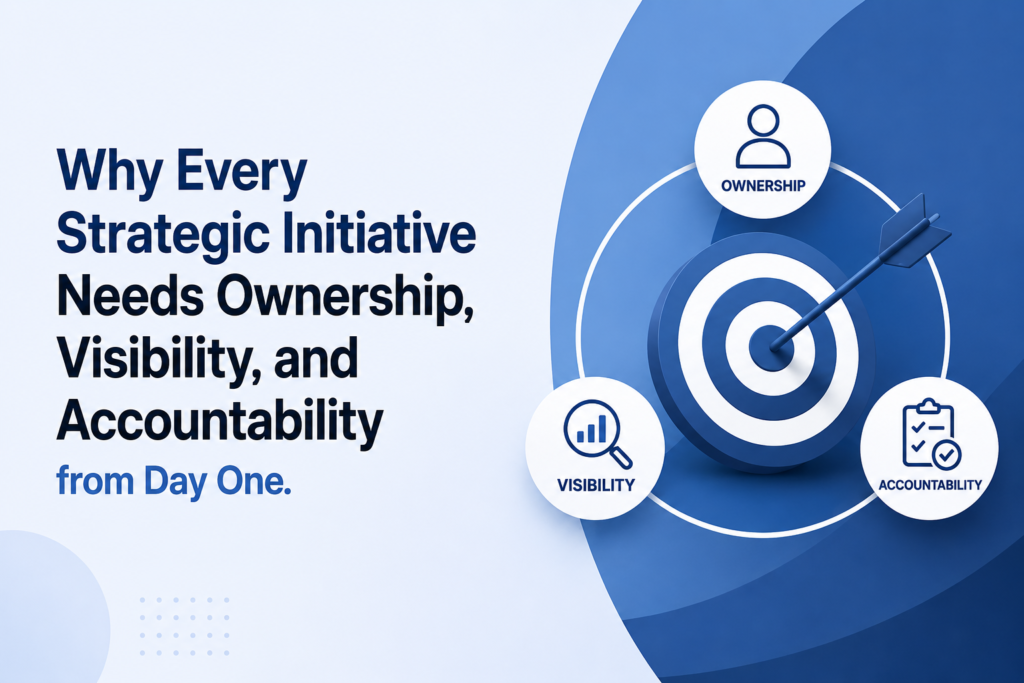
A strategic initiative does not fail only at the end. It starts weakening from day one when ownership, visibility, and accountability are not clearly built into the execution process.
For modern enterprises, especially those managing multiple transformation programs, digital initiatives, compliance projects, and cross-functional priorities, day-one governance is no longer optional. It is the foundation that decides whether an initiative becomes a measurable outcome or another delayed project in the portfolio.
The Problem: Strategic Initiatives Often Begin Without Clear Ownership
Many initiatives are approved with a clear business goal but without a clearly defined execution owner. Teams may understand the broad objective, but they may not know who owns decisions, who resolves blockers, who tracks dependencies, and who is responsible for final outcomes.
Why Ownership Gaps Create Execution Risk
When ownership is unclear, initiatives become dependent on informal follow-ups. Teams wait for approvals, leaders wait for updates, and decisions move slowly because responsibility is distributed but not defined. This creates confusion across departments and weakens momentum.
The problem becomes bigger when initiatives involve multiple functions such as IT, finance, operations, compliance, and business teams. Each team may own a part of the work, but no one has complete visibility into the overall execution health.
The Solution: Define Ownership Before Execution Begins
Every initiative should begin with a named owner, clear role responsibilities, decision rights, escalation paths, and measurable success criteria. Ownership should not be limited to assigning a task. It should include accountability for progress, risks, dependencies, approvals, and outcomes.
Platforms like Initiatives.app help enterprises create this structure by connecting strategic initiatives with owners, workflows, status updates, and governance checkpoints. This ensures that execution does not depend only on meetings or manual follow-ups.
For deeper thinking on leadership and execution governance, you can also explore insights from Vish Mahajan.
The Problem: Visibility Usually Arrives Too Late
In many organizations, leadership visibility depends on review meetings, spreadsheets, presentation decks, and weekly status reports. By the time information reaches decision-makers, the actual situation may have already changed.
This delay creates a major execution gap. Leaders may believe an initiative is on track, while approvals are pending, dependencies are blocked, resources are stretched, or risks are quietly building in the background.
Why Delayed Visibility Damages Strategic Outcomes
Strategic initiatives are dynamic. Priorities shift, timelines move, stakeholders change, and dependencies evolve. Static reporting cannot capture this movement accurately. When visibility is delayed, leaders are forced to make decisions based on old information.
This often results in late escalations, missed milestones, duplicated efforts, and poor resource allocation. Instead of proactively steering execution, leaders end up reacting after the damage has already happened.
The Solution: Build Real-Time Visibility into the Initiative Layer
Visibility should not be created only for leadership reviews. It should exist from day one as part of the initiative execution layer. Every key stakeholder should be able to see initiative status, ownership, pending actions, risks, dependencies, and progress in real time.
This is where an execution governance platform such as Initiatives.app’s real-time visibility approach becomes valuable. It helps leaders move from delayed reporting to live execution awareness, so risks can be detected early and decisions can be made with better context.
The Problem: Accountability Becomes Weak When Work Is Scattered
Accountability becomes difficult when initiative-related work is spread across emails, chats, Excel files, project tools, and disconnected dashboards. Even when teams are working hard, leadership may not have a reliable way to connect actions with outcomes.
This creates a common enterprise problem: everyone is busy, but no one has a complete view of whether the initiative is actually moving toward the intended business result.
Why Scattered Execution Weakens Accountability
When updates are fragmented, accountability becomes opinion-based. Teams may report progress differently, blockers may remain hidden, and decision-makers may struggle to identify where execution is slowing down.
In such environments, accountability often appears only during escalation. Instead of being continuous and transparent, it becomes reactive and uncomfortable.
The Solution: Make Accountability Continuous, Visible, and Contextual
Accountability should be built into the execution rhythm. Every initiative should have visible owners, clear milestones, defined approvals, documented decisions, and transparent progress signals.
With Initiatives.app, organizations can create a connected governance layer where accountability is not dependent on manual chasing. Stakeholders can see what is pending, who owns it, what has changed, and where intervention is required.
This makes accountability practical, not political.
The Problem: Approvals and Decisions Become Bottlenecks
Strategic initiatives often slow down not because teams lack effort, but because decisions and approvals are delayed. When approval paths are unclear, teams wait. When decision ownership is missing, execution pauses. When escalation is informal, blockers remain unresolved.
Why Delayed Decisions Reduce Initiative Value
Every delay has a cost. It affects timelines, budgets, stakeholder confidence, and business impact. In transformation programs, delayed decisions can also reduce market advantage because opportunities may lose relevance over time.
Approval delays are especially harmful when initiatives involve senior leadership, compliance reviews, vendor dependencies, or cross-functional prioritization.
The Solution: Create Structured Approval and Governance Workflows
Strategic initiatives need structured governance from the beginning. Approval workflows, maker-checker responsibilities, stage gates, and escalation rules should be visible to all relevant stakeholders.
A platform like Initiatives.app supports structured initiative governance by helping organizations bring approvals, reviews, visibility, and execution tracking into one connected flow. This reduces ambiguity and improves decision speed.
Why Day-One Governance Matters
Ownership, visibility, and accountability should not be added after problems appear. They should be designed into the initiative from the first day.
When these three elements are missing, initiatives become dependent on individual discipline, manual follow-ups, and leadership intervention. But when they are present from the start, execution becomes more predictable, transparent, and outcome-focused.
Day-one governance helps organizations:
- Reduce execution ambiguity
- Improve leadership visibility
- Detect risks earlier
- Strengthen ownership across teams
- Improve decision speed
- Build confidence in strategic outcomes
Conclusion: Strategy Needs an Execution Context Layer
A strategic initiative is not just a project. It is a business commitment. It carries expectations, investment, leadership attention, and measurable outcomes.
That is why every initiative needs ownership, visibility, and accountability from day one.
Without ownership, execution becomes unclear.
Without visibility, risks become invisible.
Without accountability, outcomes become difficult to control.
With a connected governance layer like Initiatives.app, enterprises can move beyond scattered tracking and create a clearer path from strategy to execution.
Ready to bring ownership, visibility, and accountability into every strategic initiative from day one?
Explore Initiatives.app and see how enterprises can govern execution with better clarity, context, and control.
FAQs
Why is ownership important in strategic initiatives?
Ownership ensures that every initiative has a responsible person or team accountable for decisions, progress, risks, and outcomes. Without ownership, execution becomes unclear and delays increase.
What does visibility mean in initiative execution?
Visibility means having a real-time view of initiative progress, risks, dependencies, approvals, and stakeholder actions. It helps leaders make faster and better decisions.
How does accountability improve strategic execution?
Accountability connects actions with outcomes. It helps teams understand responsibilities clearly and enables leaders to track whether execution is moving in the right direction.
Why should governance start from day one?
Governance should start from day one because most execution problems begin early. Clear ownership, visibility, and accountability prevent confusion before it becomes a major risk.
How does Initiatives.app help?
Initiatives.app helps enterprises manage strategic initiatives through structured ownership, real-time visibility, governance workflows, and accountability tracking inside a connected execution layer.
👉 Book a Demo | 🌐 Visit Initiatives.app
📥 Learn more about features, benefits, and use cases at:
👉 www.initiatives.app
Contact Us : info@whizible.com | +91 855-498-3315
Address : Mrugank, Level 3, Kothrud, Pune, Maharashtra, 411038