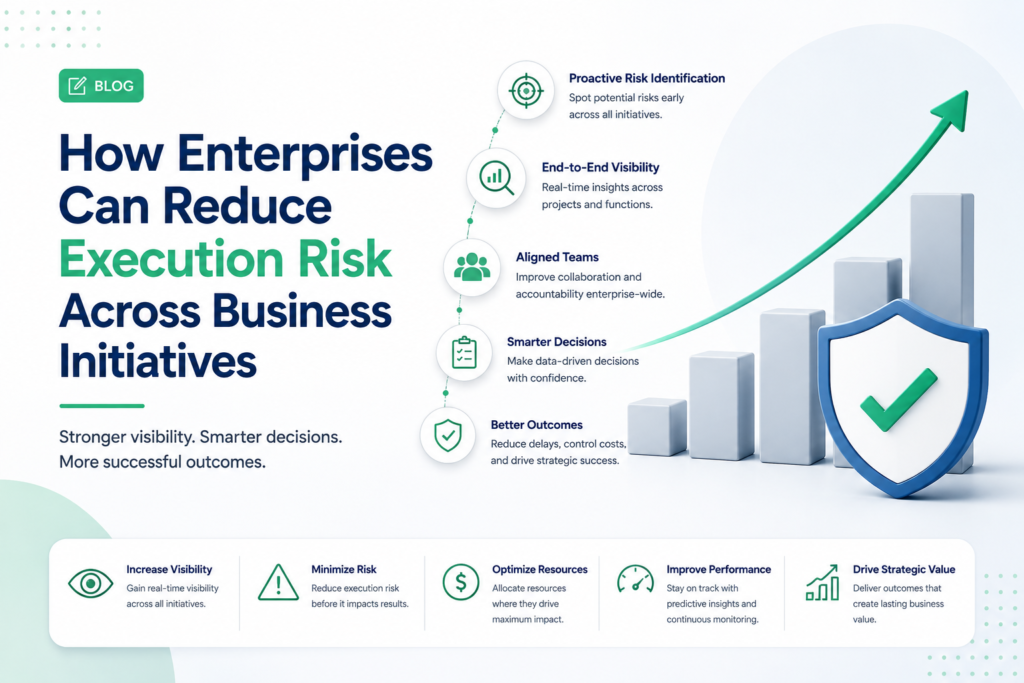
Enterprise initiatives rarely fail because of poor strategy. They fail because execution becomes fragmented after approval.
Leadership teams invest months defining priorities, allocating budgets, and aligning stakeholders. Yet once execution begins, visibility diminishes. Progress updates become dependent on meetings, spreadsheets, emails, and manually prepared reports. By the time risks become visible, they have often already impacted timelines, budgets, and business outcomes.
Reducing execution risk is no longer about adding more governance. It is about creating continuous visibility into how every initiative is progressing.
The Problem: Execution Risk Grows as Initiatives Scale
As organizations manage dozens or even hundreds of strategic initiatives, execution becomes increasingly complex. Multiple business units, project teams, executives, and external stakeholders contribute to delivery, often using different tools and reporting methods.
This creates several common challenges:
- Ownership becomes unclear.
- Dependencies remain hidden.
- Risks are identified too late.
- Leadership receives inconsistent status updates.
- Decision-making slows because information is fragmented.
Instead of governing execution proactively, leadership spends valuable time validating reports and chasing updates.
Why Traditional Governance Falls Short
Traditional governance relies heavily on scheduled reviews and manual reporting. Weekly meetings and monthly steering committees provide only periodic snapshots of execution, leaving long periods where issues can develop unnoticed.
Without live execution signals, organizations struggle to answer critical questions:
- Which initiatives are drifting off track?
- Where are approvals creating delays?
- Which dependencies threaten delivery?
- Which risks require immediate leadership attention?
By the time these answers emerge, recovery often becomes significantly more expensive.
The Solution: Build Continuous Execution Visibility
Reducing execution risk starts with connecting governance directly to execution instead of relying solely on periodic reporting.
Every initiative should provide leadership with live visibility into:
- Progress against milestones
- Pending approvals
- Ownership and accountability
- Risks and issues
- Cross-functional dependencies
- Decision history
Rather than waiting for reports, leaders gain immediate awareness of execution health and can intervene before small issues become major delivery risks.
Learn more about enterprise execution visibility:
https://initiatives.app/blog/
Follow Dr. Vishwas Mahajan's leadership insights:
https://www.linkedin.com/in/vishmahajan/
Accountability Reduces Operational Risk
Execution risk increases when responsibilities are distributed but accountability is not.
Every initiative should have clearly defined owners responsible for deliverables, approvals, timelines, and outcomes. Transparent ownership eliminates confusion, reduces delays, and enables faster decision-making across departments.
When accountability becomes visible, governance shifts from reactive monitoring to proactive leadership.
Discover how Initiatives strengthens ownership and governance:
https://initiatives.app/
Read more leadership perspectives:
https://www.linkedin.com/in/vishmahajan/
Real-Time Signals Enable Faster Decisions
Leadership teams should not discover execution problems during quarterly reviews.
Modern governance requires real-time execution signals that continuously highlight changing priorities, delayed approvals, missed milestones, and emerging risks.
Instead of relying on assumptions, executives can prioritize interventions using current operational data.
This enables organizations to:
- Reduce delivery delays
- Improve cross-functional collaboration
- Resolve bottlenecks earlier
- Increase confidence in strategic execution
Explore more governance insights:
https://initiatives.app/blog/
Connect with Dr. Vishwas Mahajan:
https://www.linkedin.com/in/vishmahajan/
From Project Tracking to Enterprise Execution Intelligence
Project tracking alone cannot reduce enterprise execution risk.
Organizations need an execution intelligence layer that connects initiatives, governance, ownership, approvals, dependencies, and leadership decisions into one continuously updated view.
This allows executives to move beyond monitoring activity and focus on driving measurable business outcomes with greater confidence.
Conclusion
Execution risk is not created by poor planning, it is created by limited visibility after execution begins.
Organizations that reduce execution risk are those that replace fragmented reporting with continuous governance, real-time accountability, and connected execution insights.
As enterprise initiatives become increasingly complex, execution visibility becomes a strategic advantage rather than an operational convenience.
Explore how Initiatives helps organizations reduce execution risk through real-time governance:
https://initiatives.app/
Frequently Asked Questions
How can enterprises reduce execution risk?
By improving real-time visibility, strengthening accountability, tracking dependencies, and monitoring execution continuously rather than relying on periodic reports.
Why do business initiatives fail despite good planning?
Most initiatives fail because execution becomes fragmented after approval, making it difficult for leadership to identify risks and intervene early.
What role does governance play in reducing execution risk?
Effective governance provides continuous oversight, clear ownership, transparent approvals, and timely execution insights that help leaders make faster, better decisions.
Why is execution visibility important?
Execution visibility enables organizations to identify bottlenecks, manage risks proactively, and keep strategic initiatives aligned with business objectives throughout delivery.
👉 Book a Demo | 🌐 Visit Initiatives.app
📥 Learn more about features, benefits, and use cases at:
👉 www.initiatives.app
Contact Us : info@whizible.com | +91 855-498-3315
Address : Mrugank, Level 3, Kothrud, Pune, Maharashtra, 411038