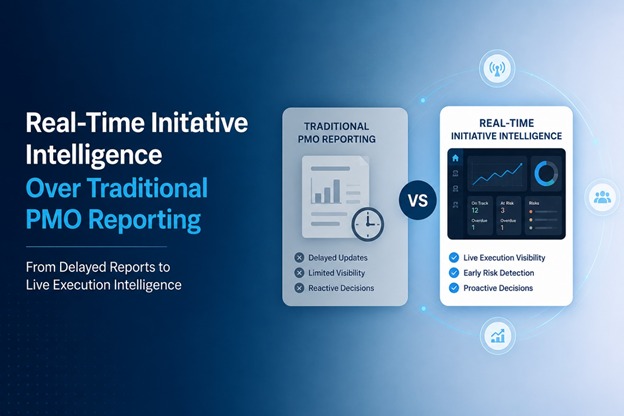
For years, PMOs operated through weekly updates, monthly reviews and quarterly governance meetings. That model worked when enterprise execution moved slowly. Today, it doesn’t.
Modern organizations operate in fast-changing environments where priorities, risks, dependencies, and delivery realities evolve daily. Yet many enterprises still rely on reporting structures built around delayed updates and static dashboards. By the time information reaches leadership, execution has already shifted.
This creates a dangerous visibility gap.
Projects begin drifting before leadership notices. Risks escalate silently. Dependencies break without early intervention. Teams become overloaded while dashboards continue showing “green” status indicators. Traditional PMO reporting creates visibility into the past instead of clarity about what is happening now.
This is exactly why enterprises are shifting toward real-time initiative intelligence.
Instead of waiting for reports, organizations now want continuous visibility across initiatives, ownership, dependencies, risks, budgets and execution signals in real time. Platforms like Initiatives.app help organizations move beyond retrospective governance and create continuous execution visibility directly inside operational workflows.
A related perspective on governance visibility can also be explored here:
The Governance Gap in Enterprise Execution
The Problem With Traditional PMO Reporting
The biggest challenge with traditional PMO reporting is timing.
Most reporting frameworks are dependent on manual updates collected periodically from multiple stakeholders, spreadsheets, disconnected tools and review meetings. By the time leadership reviews the information, the operational reality has already changed.
- A budget issue may already be growing
- A critical initiative may already be delayed
- A dependency may already be impacting downstream teams
- A strategic priority may already be drifting
This delay creates governance latency where decision-making becomes slower than execution itself.
And in high-velocity enterprises, governance latency becomes expensive.
Organizations spend enormous effort generating reports while still struggling to achieve real execution clarity. This is especially visible in large enterprises and GCC environments where execution signals are spread across multiple teams and business units.
Another strong example of this challenge is explained in:
Why QBRs Fail Without Continuous Governance
What Real-Time Initiative Intelligence Changes
Real-time initiative intelligence transforms governance from periodic reporting into continuous operational awareness.
Instead of asking “What happened last month?”, leadership teams can now understand:
- What is changing right now
- Where execution risks are building
- Which initiatives are drifting
- What dependencies may impact delivery
- Where leadership intervention is needed proactively
This fundamentally changes how organizations manage execution.
Rather than reacting after escalation, leaders gain the ability to act earlier while issues are still manageable.
Platforms like Initiatives.app help enterprises connect strategy, execution, risks, ownership, and governance into a single operational visibility layer, enabling faster and more informed decision-making.
Why PMOs Are Evolving Beyond Reporting
The role of the PMO itself is evolving rapidly.
Modern enterprises no longer need PMOs to simply consolidate updates and generate status reports. Leadership teams now expect PMOs to become execution intelligence functions capable of delivering real-time operational clarity.
The future PMO is not built around static reporting cycles.
It is built around continuous visibility, predictive governance, proactive risk management and connected execution intelligence.
Organizations adopting this model are improving decision speed, execution alignment, and governance effectiveness while reducing operational blind spots.
This shift is becoming increasingly important for enterprises trying to align strategy with execution in dynamic environments.
Another related read from Initiatives.app on strategic alignment and execution visibility explains how delayed visibility creates strategic drift across initiatives.
Conclusion
Traditional PMO reporting is no longer enough for modern enterprise execution.
Static reports and delayed governance cycles cannot keep pace with today’s execution complexity. Organizations need continuous visibility into initiatives, risks, dependencies, and outcomes while decisions can still influence results.
That is why real-time initiative intelligence is rapidly replacing traditional reporting models.
The future of governance will belong to organizations that can move from retrospective reporting toward continuous execution awareness.
To explore more perspectives around execution intelligence and enterprise governance, follow Vishwas Mahajan.
👉 Book a Demo | 🌐 Visit Initiatives.app
📥 Learn more about features, benefits, and use cases at:
👉 www.initiatives.app
Contact Us : info@whizible.com | +91 855-498-3315
Address : Mrugank, Level 3, Kothrud, Pune, Maharashtra, 411038