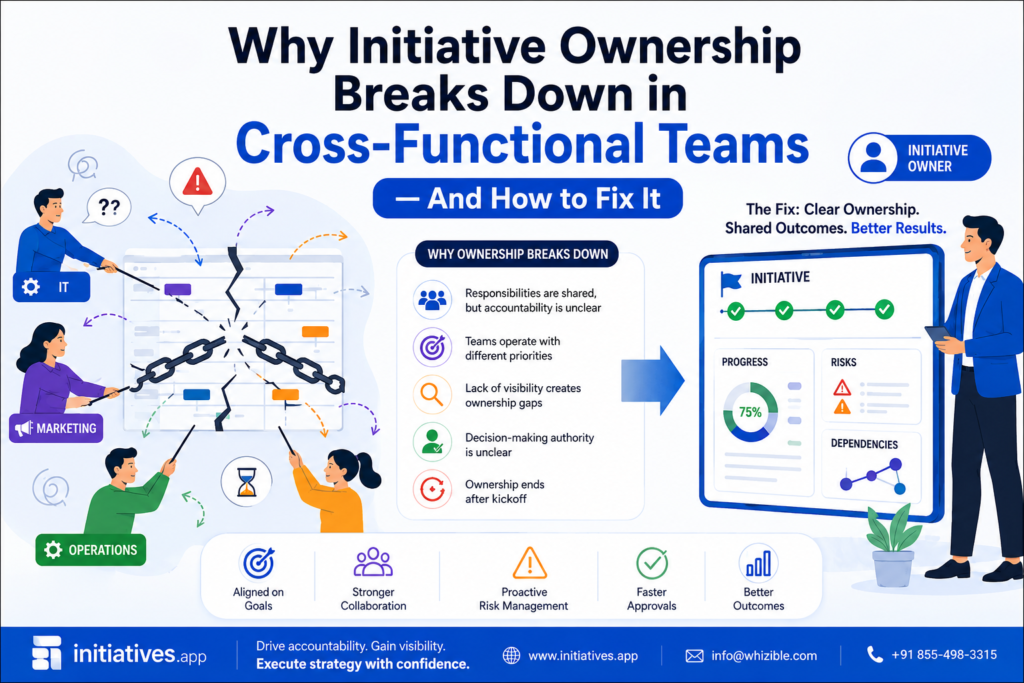
Modern organizations increasingly rely on cross-functional teams to execute strategic initiatives. Whether launching a new product, implementing enterprise technology, improving customer experience or driving digital transformation, success rarely depends on a single department. Marketing, IT, Operations, Finance, HR and business leaders must collaborate toward shared outcomes.
While cross-functional collaboration promises faster innovation and better business alignment, it often introduces a hidden challenge that silently undermines execution: unclear initiative ownership.
Most initiatives do not fail because organizations lack strategy. They fail because accountability becomes fragmented as initiatives move across teams, departments, priorities, and reporting structures. Multiple stakeholders become involved, everyone contributes partially but nobody truly owns the final outcome.
The result is familiar to many organizations. Meetings increase. Status updates multiply. Dependencies become difficult to track. Decisions get delayed. Risks remain unresolved. Leadership struggles to understand who is responsible when progress slows. Eventually, execution loses momentum while strategic objectives remain unmet.
The challenge is not collaboration itself. The challenge is establishing clear ownership within collaborative environments.
The Ownership Illusion in Cross-Functional Execution
Many organizations assume ownership exists simply because an initiative has a sponsor, project manager or department head attached to it. In reality, ownership often becomes diluted the moment execution requires coordination across multiple functions.
A transformation initiative may involve technology teams implementing systems, operations teams redesigning processes, finance teams managing budgets, and leadership teams approving milestones. Each group believes another stakeholder is ultimately responsible for driving progress.
This creates what can be called the "ownership illusion" the perception that accountability exists when no single person has end-to-end responsibility for outcomes.
When challenges emerge, teams focus on completing assigned tasks rather than ensuring the initiative achieves its intended business objectives. Activities continue but accountability for results disappears.
Organizations looking to improve initiative governance often discover that visibility and accountability must be managed continuously rather than through periodic reviews. Insights shared in the Initiatives blog on continuous governance provide valuable perspectives on maintaining ownership throughout execution.
https://initiatives.app/continuous-initiative-governance-vs-quarterly-reviews/
https://www.linkedin.com/in/vishmahajan/
Problem #1: Responsibility Is Distributed but Accountability Is Not Defined
The first and most common reason ownership breaks down is confusion between responsibility and accountability.
Cross-functional initiatives naturally distribute responsibilities among various teams. However, organizations frequently fail to identify a single accountable owner who is responsible for the final business outcome.
As responsibilities spread across departments, accountability becomes increasingly ambiguous. Team members understand their tasks but remain unclear about who owns risk resolution, dependency management, decision-making and ultimate success.
When delays occur, stakeholders begin pointing toward external dependencies rather than taking ownership of resolution. Meetings become discussions about blockers rather than actions to eliminate them.
Solution: Establish a Single Accountable Owner
Every initiative should have one clearly identified owner responsible for outcomes, regardless of how many contributors participate.
This individual should possess authority to coordinate stakeholders, resolve conflicts, escalate risks, manage dependencies and maintain momentum throughout execution.
Ownership should never be assigned to committees, departments, or governance boards. Accountability requires an identifiable individual with measurable objectives and transparent responsibilities.
Organizations implementing structured initiative governance platforms often create explicit ownership models that remain visible across the lifecycle of every initiative.
https://initiatives.app/interlinking-initiatives-managing-dependencies-and-avoiding-redundancy/
https://www.linkedin.com/in/vishmahajan/
Problem #2: Teams Operate with Different Priorities
Cross-functional teams frequently report to different leaders, operate under different KPIs and pursue different objectives.
A technology team may prioritize platform stability. Operations may focus on efficiency. Finance may emphasize cost control. Business leaders may prioritize growth and speed.
While each objective is valid, competing priorities often create execution friction. Initiative owners struggle to gain alignment because participating teams evaluate success differently.
Over time, strategic initiatives become secondary to departmental objectives. Teams remain busy but progress stalls.
Solution: Align Teams Around Shared Outcomes
Successful organizations connect initiative execution directly to measurable business outcomes rather than departmental activities.
Instead of measuring task completion alone, leaders should track outcomes such as revenue impact, cost reduction, adoption rates, customer experience improvements, compliance achievements or operational efficiencies.
When every participating team understands how their contributions influence shared objectives, ownership becomes collective without sacrificing accountability.
Organizations increasingly use outcome-driven governance frameworks to ensure alignment remains visible across all stakeholders.
https://initiatives.app/kpis-vs-kris-why-measuring-outcomes-matters-more-than-tracking-activity/
https://www.linkedin.com/in/vishmahajan/
Problem #3: Lack of Visibility Creates Ownership Gaps
Ownership becomes difficult when stakeholders lack real-time visibility into initiative progress.
In many organizations, updates remain scattered across spreadsheets, emails, project tools, presentations and departmental reports. Critical information resides within functional silos, preventing leaders from obtaining a complete picture of execution status.
As visibility decreases, accountability weakens. Stakeholders become reactive rather than proactive. Risks are discovered late. Dependencies remain hidden until deadlines approach.
The absence of transparency allows ownership gaps to grow unnoticed.
Solution: Create a Single Source of Execution Visibility
Cross-functional initiatives require centralized visibility into progress, risks, milestones, decisions, approvals and dependencies.
A unified initiative management platform enables stakeholders to understand ownership structures, monitor execution health and identify emerging issues before they become significant obstacles.
Continuous visibility transforms ownership from a static assignment into an actively managed discipline.
Organizations embracing real-time execution management frequently reduce escalation cycles because accountability becomes transparent across teams.
https://www.linkedin.com/in/vishmahajan/
Problem #4: Decision-Making Authority Is Unclear
Many initiatives experience delays not because teams cannot execute but because nobody knows who can make critical decisions.
Approvals move through multiple management layers. Stakeholders wait for consensus. Escalations remain unresolved. Ownership becomes ineffective because initiative leaders lack sufficient authority to remove obstacles.
As uncertainty increases, teams hesitate to act, resulting in slower execution and reduced accountability.
Solution: Define Governance and Escalation Paths Early
Initiative governance should clearly specify decision rights, approval structures, escalation mechanisms and ownership boundaries from the outset.
When stakeholders understand who can approve budgets, resolve conflicts, adjust priorities and address risks, execution accelerates significantly.
Effective governance does not create bureaucracy. It removes ambiguity.
Organizations that implement structured governance frameworks experience faster decision cycles and stronger ownership accountability throughout initiative delivery.
https://initiatives.app/why-qbrs-fail-continuous-initiative-governance/
https://www.linkedin.com/in/vishmahajan/
Problem #5: Ownership Ends After Kickoff
Another frequent challenge is treating ownership as a planning activity rather than an ongoing responsibility.
Organizations often define ownership during project initiation and assume accountability will naturally persist throughout execution.
However, priorities change. Team members move. Dependencies evolve. Risks emerge. Strategic objectives shift.
Without continuous monitoring, ownership gradually deteriorates.
Initiatives may continue operating while accountability structures quietly disappear.
Solution: Adopt Continuous Initiative Governance
Ownership must be reviewed continuously throughout the initiative lifecycle.
Leaders should regularly evaluate accountability structures, stakeholder engagement, risk ownership, decision velocity and execution progress. Governance should evolve alongside changing business conditions rather than remaining static.
Continuous initiative governance ensures ownership remains active, visible and measurable from planning through completion.
Organizations implementing this approach often experience stronger alignment, faster execution, and significantly improved strategic outcomes.
https://initiatives.app/gcc-strategic-drift-real-time-alignment/
https://www.linkedin.com/in/vishmahajan/
How Initiatives.app Helps Strengthen Ownership Across Cross-Functional Teams
Cross-functional execution succeeds when accountability, visibility, governance and collaboration operate together.
Initiatives.app helps organizations establish clear ownership structures, maintain real-time visibility across initiatives, manage dependencies, streamline governance processes and ensure accountability remains transparent throughout execution.
Instead of relying on spreadsheets, fragmented reporting systems, and periodic reviews, organizations gain a centralized environment where initiative owners, stakeholders, executives and delivery teams remain aligned around shared outcomes.
This enables leaders to identify risks earlier, accelerate decision-making, strengthen accountability and improve strategic execution success rates.
Conclusion
Cross-functional collaboration is essential for modern organizations, but collaboration without ownership creates execution risk.
When accountability becomes unclear, priorities diverge, visibility decreases, decision-making slows and governance weakens, even the most promising initiatives struggle to deliver intended outcomes.
The solution is not reducing collaboration. The solution is strengthening ownership through clear accountability structures, outcome-based alignment, real-time visibility, defined governance, and continuous oversight.
Organizations that successfully establish these foundations transform cross-functional complexity into strategic advantage. They move beyond simply managing initiatives and begin executing strategy with confidence, clarity and accountability.
Top of Form
Bottom of Form
👉 Book a Demo | 🌐 Visit Initiatives.app
📥 Learn more about features, benefits, and use cases at:
👉 www.initiatives.app
Contact Us : info@whizible.com | +91 855-498-3315
Address : Mrugank, Level 3, Kothrud, Pune, Maharashtra, 411038