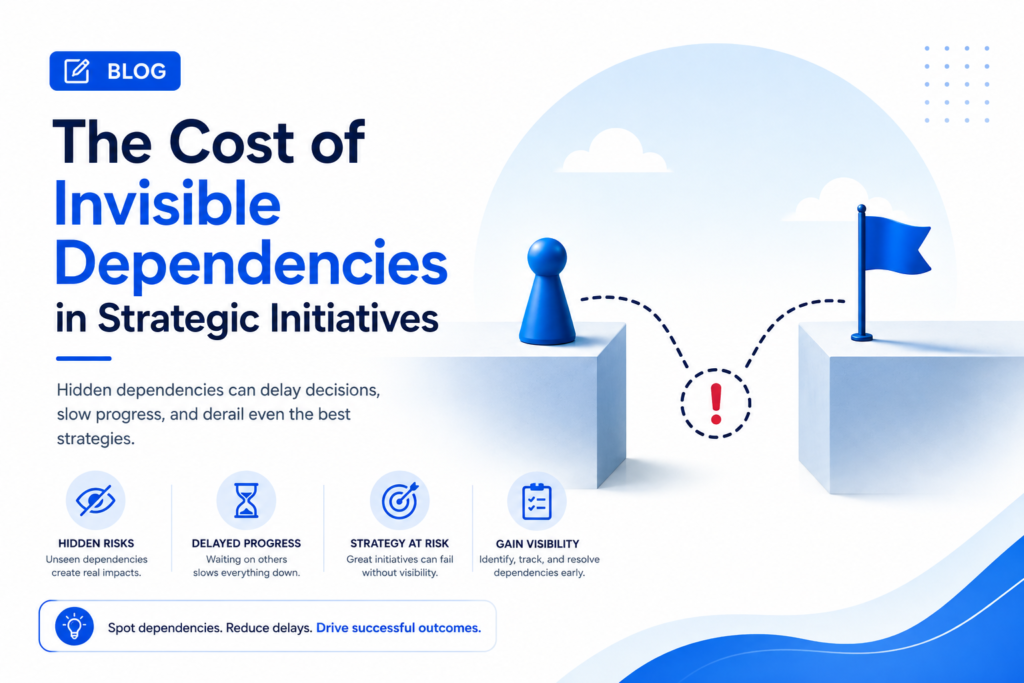
Strategic initiatives rarely operate independently. A digital transformation may depend on infrastructure readiness, a product launch may rely on compliance approval, an automation program may require data from another business unit, and a cost-optimization initiative may depend on decisions being made elsewhere. These connections are normal. The real risk begins when they remain invisible.
Invisible dependencies create a gap between what leadership believes is progressing and what teams can actually execute. An initiative may appear green on a dashboard while a critical approval, upstream deliverable, resource commitment, or cross-functional decision is already putting the outcome at risk. By the time the dependency becomes visible, teams are often managing escalation rather than execution.
This is why modern initiative governance must go beyond tracking individual milestones. Platforms such as Initiatives.app are designed to bring initiatives, ownership, dependencies, decisions, and execution signals into a more connected governance environment.
Problem 1: Initiative Plans Show Activities, Not the Full Dependency Network
Traditional initiative plans are usually built around tasks, milestones, owners, and deadlines. While these elements are important, they do not always reveal how one initiative depends on another.
For example, Initiative B may be scheduled to begin next month, but its success could depend on Initiative A completing a technology integration two weeks earlier. Both initiatives may independently show healthy progress, while the dependency connecting them is already slipping.
The problem becomes more serious at enterprise scale. When dozens of strategic programs are running simultaneously across IT, operations, finance, HR, product, and business teams, leadership cannot reasonably discover every dependency through meetings, spreadsheets, emails, and status updates.
Solution: Make Dependencies Part of Initiative Governance
Dependencies should be treated as governance objects rather than informal notes. Teams need visibility into what is dependent on what, who owns the dependency, when it is required, and what happens if it slips.
A connected governance approach allows leadership to evaluate initiative health in context rather than looking at each initiative as an isolated project. This creates earlier visibility into execution risk and gives teams more time to intervene.
This broader shift from fragmented tracking toward connected execution visibility is explored further in Initiatives.app insights on enterprise initiative governance. Additional perspectives on strategy, execution, and enterprise transformation are also shared by Dr. Vishwas Mahajan on LinkedIn.
Problem 2: One Small Delay Can Create a Much Larger Business Impact
The cost of an invisible dependency is rarely limited to one delayed task.
A delayed approval may hold up procurement. Procurement may delay implementation. Implementation delays may affect testing, which may then move the launch date. What initially looked like a minor operational issue becomes a strategic delay through a chain reaction.
This creates what can be described as dependency debt: accumulated execution risk caused by unresolved connections between initiatives, teams, decisions, resources, and milestones.
The financial impact may appear through additional resource costs, delayed revenue realization, missed market opportunities, duplicated work, or leadership time spent resolving preventable escalations.
Solution: Detect Dependency Risk Before It Becomes an Escalation
Organizations need to move from retrospective reporting toward earlier execution signals. Instead of discovering a dependency during a weekly or monthly review, teams should be able to identify when an upstream commitment changes and immediately understand which downstream initiatives may be affected.
That changes governance from:
“What went wrong?”
to:
“What is likely to be affected next?”
This is where real-time initiative visibility becomes valuable. Initiatives.app focuses on connecting execution information so decision-makers can identify risks, ownership gaps, and changing conditions earlier. For additional thinking around improving execution discipline at scale, follow Dr. Vishwas Mahajan.
Problem 3: Dependency Ownership Is Often Unclear
A dependency can be visible and still remain unmanaged.
Team A may know that it needs information from Team B, but who is responsible for ensuring that information arrives? The initiative owner? The upstream team? The PMO? A functional leader?
When dependency ownership is unclear, follow-ups move into email threads, chats, meetings, and personal reminders. Progress begins to depend on individual persistence rather than an established governance process.
This becomes especially dangerous for strategic initiatives because accountability gets distributed across multiple functions while the final outcome still has a single deadline.
Solution: Connect Dependencies With Clear Ownership
Every critical dependency should have an identifiable owner, expected outcome, required date, and escalation path.
More importantly, dependency accountability should exist alongside the initiative itself. Leadership should not need to reconstruct ownership from emails or meeting notes when something slips.
A structured approach to ownership is part of the broader move toward continuous initiative governance discussed across the Initiatives.app blog. Related leadership perspectives on creating stronger alignment between strategy and execution can also be found on Dr. Vishwas Mahajan’s LinkedIn.
Problem 4: Leadership Sees the Dependency Too Late
Many organizations have plenty of reporting but insufficient foresight.
Dashboards can show milestone completion, percentage progress, budgets, and status indicators. Yet a green initiative can still be exposed to a critical dependency that has not appeared in its formal status.
By the time that dependency turns the initiative red, the organization may have already lost valuable recovery time.
Solution: Shift From Status Visibility to Execution Visibility
Effective governance should show more than where an initiative stands today. It should help leaders understand what could prevent the initiative from achieving its intended outcome.
That means connecting initiatives with dependencies, decisions, ownership, risks, approvals, and changing execution signals.
The objective is not more reporting. It is earlier understanding.
Solutions such as Initiatives.app help organizations establish this connected view of strategic execution, while insights from Dr. Vishwas Mahajan provide additional perspectives on improving governance and enterprise execution.
The Real Cost of an Invisible Dependency
Invisible dependencies do not simply create schedule delays. They weaken predictability.
When leadership cannot see how initiatives influence one another, prioritization becomes harder, risk appears later, accountability becomes fragmented, and strategic decisions are made with incomplete execution context.
Organizations therefore need to stop treating dependencies as secondary project-management details. At enterprise scale, they are a strategic governance issue.
Making them visible creates the opportunity to intervene earlier, coordinate teams faster, and protect strategic outcomes before a small dependency becomes an expensive business problem.
Explore how Initiatives.app can help create greater visibility across strategic initiatives, ownership, dependencies, and execution signals. For more perspectives on strategy execution and enterprise governance, connect with Dr. Vishwas Mahajan on LinkedIn.
FAQs
What is an initiative dependency?
An initiative dependency exists when the progress or outcome of one initiative relies on another team, decision, resource, deliverable, approval, system, or initiative.
Why are invisible dependencies dangerous?
They allow initiatives to appear healthy even when external factors are creating execution risk. This can delay leadership intervention until the impact has already spread.
How can organizations manage strategic dependencies better?
Organizations should establish centralized visibility, assign clear ownership, define expected dates and outcomes, and continuously monitor how changes affect connected initiatives.
Can real-time governance reduce dependency risk?
Yes. Earlier visibility does not eliminate dependencies, but it gives teams more time to coordinate, make decisions, and prevent downstream disruption. Learn more about connected initiative governance at Initiatives.app.
👉 Book a Demo | 🌐 Visit Initiatives.app
📥 Learn more about features, benefits, and use cases at:
👉 www.initiatives.app
Contact Us : info@whizible.com | +91 855-498-3315
Address : Mrugank, Level 3, Kothrud, Pune, Maharashtra, 411038