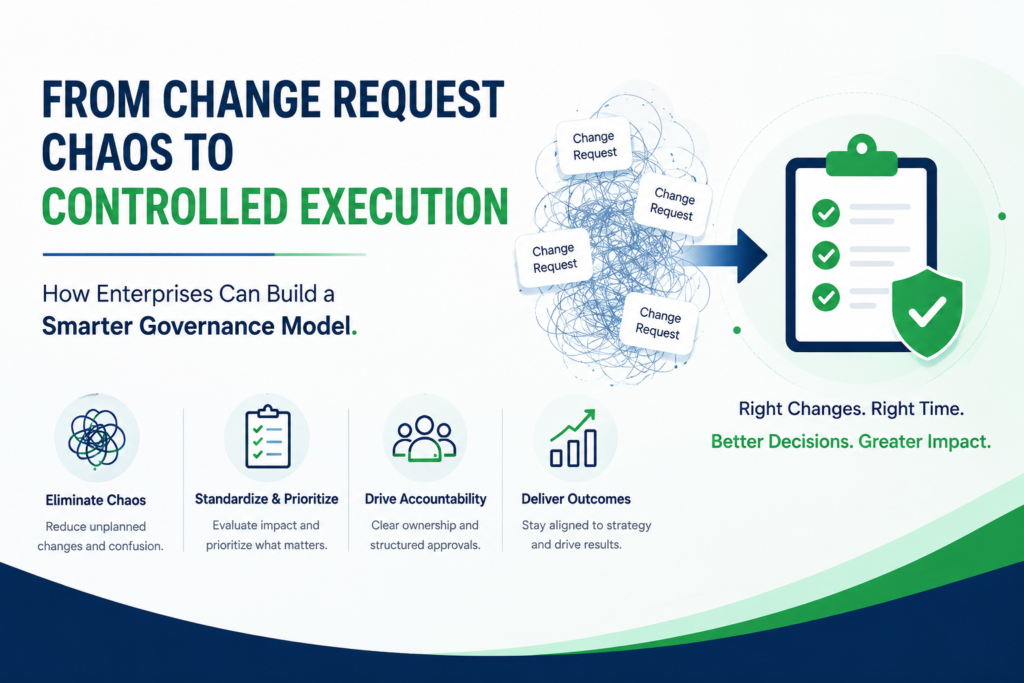
Enterprise transformation rarely fails because organizations lack ideas. More often, it fails because execution becomes overwhelmed by an endless stream of change requests. New business requirements emerge, stakeholders request additional features, regulations evolve and leadership priorities shift. While every change may seem justified in isolation, the cumulative effect often creates delivery delays, resource conflicts, budget overruns and governance breakdowns.
As organizations scale their portfolios, managing change becomes increasingly difficult. Teams find themselves trapped in a cycle of approvals, meetings, spreadsheets and status updates, while leaders struggle to understand the true impact of changes on strategic objectives. What begins as a manageable process gradually turns into execution chaos. The solution is not to eliminate change but to build a governance model capable of controlling and prioritizing it effectively.
The Problem: Why Traditional Change Management Breaks Down
Many enterprises still rely on fragmented processes for managing change requests. Requests arrive through emails, chat messages, meetings, ticketing systems and spreadsheets. Different teams evaluate changes differently, creating inconsistent approval decisions and limited accountability.
As the volume of requests increases, project teams spend more time discussing changes than delivering outcomes. The lack of a centralized governance framework makes it difficult to determine which requests genuinely support strategic goals and which simply create unnecessary complexity.
The challenge becomes even more severe when multiple initiatives are running simultaneously. A change approved in one project may affect resources, budgets, dependencies, and timelines across several others. Without enterprise-wide visibility, leadership teams often discover these impacts only after they become business problems.
Organizations experiencing these challenges often face the same visibility issues discussed in this Initiatives.app article:
👉 The Visibility Problem in Enterprise Execution: Why Leaders Discover Risks Too Late
Strategic Drift The Hidden Consequence of Uncontrolled Changes
The most dangerous outcome of poor change governance is strategic drift. Every approved request consumes resources, budget and management attention. Over time, initiatives gradually move away from their original business objectives.
Projects become overloaded with additional requirements. Delivery teams lose focus. Forecasts become unreliable. Leadership loses confidence in project reporting because plans no longer reflect actual execution realities.
This disconnect between strategy and execution is becoming increasingly common in modern enterprises. As highlighted in:
Organizations frequently invest heavily in planning but fail to maintain governance once execution begins.
For additional insights on enterprise governance and strategy execution, follow:
The Solution: Building a Smarter Governance Model
The answer lies in moving beyond reactive change management toward proactive governance. A modern governance framework ensures that every change request is evaluated against business value, strategic alignment, delivery impact, resource availability and associated risks before approval.
Instead of asking, "Can we do this change?" organizations begin asking, "Should we do this change?"
This shift fundamentally changes how enterprises manage execution. Governance becomes a business decision framework rather than an administrative process.
A structured governance model allows organizations to:
- Prioritize changes based on strategic value.
- Assess portfolio-wide impact before approval.
- Improve accountability and ownership.
- Maintain visibility across initiatives.
- Reduce execution risk and resource conflicts.
Organizations pursuing this approach often benefit from adopting live governance principles described in:
👉 The Future of Enterprise Governance: Live Execution Signals
Creating Visibility Before Approving Change
One of the biggest weaknesses of traditional governance is that decisions are often made without understanding execution consequences.
A smarter governance model provides real-time visibility into initiative health, dependencies, resource allocation, budget impact, and delivery risk. Decision-makers can evaluate the downstream effects of changes before approvals are granted.
This prevents organizations from creating bottlenecks that only become visible weeks or months later.
The importance of real-time execution visibility is explored further in:
👉 Real-Time Governance: Why Enterprises Need Live Execution Intelligence
For broader perspectives on digital transformation and governance modernization, connect with:
From Approval Workflows to Outcome Governance
Traditional governance focuses on approvals. Modern governance focuses on outcomes.
Approving a change request should not mark the end of governance. Instead, governance should continue throughout execution, tracking whether approved changes actually deliver the expected business value.
Organizations that successfully manage enterprise-scale change establish clear links between strategic objectives, initiatives, execution activities and measurable outcomes. Every approved change becomes traceable to a business objective.
This creates accountability while ensuring that change remains aligned with organizational priorities.
Organizations looking to strengthen initiative governance can also explore:
The Role of Technology in Modern Governance
Governance at scale cannot rely on spreadsheets and manual coordination. As enterprise portfolios grow, organizations require centralized platforms that provide a single source of truth for initiatives, approvals, dependencies, risks and outcomes.
Modern initiative governance platforms help leadership teams gain continuous visibility into execution without creating additional reporting burdens for project teams.
This enables faster decisions, stronger accountability and more predictable delivery outcomes.
To learn more about how modern organizations are evolving governance practices, follow:
Conclusion
Change requests are inevitable. Change chaos is not.
Organizations that continue managing changes through disconnected processes will struggle with delays, cost overruns and strategic drift. Those that establish a structured governance model can transform change into a competitive advantage.
The future of enterprise execution belongs to organizations that can adapt quickly while maintaining complete visibility, accountability and strategic alignment. Moving from change request chaos to controlled execution requires more than better approvals, it requires a smarter governance model built around outcomes, visibility and continuous execution intelligence.
To explore how modern enterprises are transforming governance and initiative execution, visit:
👉 Initiatives.app Official Website
And connect with:
FAQs
What is change request governance?
Change request governance is the structured process of evaluating, prioritizing, approving, and monitoring changes to ensure they align with business objectives and do not negatively impact execution outcomes.
Why do enterprises struggle with change management?
Most organizations struggle because change requests are managed through disconnected tools and inconsistent processes, creating limited visibility and poor decision-making.
How does governance improve execution?
Governance provides accountability, prioritization, visibility and strategic alignment, helping organizations manage change without disrupting execution.
Why is real-time visibility important for governance?
Real-time visibility enables leaders to understand the impact of changes before approving them, reducing delivery risks and improving decision quality.
Top of Form
Bottom of Form
👉 Book a Demo | 🌐 Visit Initiatives.app
📥 Learn more about features, benefits, and use cases at:
👉 www.initiatives.app
Contact Us : info@whizible.com | +91 855-498-3315
Address : Mrugank, Level 3, Kothrud, Pune, Maharashtra, 411038