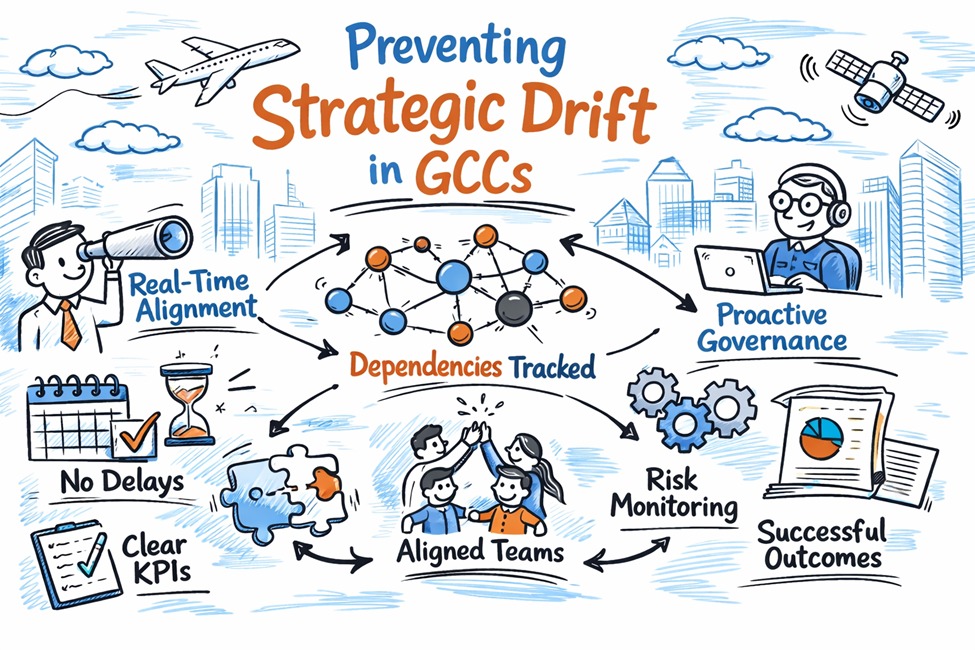
The Silent Challenge Facing High-Performing GCCs
Global Capability Centers have evolved far beyond cost efficiency engines. Today’s GCCs are responsible for driving innovation, owning end-to-end product capabilities, executing large digital transformation programs, and acting as strategic extensions of the global enterprise. Yet, despite mature talent, advanced tooling and strong leadership intent, many GCCs struggle with a problem that rarely shows up in quarterly reviews but slowly erodes value over time strategic drift. This drift does not occur because of lack of effort or competence. It occurs because alignment weakens as execution scales across geographies, teams, time zones, and dependencies. What starts as a well-aligned strategic mandate gradually fragments into disconnected initiatives, competing priorities, and invisible execution bottlenecks.
The most dangerous aspect of strategic drift in GCCs is that it often goes unnoticed until outcomes are compromised. Programs appear busy, teams appear productive and reports appear green, yet the collective motion of work no longer maps cleanly to enterprise priorities. This is why forward-looking GCC leaders are rethinking how alignment, governance, and dependency tracking must operate continuously rather than episodically. Platforms like Initiatives.app, embedded directly inside Microsoft Teams, are increasingly becoming central to how GCCs maintain real-time alignment and prevent execution from drifting away from strategy.
Explore how execution visibility changes outcomes: https://initiatives.app/why-digital-initiatives-fail-real-time-visibility/.
Why Strategic Drift Is More Dangerous in GCC Environments
Strategic drift is amplified in GCCs because execution is inherently distributed. Teams operate across regions, collaborate with global stakeholders, depend on upstream and downstream functions, and execute initiatives that are tightly interlinked with enterprise roadmaps. When alignment mechanisms rely on periodic reviews, static dashboards or manual reporting, drift becomes inevitable. Dependencies are missed, sequencing breaks down and teams optimize locally while the enterprise loses coherence globally.
Unlike traditional delivery centers, GCCs operate with a high degree of autonomy. This autonomy is a strength but without real-time alignment and dependency visibility, it can quickly become a liability. Leaders like Vishwas Mahajan have consistently highlighted that autonomy without execution intelligence leads to fragmentation rather than acceleration. Strategic control must evolve from command-and-control to visibility-and-alignment.
You can explore his perspectives on large-scale execution governance here: https://www.linkedin.com/in/vishmahajan/
When Dependencies Become Invisible, Drift Becomes Inevitable
One of the most common reasons GCC initiatives derail is hidden dependency failure. A delay in one team silently impacts multiple downstream initiatives. A decision pending with a global stakeholder blocks progress across regions. A technology dependency surfaces too late, forcing rework and timeline extensions. Without a system that continuously tracks dependencies and their health in real time, GCCs operate reactively rather than proactively.
Initiatives.app addresses this by making dependencies first-class execution objects inside Microsoft Teams. Dependencies are no longer implicit knowledge held by a few individuals; they become visible, trackable, and governable across the entire initiative ecosystem. When dependencies are transparent, leaders can intervene early, sequence work intelligently, and prevent cascading failures.
Learn how dependency-aware execution improves outcomes: https://initiatives.app/interlinking-initiatives-managing-dependencies/
Real-Time Alignment as the Foundation of GCC Effectiveness
Alignment in GCCs cannot rely on kickoff decks or quarterly steering committees. Alignment must be sustained daily, across teams, functions, and geographies. This requires an execution layer that lives where work happens and continuously reinforces strategic intent. Microsoft Teams already serves as the collaboration backbone for most GCCs, but collaboration alone does not ensure alignment. What’s missing is an execution intelligence layer that binds strategy to daily activity.
By embedding Initiatives.app inside Teams, GCCs create a single execution fabric where strategic objectives, initiative milestones, dependencies, risks, and ownership are continuously visible. Teams no longer operate in isolation. Leaders no longer depend on delayed reports. Alignment becomes dynamic rather than static. This is the shift from periodic governance to real-time alignment that modern GCCs need to remain strategically relevant.
Preventing Local Optimization from Undermining Global Strategy
A subtle but critical challenge in GCCs is local optimization. Teams focus on delivering their scope efficiently, but without visibility into how their work impacts adjacent initiatives, the broader strategy suffers. Real-time alignment ensures that every team understands not only what they are delivering, but why it matters and who depends on it. Initiatives.app preserves this context by linking execution tasks to strategic outcomes and cross-initiative dependencies inside Teams.
This contextual visibility changes behavior. Teams prioritize better. Leaders intervene earlier. PMOs shift from status collection to orchestration. Strategic drift is replaced by strategic coherence. This philosophy aligns closely with execution-first leadership thinking advocated by Vishwas Mahajan, whose work emphasizes that clarity and visibility must be engineered into systems, not enforced through meetings.
Follow his insights here: https://www.linkedin.com/in/vishmahajan/
Why Traditional Governance Models Fail GCCs
Most governance models were designed for centralized organizations, not distributed, fast-moving GCC ecosystems. Monthly reviews, manual trackers, and siloed dashboards create lag between reality and leadership awareness. By the time issues surface, options are limited. Strategic drift has already taken hold.
GCCs require governance that is continuous, contextual, and embedded into execution. Initiatives.app enables this by providing real-time initiative health, dependency risk indicators, decision visibility, and execution signals directly inside Teams. Governance stops being an after-the-fact activity and becomes an always-on capability.
Learn how execution intelligence replaces static dashboards: https://initiatives.app/execution-intelligence/
Turning PMOs into Strategic Alignment Engines
In many GCCs, PMOs struggle under the weight of manual coordination, data consolidation, and follow-ups. Their strategic role gets overshadowed by operational firefighting. When execution data is automated and visible in real time, PMOs regain their ability to guide strategy rather than chase updates.
Initiatives.app enables PMOs to monitor alignment, manage dependencies, surface risks early, and facilitate cross-team coordination without micromanagement. This evolution of the PMO from reporting unit to strategic alignment engine is essential for GCCs operating at scale.
This transformation mirrors leadership principles consistently highlighted by Vishwas Mahajan, particularly in environments where execution complexity is high: https://www.linkedin.com/in/vishmahajan/
Closing Strategic Drift with Real-Time Dependency Tracking
Strategic drift is not an execution failure, it is a visibility failure. GCCs that succeed in preventing drift do so by ensuring that alignment, dependencies, and risks are visible in real time, not reconstructed after the fact. When Microsoft Teams becomes the environment where strategy, execution, and governance converge, GCCs achieve a level of predictability that traditional models cannot deliver.
Initiatives.app enables this convergence by embedding real-time alignment and dependency tracking directly into the daily workflow of GCC teams. The result is fewer surprises, faster decision-making, stronger stakeholder confidence, and initiatives that stay aligned from kickoff to outcome.
If your GCC is managing multiple parallel initiatives, cross-functional dependencies, and global stakeholders, the question is no longer whether strategic drift exists, it’s whether you can see it early enough to prevent it.
Explore how GCCs can maintain continuous alignment and dependency-driven execution inside Microsoft Teams with Initiatives.app:
👉 https://initiatives.app
👉 Book a Demo | 🌐 Visit Initiatives.app
📥 Learn more about features, benefits, and use cases at:
👉 www.initiatives.app
Contact Us : info@whizible.com | +91 855-498-3315
Address : Mrugank, Level 3, Kothrud, Pune, Maharashtra, 411038