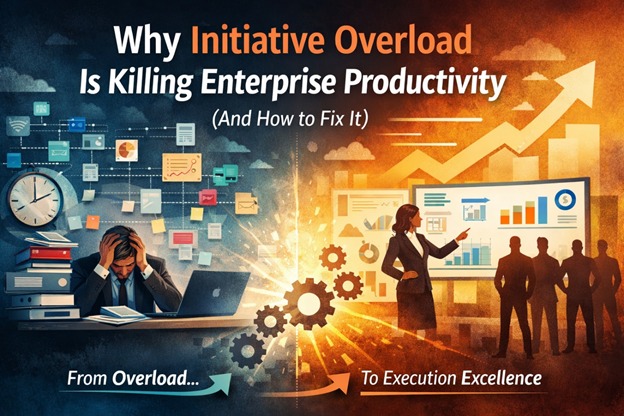
In today’s enterprise landscape, progress is often mistaken for activity. Leadership teams proudly showcase dozens sometimes hundreds of active initiatives across digital transformation, operational excellence, customer experience, AI adoption and cost optimization. On paper, it looks like momentum. In reality, it often masks a deeper, more dangerous issue: initiative overload.
Organizations are not failing due to lack of ideas. They are failing because they are trying to execute too many ideas at once without clarity, alignment or governance. The result is a slow but consistent erosion of productivity, accountability and business outcomes.
Initiative overload doesn’t create chaos overnight. It builds quietly. Teams get stretched. Priorities blur. Decision-making slows. Execution quality drops. And before anyone realizes it, the organization is busy but not effective.
The Hidden Cost of Too Many Initiatives
Problem Activity Without Impact
Most enterprises equate more initiatives with more progress. However, when teams are spread across too many parallel efforts, productivity doesn’t scale, it fragments. Employees switch contexts constantly, leadership attention gets diluted and critical initiatives lose the focus they require.
This creates a dangerous illusion: dashboards show progress across multiple initiatives, but none of them are delivering meaningful business outcomes. Instead of depth, organizations operate in shallow execution cycles.
Solution Ruthless Prioritization Aligned to Business Outcomes
The first step to solving initiative overload is not better tracking, it is better prioritization. Enterprises must shift from managing a list of initiatives to managing a portfolio aligned with strategic outcomes. This means defining clear success metrics, eliminating redundant initiatives and ensuring every active effort has a direct link to business value.
Organizations that implement structured initiative prioritization frameworks see a significant shift from activity-driven execution to outcome-driven delivery.
👉 Learn how continuous alignment helps eliminate execution noise: https://initiatives.app/strategic-drift-real-time-alignment/
👉 External perspective on strategic execution: https://www.linkedin.com/in/vishmahajan/
The Fragmentation Problem No Single Source of Truth
Problem Data Exists Everywhere, Insight Exists Nowhere
One of the biggest contributors to initiative overload is fragmentation. Different teams track initiatives in different tools Excel sheets, Jira boards, PowerPoint updates, email threads. Each system captures a part of the truth but no system provides the complete picture.
Leadership ends up spending more time reconciling data than making decisions. By the time insights are compiled, they are already outdated.
This lack of a unified view leads to duplicated efforts, missed dependencies and delayed escalations.
Solution Create a Single Version of Truth for All Initiatives
To eliminate overload, organizations need a centralized initiative governance layer that connects strategy, execution, and reporting in real time. A single source of truth ensures that everyone from CXOs to execution teamsoperates on the same data.
This unified visibility enables faster decisions, proactive risk management, and better alignment across departments.
👉 Explore how unified visibility transforms execution: https://initiatives.app/single-version-of-truth-execution/
👉 External insights on governance thinking: https://www.linkedin.com/in/vishmahajan/
The Capacity Illusion Teams Are Busy, Not Productive
Problem Overloaded Teams, Underwhelming Outcomes
When too many initiatives are active, resource allocation becomes reactive instead of strategic. High-performing employees get assigned to multiple initiatives simultaneously, leading to burnout and reduced efficiency. Meanwhile, other areas remain underutilized.
The organization believes it is maximizing capacity but in reality, it is diluting productivity.
Solution Align Capacity with Strategic Priorities
Fixing initiative overload requires linking resource capacity directly to prioritized initiatives. Leaders must have visibility into who is working on what, how much bandwidth is available, and whether resources are aligned with the highest-impact initiatives.
This shift ensures that critical initiatives get the attention they deserve while preventing unnecessary overload on teams.
👉 Read more on aligning execution with priorities: https://initiatives.app/connecting-strategy-to-weekly-commitments/
👉 External leadership perspective: https://www.linkedin.com/in/vishmahajan/
The Governance Gap Reactive Instead of Proactive Execution
Problem Issues Are Identified Too Late
In overloaded environments, governance becomes reactive. Leadership reviews happen monthly or quarterly, by which time issues have already escalated. Delays, cost overruns and misalignment are discovered too late to fix efficiently.
The absence of real-time governance turns initiative management into a reporting exercise rather than a control mechanism.
Solution Move to Continuous, Real-Time Governance
Organizations must transition from periodic reviews to continuous governance models. This means real-time tracking of progress, risks, dependencies and outcomes enabling leaders to intervene early rather than react late.
Continuous governance transforms initiative management from passive monitoring to active control.
👉 Understand why traditional reviews fail: https://initiatives.app/why-qbrs-fail-continuous-initiative-governance/
👉 External governance insights: https://www.linkedin.com/in/vishmahajan/
The Alignment Breakdown Strategy Gets Lost in Execution
Problem Strategy and Execution Operate in Silos
One of the most dangerous consequences of initiative overload is misalignment. Strategic goals are defined at the top, but execution happens in silos. Teams focus on completing tasks rather than delivering outcomes aligned with business objectives.
Over time, this disconnect creates “execution debt” a growing gap between what the organization intended to achieve and what it is actually delivering.
Solution Connect Strategy to Daily Execution
To fix this, organizations must ensure that every initiative, task, and milestone is directly linked to strategic objectives. This requires a system where strategy is not just defined but continuously visible and measurable throughout execution.
When teams understand how their work contributes to larger goals, productivity improves and alignment becomes natural.
👉 Learn how to connect strategy with execution: https://initiatives.app/connecting-strategy-to-weekly-commitments/
👉 External thought leadership: https://www.linkedin.com/in/vishmahajan/
The Decision Bottleneck Too Much Data, Not Enough Clarity
Problem Leaders Are Overwhelmed, Not Informed
Ironically, initiative overload often leads to information overload. Leaders receive multiple reports, dashboards and updates but lack clear, actionable insights. Decision-making slows down and critical actions get delayed.
This creates a bottleneck at the leadership level, impacting the entire organization.
Solution Shift from Reporting to Decision Intelligence
The focus must shift from generating reports to enabling decisions. Leaders need contextual, real-time insights that highlight what needs attention not just what has happened.
Decision intelligence systems help leaders prioritize actions, allocate resources effectively, and drive outcomes with confidence.
👉 Discover the shift from dashboards to decisions: https://initiatives.app/beyond-dashboards-governance-intelligence/
👉 External executive perspective: https://www.linkedin.com/in/vishmahajan/
The Way Forward From Initiative Overload to Execution Excellence
Initiative overload is not a capacity problem. It is a visibility, prioritization and governance problem.
Organizations that continue to operate with fragmented systems, unclear priorities, and reactive governance will remain stuck in a cycle of activity without impact. On the other hand, those that embrace structured initiative management will unlock a new level of productivity and performance.
The path forward is clear:
Align initiatives with business outcomes.
Create a single source of truth.
Connect capacity with priorities.
Adopt real-time governance.
Enable decision intelligence.
When these elements come together, enterprises move from chaos to clarity from overload to execution excellence.
Final CTA
If your organization is running more initiatives than it can effectively execute, the problem isn’t effort, it’s structure.
It’s time to rethink how initiatives are governed, aligned, and executed.
👉 Explore how Initiatives.app helps enterprises eliminate overload and drive real outcomes: https://initiatives.app/
👉 Connect for deeper insights on execution excellence: https://www.linkedin.com/in/vishmahajan/
👉 Book a Demo | 🌐 Visit Initiatives.app
📥 Learn more about features, benefits, and use cases at:
👉 www.initiatives.app
Contact Us : info@whizible.com | +91 855-498-3315
Address : Mrugank, Level 3, Kothrud, Pune, Maharashtra, 411038