The Illusion of Progress: When Activity Masquerades as Impact
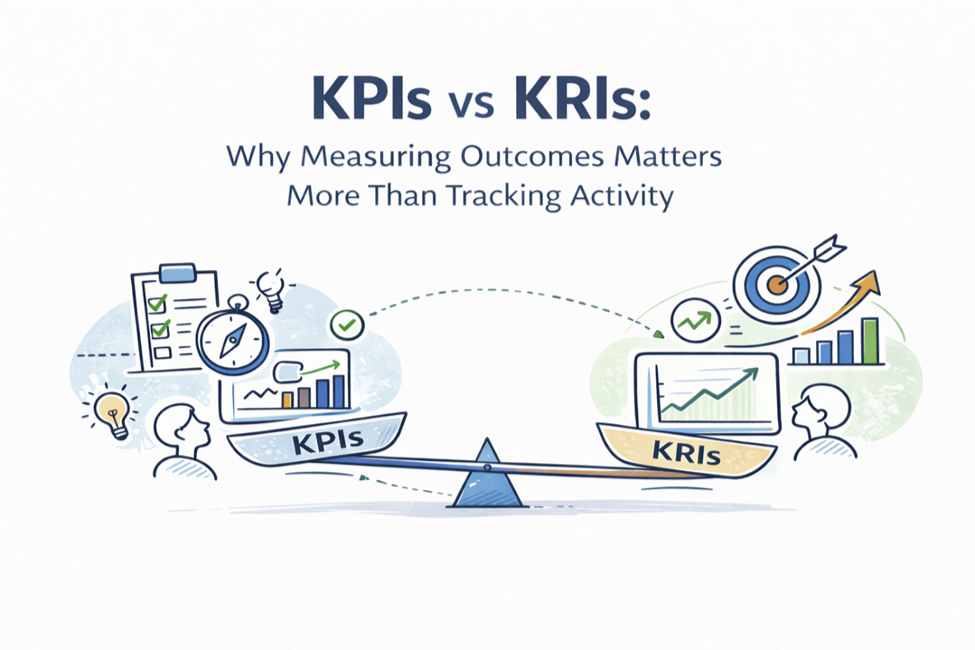
In most enterprises, performance dashboards are filled with activity metrics. Teams proudly report the number of meetings conducted, tasks completed, tickets closed, releases deployed and hours logged. These numbers create an illusion of motion, and motion often gets mistaken for progress. However, when leadership steps back and asks a more uncomfortable question “Are we actually achieving strategic outcomes?” silence begins to replace confidence. This is where the real tension between KPIs and KRIs emerges. KPIs, or Key Performance Indicators, often measure effort and operational throughput. KRIs, or Key Result Indicators, measure outcomes and strategic impact. The difference is not semantic; it is existential for organizations that want predictable execution.
The tragedy is not that companies measure KPIs. The tragedy is that they stop there. They assume that activity inevitably leads to impact. But in volatile, high-velocity environments, activity without alignment leads to strategic drift. When dashboards highlight busyness instead of outcomes, leaders lose visibility into whether execution is creating value or simply consuming resources.
Explore how strategic drift quietly undermines organizations → https://initiatives.app/strategic-drift-real-time-alignment/
Understanding KPIs: Necessary but Not Sufficient
The Operational Comfort of Activity Metrics
KPIs are comfortable because they are measurable, immediate and controllable. Teams can influence them directly. For example, a project team can increase sprint velocity, reduce cycle time or close more tickets within a month. These indicators provide short-term feedback and are critical for operational management. Without KPIs, teams would lack direction and accountability. However, KPIs operate within the boundary of effort. They tell you how efficiently you are running but not whether you are running in the right direction.
The danger begins when KPIs are elevated to strategic indicators. A team may deliver features faster but if those features do not move revenue, customer satisfaction, adoption or risk reduction, the organization has optimized motion without creating momentum. KPIs are necessary for execution discipline, but they are insufficient for strategic assurance.
Learn how execution discipline must connect to strategy → https://initiatives.app/strategy-execution-visibility-enterprise/
Understanding KRIs: Measuring What Actually Changes
Outcomes as the True Currency of Strategy
KRIs measure what truly changes because of execution. They answer whether customer churn reduced, whether digital adoption increased, whether cost leakage declined, or whether risk exposure was mitigated. Unlike KPIs, KRIs are harder to manipulate in the short term because they represent accumulated impact. This is precisely why they matter. When organizations focus on KRIs, they shift attention from effort to effect.
Measuring KRIs requires a mature governance mindset. It demands clarity on strategic intent and alignment between initiatives and desired outcomes. If teams do not know which outcomes they are expected to influence, KRIs remain abstract. But when initiatives are explicitly mapped to results, KRIs become the ultimate validation mechanism. They force leaders to confront whether strategy is working, not merely whether work is happening.
Discover how governance must evolve beyond dashboards → https://initiatives.app/continuous-initiative-governance/
The KPI Trap: When Activity Crowds Out Outcomes
Many organizations unintentionally fall into what can be called the KPI trap. They reward teams for meeting activity thresholds without examining whether those activities move strategic needles. Over time, behavior adapts to measurement. If employees are evaluated on ticket closure rates, they optimize closure rates. If managers are evaluated on utilization, they maximize utilization. But none of these necessarily improve profitability, customer value or innovation velocity.
The KPI trap becomes most dangerous in transformation programs. Digital initiatives often report milestones achieved and deliverables completed. Yet months later, expected business impact fails to materialize. This disconnect exists because the review system focused on activity KPIs rather than outcome KRIs. Without KRIs embedded into governance rituals, transformation becomes theater instead of progress.
Understand why traditional reviews fail without outcome visibility → https://initiatives.app/why-qbrs-fail-continuous-initiative-governance/
Bridging KPIs and KRIs: A Practical Execution Framework
Aligning Effort to Impact Through Structured Initiative Governance
The solution is not to abandon KPIs but to contextualize them. KPIs should feed into KRIs. Every initiative must clearly articulate which KRI it intends to influence. For example, if a customer experience initiative increases response speed (KPI), the expected KRI might be improved Net Promoter Score or reduced churn. This explicit mapping prevents teams from celebrating effort detached from results.
Modern execution platforms enable this alignment by linking initiatives, metrics, ownership, and outcomes in a single governance layer. When leaders review execution, they can see not only what is being done but why it matters. This alignment transforms reviews from operational check-ins into strategic steering sessions.
Explore how initiative-level governance drives measurable outcomes → https://initiatives.app/initiative-governance-framework/
At this point, leaders must ask themselves a difficult question: Are our dashboards telling us what is easy to measure, or what truly matters? If your governance framework still prioritizes activity over impact, it may be time to rethink your measurement architecture.
Reimagine how you measure strategy execution → https://initiatives.app/microsoft-teams-strategy-execution/
Embedding Outcome Thinking Into Leadership Culture
Shifting from KPI obsession to KRI orientation requires cultural change. Leaders must reward impact, not busyness. They must ask outcome-based questions in review meetings: What changed because of this initiative? Which strategic objective moved? Which risk reduced? When these questions become routine, teams begin to think differently. They stop optimizing for output and start optimizing for value.
Outcome-driven governance also improves prioritization. When KRIs are visible and continuously tracked, leaders can redirect resources from low-impact initiatives to high-impact ones. This agility is impossible when visibility stops at activity. In volatile markets, adaptability depends on knowing which efforts produce results and which merely consume capacity.
See how real-time visibility enables smarter prioritization → https://initiatives.app/strategy-execution-visibility-enterprise/
The Executive Imperative: From Measurement to Meaning
For modern CIOs, COOs, and transformation leaders, the KPI vs KRI debate is not academic. It is foundational to enterprise resilience. Organizations that master outcome measurement outperform those that remain activity-driven because they detect misalignment early. They course-correct faster. They invest more intelligently. They eliminate vanity metrics.
Leaders like Vishwas Mahajan consistently emphasize that execution visibility must extend beyond task completion into measurable business impact. Measuring effort is operational hygiene. Measuring outcomes is strategic intelligence. You can explore more insights on governance and execution leadership here: https://www.linkedin.com/in/vishmahajan/
If your organization is serious about moving from activity tracking to outcome assurance, the first step is structural clarity. Define KRIs at the strategy level. Map initiatives to those KRIs. Ensure KPIs support them. Embed both into continuous governance systems. Only then does measurement become meaningful.
Discover how outcome-led execution frameworks transform enterprises → https://initiatives.app/continuous-initiative-governance/
Conclusion: Activity Is Motion, Outcomes Are Direction
KPIs tell you how hard you are working. KRIs tell you whether that work matters. In isolation, KPIs create motion. Combined with KRIs, they create direction. Enterprises that understand this distinction evolve from operational efficiency to strategic effectiveness. They do not celebrate busyness; they celebrate impact.
The future of governance belongs to organizations that measure what changes, not just what moves. If your dashboards are filled with activity but leadership still feels uncertain about strategic progress, the answer is not more KPIs. It is better KRIs, embedded into a governance system that connects effort to impact in real time.
Start aligning initiatives to outcomes today → https://initiatives.app/initiative-governance-framework/
👉 Book a Demo | 🌐 Visit Initiatives.app
📥 Learn more about features, benefits, and use cases at:
👉 www.initiatives.app
Contact Us : info@whizible.com | +91 855-498-3315
Address : Mrugank, Level 3, Kothrud, Pune, Maharashtra, 411038