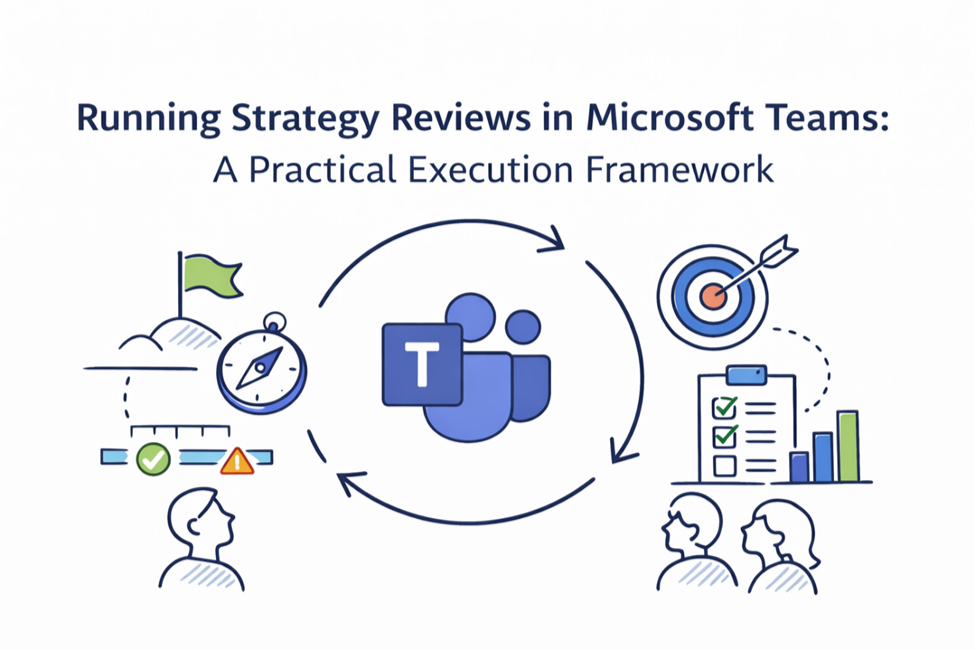
Why Strategy Reviews Fail Long Before the Review Meeting
Most organizations do not fail at strategy because of poor intent or lack of vision. They fail because strategy reviews are treated as calendar events rather than execution mechanisms. In many enterprises, quarterly or monthly strategy reviews become retrospective storytelling sessions where leaders discuss what happened instead of confronting why outcomes are drifting. Slides are prepared outside the system of work, updates are manually compiled, and the discussion rarely connects strategic intent to day-to-day execution happening across teams. This disconnect becomes even more pronounced in hybrid and distributed organizations where Microsoft Teams has become the default collaboration layer, yet strategy reviews still happen outside the flow of work.
👉 If this sounds familiar, it’s time to rethink how strategy reviews are run not as meetings but as execution checkpoints embedded directly inside Microsoft Teams.
Explore how modern organizations are re-architecting execution reviews → https://initiatives.app/microsoft-teams-strategy-execution/
From PowerPoint Reviews to Execution-Native Strategy Governance
Traditional strategy reviews rely heavily on static artifacts slides, spreadsheets and status emails that are already outdated by the time leaders meet. The problem is not the frequency of reviews, but the absence of a live execution system feeding those reviews. When Microsoft Teams became the enterprise nerve center, it unintentionally created a powerful opportunity: strategy reviews could now be run where execution already happens. Instead of pulling data from multiple tools into presentations, leaders can observe real-time progress, dependencies, risks and ownership directly inside Teams channels.
This shift transforms strategy reviews from episodic check-ins into continuous governance rituals. When initiatives, milestones, risks and decisions live inside Teams, reviews stop being backward-looking and start becoming forward-corrective. Strategy discussions move closer to execution reality, allowing leaders to intervene early rather than react late.
👉 This is where execution-native platforms integrated with Teams fundamentally change how leadership reviews work.
See how Teams can evolve from collaboration to execution → https://initiatives.app/teams-as-strategy-hub/
Designing a Practical Strategy Review Framework Inside Microsoft Teams
Establishing Strategy as a Living Execution Object
The first shift required to run effective strategy reviews in Microsoft Teams is treating strategy not as a document but as a living execution object. Strategic priorities must be broken down into clearly defined initiatives with ownership, success criteria, timelines, and dependencies. When these initiatives are tracked directly within Teams, every update, conversation, and decision automatically contributes to strategic visibility. Leaders no longer need to ask for updates; the system continuously tells the story.
This approach eliminates the manual effort of preparing review material and ensures that discussions are grounded in real data. Teams channels become the single place where strategy is discussed, monitored and refined, reducing fragmentation across tools and emails.
👉 Organizations that adopt this model see faster decision cycles and sharper accountability.
Learn how to structure initiatives for continuous visibility → https://initiatives.app/initiative-governance-framework/
Shifting Reviews From Status Reporting to Strategic Signals
Effective strategy reviews are not about listing completed tasks; they are about identifying signals. Signals reveal whether execution is aligned with strategic intent or quietly drifting. Inside Microsoft Teams, this becomes practical when leaders review outcome-oriented metrics, risk indicators and dependency health rather than raw activity counts. Discussions shift from “Are tasks on track?” to “Are we creating the impact we committed to?”
When strategic signals are visible inside Teams, review conversations become shorter but more meaningful. Leaders can focus on trade-offs, prioritization, and course correction instead of spending time understanding basic status. This is where governance matures from oversight to enablement.
👉 Signal-driven reviews dramatically reduce late-stage escalations.
Understand the difference between KPIs and execution signals → https://initiatives.app/kpis-vs-kris-new-language-of-leadership/
Embedding Ownership and Decision Context in Teams Channels
One of the most overlooked aspects of strategy reviews is decision context. Often, decisions are made during review meetings but get lost afterward because the reasoning, assumptions, and follow-ups are not documented in the flow of work. Microsoft Teams solves this problem when initiatives, decisions, and discussions are co-located. Every strategic decision can be tied back to the initiative, the data reviewed and the stakeholders involved.
This creates institutional memory and reduces dependency on individuals. New leaders or reviewers can immediately understand why a decision was made, not just what was decided. Over time, this builds a governance rhythm that is resilient to change and scale.
👉 Execution clarity increases when decisions live where work happens.
See how decision traceability strengthens governance → https://initiatives.app/real-time-governance-model/
Running the Strategy Review: What Leaders Should Actually Review
Reviewing Alignment Instead of Activity
In mature Teams-based strategy reviews, leaders focus less on how busy teams are and more on whether effort is aligned to strategic priorities. Misalignment often shows up as overloaded teams, conflicting timelines, or initiatives competing for the same resources. When execution data is visible inside Teams, these conflicts surface naturally during reviews, allowing leaders to resolve them before they become delivery failures.
This alignment-first approach ensures that strategy reviews actively shape execution rather than passively observe it. Over time, teams begin to self-correct because they know alignment will be reviewed continuously.
👉 Alignment is the leading indicator of strategic success.
Discover how alignment drift silently erodes outcomes → https://initiatives.app/strategic-drift-real-time-alignment/
Reviewing Dependencies, Not Just Deliverables
Most strategic failures do not happen because teams fail to deliver; they happen because dependencies are ignored until it is too late. Effective strategy reviews inside Microsoft Teams make dependencies visible and reviewable. Leaders can see where one initiative is blocked by another, where external dependencies pose risks and where sequencing needs adjustment.
By reviewing dependencies as first-class citizens, strategy reviews become proactive rather than reactive. Teams gain clarity on what truly matters next, not just what was planned earlier.
👉 Dependency visibility is the difference between speed and chaos.
Learn how modern enterprises manage execution dependencies → https://initiatives.app/interlinked-initiatives-dependency-management/
Making Strategy Reviews Continuous, Not Periodic
The real power of running strategy reviews in Microsoft Teams lies in continuity. Instead of waiting for quarterly reviews, leaders can observe execution health continuously and intervene when signals indicate risk or opportunity. This does not mean more meetings; it means better awareness. Strategy reviews become lighter, faster, and more focused because the groundwork is already visible in Teams.
Organizations that adopt continuous strategy reviews report fewer surprises, better cross-functional alignment, and stronger trust between leadership and delivery teams. Strategy stops being an abstract conversation and becomes an operational discipline.
👉 Continuous review is how high-velocity organizations stay aligned.
Explore how continuous governance works in Teams → https://initiatives.app/continuous-initiative-governance/
The Leadership Shift Required for Teams-Based Strategy Reviews
Running effective strategy reviews in Microsoft Teams is not just a tooling change; it requires a leadership mindset shift. Leaders must move from controlling through reports to enabling through visibility. They must trust execution data, ask better questions, and focus on removing friction rather than demanding updates. When this shift happens, Teams becomes more than a collaboration tool, it becomes the system through which strategy is executed and reviewed in real time.
Many modern CIOs and transformation leaders are already adopting this approach, recognizing that strategy cannot live outside the systems where work happens. As leaders like Vishwas Mahajan emphasize, execution visibility is no longer optional, it is foundational to scalable governance and predictable outcomes. You can explore more of these perspectives here: https://www.linkedin.com/in/vishmahajan/
👉 The future of strategy reviews is execution-native, continuous and embedded in Microsoft Teams.
👉 Book a Demo | 🌐 Visit Initiatives.app
📥 Learn more about features, benefits, and use cases at:
👉 www.initiatives.app
Contact Us : info@whizible.com | +91 855-498-3315
Address : Mrugank, Level 3, Kothrud, Pune, Maharashtra, 411038