The Silent Erosion of Strategic Intent
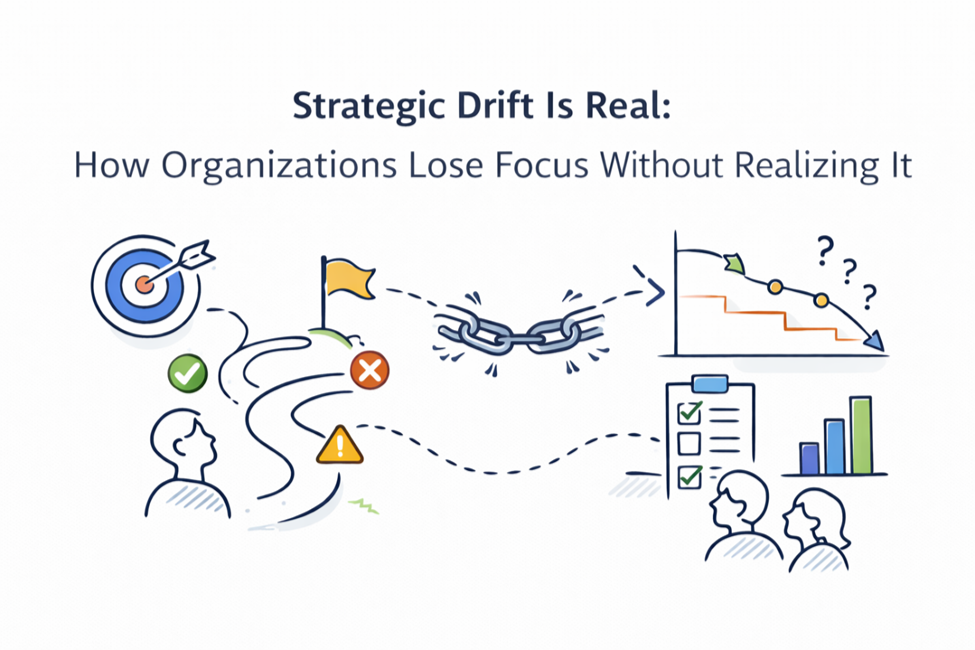
Strategic drift rarely announces itself. It does not appear as a dramatic failure or a visible collapse of direction. Instead, it begins subtly through incremental misalignments, shifting priorities, reactive decisions and disconnected execution conversations that gradually move the organization away from its intended outcomes. Leaders continue to believe they are executing against strategy because meetings are happening, dashboards are being reviewed and initiatives are progressing. Yet beneath the surface, the original strategic intent starts dissolving. Over time, what remains is activity without alignment, motion without momentum and effort without measurable impact. Strategic drift is dangerous precisely because it feels like progress while quietly eroding focus.
https://initiatives.app/strategy-execution-visibility-enterprise/
Why Strategic Drift Happens Even in High-Performing Organizations
Strategic drift is not limited to poorly managed enterprises. In fact, it often occurs in high-performing organizations where teams are empowered, execution is decentralized, and speed is valued. When autonomy increases without structured alignment mechanisms, teams begin optimizing locally rather than strategically. Business units chase urgent priorities, functional leaders protect their own KPIs and transformation initiatives expand scope to accommodate stakeholder demands. Each decision may seem rational in isolation, yet collectively they pull the organization away from its original direction. The result is fragmentation of focus where strategic priorities compete rather than converge.
https://initiatives.app/interlinked-initiatives-dependency-management/
The Illusion of Alignment
One of the primary drivers of strategic drift is the illusion of alignment. Leadership offsites define clear objectives, strategy documents articulate bold ambitions, and town halls reinforce direction. However, unless strategic goals are translated into structured initiatives with visible ownership and measurable outcomes, alignment remains rhetorical rather than operational. Teams continue working hard but their efforts no longer map cleanly to enterprise priorities. Reviews focus on completion rates instead of strategic contribution, and decision-making becomes reactive rather than directional. Alignment must be continuously validated, not assumed.
https://initiatives.app/initiative-governance-framework/
The Hidden Signals of Strategic Drift
Strategic drift manifests through signals that are often misinterpreted as routine operational noise. When initiatives consistently require reprioritization, when dependencies multiply without clarity, when review meetings feel increasingly tactical rather than strategic, drift has already begun. Leaders start spending more time resolving cross-functional friction and less time shaping long-term direction. Escalations increase, yet root causes remain ambiguous. Over time, confidence in execution weakens because outcomes fail to match expectations despite visible effort across teams.
https://initiatives.app/kpis-vs-kris-new-language-of-leadership/
When Reviews Become Retrospective Storytelling
Another clear sign of drift is the transformation of strategy reviews into retrospective storytelling sessions. Instead of asking whether initiatives are still aligned with enterprise priorities, leaders review slides summarizing what was completed. The discussion becomes descriptive rather than corrective. By the time misalignment is recognized, resource commitments and stakeholder expectations make course correction difficult. Strategy reviews must evolve from status reporting to alignment validation. They must surface leading indicators rather than celebrate lagging achievements.
https://initiatives.app/continuous-initiative-governance/
The Cost of Strategic Drift
The cost of strategic drift is rarely captured on financial statements, yet its impact is profound. Investment spreads across too many initiatives without concentrated impact. High-priority programs lose momentum because attention shifts toward short-term demands. Employees experience initiative fatigue as new projects emerge before existing ones demonstrate results. Customers sense inconsistency in strategic direction. Over time, organizational credibility suffers, and transformation efforts stall. Drift does not just delay outcomes; it reshapes the organization into something misaligned with its intended future.
https://initiatives.app/strategy-execution-visibility-enterprise/
Rebuilding Focus Through Continuous Governance
Preventing strategic drift requires more than clearer communication. It requires continuous governance mechanisms embedded within the flow of work. Strategic priorities must be translated into initiatives that are visible, measurable, and continuously reviewed against defined outcomes. Governance should not be an episodic checkpoint but an ongoing discipline where alignment is tested in real time. When initiative progress, dependencies, and risks are visible across the enterprise, drift becomes detectable early, before it compounds.
👉 If you want to understand how real-time governance prevents strategic erosion, explore how modern enterprises embed execution visibility directly into leadership workflows.
https://initiatives.app/real-time-governance-model/
Embedding Strategy Into Execution Systems
The most effective defense against strategic drift is embedding strategy directly into execution systems rather than managing it through disconnected artifacts. When strategic objectives, initiatives, milestones, and decisions live within a unified execution layer, alignment becomes transparent. Leaders no longer rely on manually prepared updates; they observe progress continuously. This visibility allows them to intervene when initiatives begin diverging from intended outcomes. Instead of discovering misalignment during quarterly reviews, they address it during weekly governance rhythms.
👉 Discover how strategy becomes execution-native instead of document-based.
https://initiatives.app/microsoft-teams-strategy-execution/
From Reactive Corrections to Proactive Alignment
Organizations that overcome strategic drift do not eliminate change; they structure it. They accept that priorities will evolve but ensure that every adjustment is measured against enterprise objectives. Proactive alignment requires disciplined review structures, clear ownership definitions, and decision traceability. Leaders must ask whether new initiatives advance core priorities or dilute them. By creating structured review frameworks, enterprises replace reactive corrections with proactive alignment management.
👉 Learn how structured initiative governance restores clarity and focus across business units.
https://initiatives.app/initiative-governance-without-micromanagement/
The Leadership Mindset Required to Prevent Drift
Preventing strategic drift ultimately depends on leadership behavior. Leaders must move beyond celebratory dashboards and interrogate whether activity translates into impact. They must encourage transparency over optimism and clarity over complexity. Drift thrives in environments where difficult questions are postponed. It weakens in cultures where execution data is visible, and strategic conversations are grounded in evidence. Leaders who prioritize visibility, alignment and disciplined review create organizations capable of sustaining focus even amid rapid change.
Thought leaders in execution governance, including Vishwas Mahajan, consistently emphasize that strategic clarity without execution visibility is incomplete. His perspectives on embedding governance within operational systems highlight why drift is not inevitable but manageable when leaders adopt structured review frameworks. You can explore deeper insights here: https://www.linkedin.com/in/vishmahajan/
If You Detect It Early
Strategic drift is not a sudden failure; it is gradual misalignment. Organizations lose focus not because they lack ambition but because they lack continuous visibility into whether their initiatives still serve that ambition. The solution lies in structured execution frameworks that connect strategic intent to operational reality in real time. When alignment becomes observable rather than assumed, leaders can protect focus, preserve momentum, and ensure that transformation efforts compound rather than fragment.
👉 If your organization wants to eliminate strategic drift before it becomes visible in financial results, explore how continuous alignment frameworks can transform governance discipline.
https://initiatives.app/strategy-execution-visibility-enterprise/
👉 Book a Demo | 🌐 Visit Initiatives.app
📥 Learn more about features, benefits, and use cases at:
👉 www.initiatives.app
Contact Us : info@whizible.com | +91 855-498-3315
Address : Mrugank, Level 3, Kothrud, Pune, Maharashtra, 411038