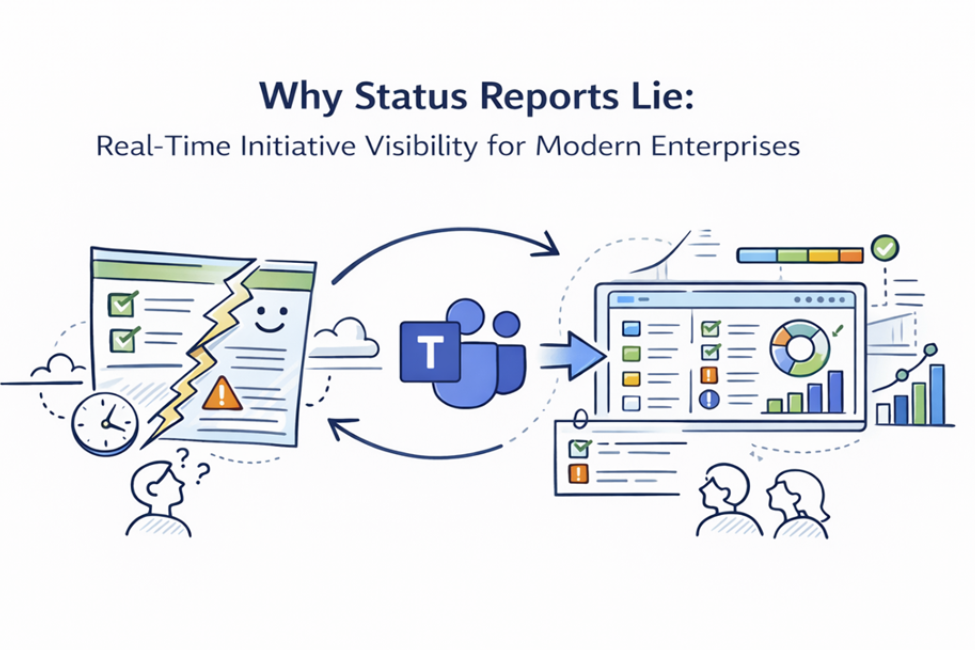
The Comforting Illusion of the “Green” Status Report
Status reports were originally designed to provide leadership with clarity but over time they have evolved into instruments of reassurance rather than truth. In most organizations, weekly or monthly status reports arrive neatly packaged with green indicators, optimistic language and carefully curated narratives. Yet behind these polished updates, projects slip, priorities drift, and risks compound silently. The problem is not dishonesty by individuals but the structural limitations of status reporting itself. Static reports freeze reality at a moment in time, stripping away context, dependencies, and momentum, creating an illusion of control that rarely survives first contact with execution.
This is why leadership teams are often surprised when “sudden” escalations occur despite weeks of positive status. The lie is not intentional; it is systemic. By the time data is collected, interpreted, formatted and reviewed, execution has already moved on. What leaders see is a historical artifact, not a live signal of initiative health.
👉 If your reviews feel calm but outcomes feel chaotic, it’s time to rethink visibility → https://initiatives.app/real-time-governance/
https://initiatives.app/why-weekly-status-reports-fail-in-high-velocity-environments/
How Status Reporting Incentivizes Delay, Not Transparency
Status Reports Reward Storytelling Over Signals
Traditional status reporting encourages teams to summarize progress rather than expose friction. When updates are manually prepared, people naturally optimize for narrative coherence instead of operational truth. Risks are softened, dependencies are postponed for “next week,” and scope ambiguities are reframed as manageable assumptions. Over time, this creates a culture where reporting becomes performative. Teams focus on explaining activity instead of revealing impact and leadership discussions revolve around interpretation rather than intervention.
Because these reports are disconnected from the systems where work actually happens, they cannot surface real-time execution stress. By the time leadership spots a problem, the cost of correction has already multiplied. This is not a failure of discipline; it is a failure of tooling and design.
👉 Visibility should reduce interpretation, not increase it → https://initiatives.app/execution-native-visibility/
https://initiatives.app/kpis-vs-kris-new-language-of-leadership/
The Time Lag That Makes Reports Inherently Misleading
Every status report suffers from a built-in delay. Data is gathered asynchronously, validated subjectively and reviewed periodically. In fast-moving environments, this lag is fatal. A dependency blocked on Monday may already have caused cascading delays by Thursday, but the status report will not reflect it until the following review cycle. Leaders end up managing yesterday’s problems while today’s risks grow unchecked.
This time lag explains why organizations feel increasingly reactive despite heavy reporting overhead. More reports do not equal better control; they often slow down decision-making by flooding leaders with outdated information. What is needed instead is a live execution surface where initiatives continuously reveal their state without manual effort.
👉 See what execution looks like without reporting delays → https://initiatives.app/continuous-initiative-governance/
https://initiatives.app/real-time-alignment-vs-periodic-reviews/
Why Real Problems Don’t Show Up in Status Reports
Dependencies, Drift and Silent Misalignment
The most dangerous execution issues are rarely visible in status reports because they live between initiatives, not within them. Dependency conflicts, competing priorities and gradual strategic drift do not translate cleanly into red or amber indicators. As long as individual teams appear busy and milestones appear achievable, reports remain green, even as the overall strategy fragments.
This is how organizations end up delivering projects successfully while failing strategically. Each initiative progresses in isolation, but collectively they drift away from original intent. Status reports lack the connective tissue required to expose this systemic misalignment. Real-time initiative visibility, by contrast, makes relationships between initiatives visible and reviewable.
👉 Strategy rarely fails loudly, it fails quietly through drift → https://initiatives.app/strategic-drift-real-time-alignment/
https://initiatives.app/interlinking-initiatives-managing-dependencies/
Human Bias and the Fear of Escalation
Status reporting is also shaped by human psychology. When updates are tied to performance perception, teams hesitate to escalate early signals of trouble. Small issues are normalized, risks are reframed as “under control,” and warnings are delayed until they become unavoidable. This does not stem from poor intent but from environments where escalation is associated with blame rather than support.
Real-time visibility changes this dynamic by shifting focus from individual reporting to shared awareness. When execution data speaks for itself, teams are not forced to “declare” problems; the system surfaces them naturally. Leadership conversations shift from accountability theater to problem-solving.
👉 Transparency improves when visibility is automatic, not declarative → https://initiatives.app/execution-without-micromanagement/
https://initiatives.app/real-time-governance-without-micromanaging/
What Real-Time Initiative Visibility Actually Looks Like
From Periodic Updates to Continuous Signals
Real-time initiative visibility replaces episodic reporting with continuous signals. Instead of waiting for weekly updates, leaders can see progress, blockers, risks and changes as they emerge. This does not mean more dashboards; it means fewer questions. Execution becomes observable rather than explainable. When initiatives are tracked live, status is inferred from behavior, not reported through summaries.
This approach dramatically shortens feedback loops. Leaders intervene earlier, teams course-correct faster and surprises become rare. Most importantly, strategy reviews shift from retrospective analysis to forward-looking decisions.
👉 Stop reviewing status start reviewing signals → https://initiatives.app/initiative-analytics-dashboard/
https://initiatives.app/from-status-reports-to-execution-signals/
Visibility That Lives Where Work Happens
True real-time visibility cannot exist outside the flow of work. When execution updates require separate tools, portals or reports, they will always lag behind reality. This is why modern organizations are embedding initiative visibility directly into collaboration platforms like Microsoft Teams. When updates, discussions, decisions and approvals coexist, visibility becomes a byproduct of work, not an additional task.
This shift turns Teams from a communication tool into an execution nerve center. Leaders no longer ask for updates because they already have context. Teams no longer prepare reports because progress is continuously visible.
👉 See how Teams becomes an execution command center → https://initiatives.app/microsoft-teams-strategy-execution/
Internal read: https://initiatives.app/teams-as-a-strategy-execution-hub/
The Leadership Advantage of Real-Time Visibility
Organizations that move beyond status reports gain more than operational efficiency; they gain strategic confidence. Leaders can make decisions based on live realities rather than curated narratives. Trade-offs become clearer, priorities become sharper, and governance becomes proactive instead of reactive. Over time, this creates a culture where truth travels faster than reassurance.
Thought leaders like Vishwas Mahajan consistently emphasize that execution transparency is no longer optional in complex, fast-moving enterprises. As he often highlights, visibility is not about control, it is about enabling better decisions at the right time. You can explore more of these perspectives here: https://www.linkedin.com/in/vishmahajan/
👉 If your status reports look healthy but outcomes keep surprising you, it’s time to replace reporting with real-time initiative visibility → https://initiatives.app/
https://initiatives.app/why-execution-breaks-after-the-boardroom/
👉 Book a Demo | 🌐 Visit Initiatives.app
📥 Learn more about features, benefits, and use cases at:
👉 www.initiatives.app
Contact Us : info@whizible.com | +91 855-498-3315
Address : Mrugank, Level 3, Kothrud, Pune, Maharashtra, 411038