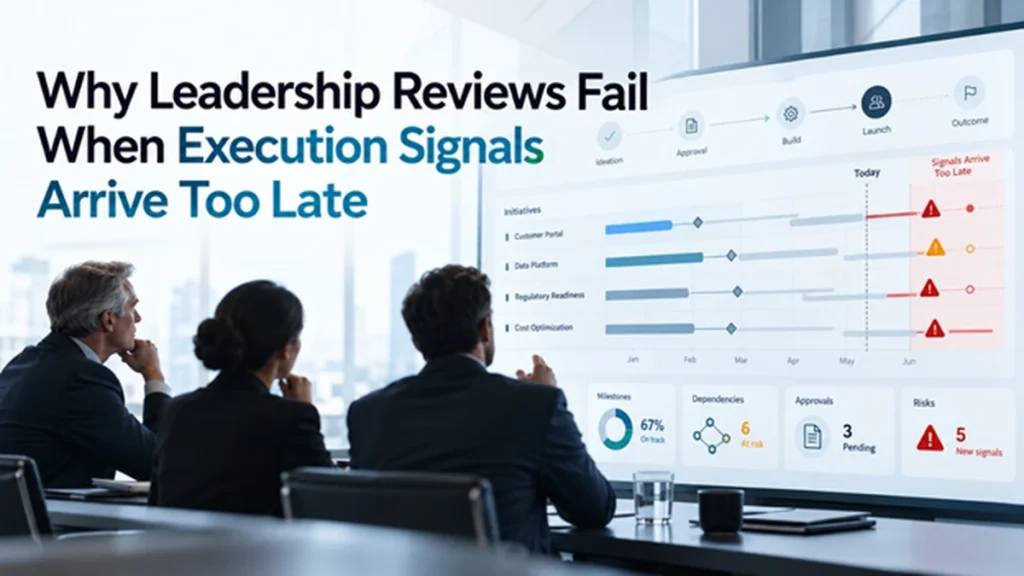
Leadership reviews are meant to bring clarity. They help leaders understand progress, identify risks, remove blockers, and keep strategic initiatives aligned with business outcomes.
But many leadership reviews fail because the signals reaching the room are already delayed.
By the time a risk appears in a review deck, the real issue may have started days or weeks earlier. A decision may have been pending, a dependency may have slipped, or ownership may have become unclear. The review then becomes less about preventing risk and more about explaining what already went wrong.
The Problem: Reviews Depend Too Much on Periodic Updates.
Most leadership reviews rely on weekly, monthly, or quarterly updates. Teams prepare status reports, dashboards, and presentations to summarize what happened.
The issue is that execution does not wait for review cycles.
A blocker may appear today but reach leadership only in the next review. By then, timelines may have shifted, costs may have increased, and teams may have already lost momentum.
The Solution: Create Continuous Execution Visibility
Leadership needs visibility before the review meeting begins. Risks, dependencies, approvals, decisions, and ownership gaps should be visible while execution is still moving.
A continuous governance layer helps leaders see what needs attention early, so reviews become decision forums instead of status collection meetings.
Read more on this in The Governance Gap Between Leadership Decisions and Team Execution.
The Problem: Green Status Can Hide Execution Risk.
Many initiatives look healthy because tasks are marked green. But green status does not always mean execution is under control.
A team may be on track, while another team is waiting for approval. A milestone may look safe, while a key dependency is still unresolved. Leaders may see progress, but not the friction behind it.
This creates a false sense of control.
The Solution: Review Dependencies, Decisions, and Ownership.
Leadership reviews should go beyond task status. They should show what is blocked, who owns the next action, which decision is pending, and which dependency can affect the outcome.
When these signals are visible, leaders get a more accurate picture of initiative health.
For more on this, explore The Dependency Blind Spot.
The Problem: Risks Reach Leaders After Momentum Is Lost.
When leadership receives risk signals late, decision-making becomes reactive.
Teams may spend days trying to manage an issue locally. Leaders then need more time to understand the context. By the time a decision is made, the impact may have already spread across timelines, teams, budgets, or business commitments.
This is how small delays become strategic execution risks.
The Solution: Treat Execution Signals as Early Warnings.
Organizations need early-warning indicators such as delayed approvals, overdue actions, unresolved risks, repeated dependency slippages, and unclear ownership.
When leaders see these signals early, they can intervene faster and with less escalation.
You can also read Why Strategic Initiatives Go Off Track Before Leaders See the Warning Signs.
The Problem: Reviews End with Discussions, Not Trackable Action.
Many review meetings create alignment in the room, but the follow-through happens across emails, chats, spreadsheets, or separate notes.
As a result, decisions get scattered. Owners are unclear. Actions are not tracked properly. The same issues return in the next review.
The Solution: Connect Reviews to Owners and Outcomes.
Every review decision should connect to an owner, action, due date, milestone, dependency, and expected outcome.
This creates a closed loop between leadership decisions and team execution. Leaders no longer need to chase updates manually, and teams know exactly what needs to move next.
Initiatives.app supports this connected governance approach by helping enterprises manage initiatives, risks, decisions, dependencies, and outcomes in one structured flow. You can also explore more governance perspectives from Vishwas Mahajan.
Conclusion
Leadership reviews do not fail because leaders ask the wrong questions. They fail because execution signals reach them too late.
When risks, dependencies, ownership gaps, and decisions become visible only during review cycles, leaders are forced to react. But when execution signals are continuously visible, reviews become sharper, faster, and more useful.
The future of leadership reviews is not more meetings. It is earlier visibility, clearer ownership, and faster decision-making.
CTA:
If your leadership reviews often surface risks after execution has already drifted, explore Initiatives.app to see how continuous initiative governance can help leaders act earlier.
FAQs
- Why do leadership reviews fail?
Leadership reviews fail when risks, delays, ownership gaps, and dependencies become visible too late for leaders to act effectively.
- What are execution signals?
Execution signals are early indicators such as delayed approvals, unresolved risks, pending decisions, missed milestones, and dependency issues.
- Why is green status not enough?
Green status may show task progress, but it may not reveal hidden risks, blocked dependencies, or unclear ownership.
- How can leadership reviews become more effective?
They should focus on live execution signals, decision needs, owners, dependencies, risks, and business outcomes not just status updates.
- How does Initiatives.app help?
Initiatives.app helps organizations connect initiatives, owners, risks, decisions, dependencies, and outcomes so leadership reviews become more proactive and execution-focused.