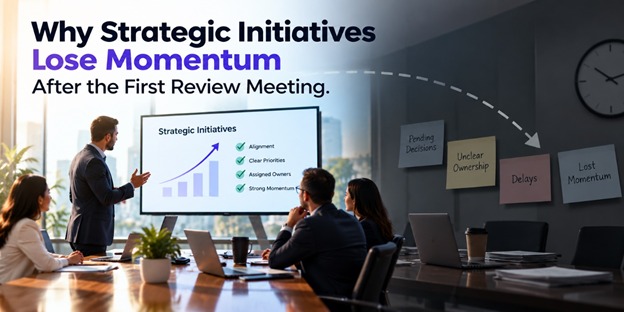
Strategic initiatives often begin with enthusiasm, leadership alignment, and clearly defined objectives. The first review meeting creates confidence as teams present progress, discuss milestones, and establish responsibilities.
However, as weeks pass, momentum begins to decline. Decisions remain pending, accountability becomes unclear, and execution slows.
The real challenge is not planning the strategy but maintaining continuous governance after the first review.
1. Accountability Weakens After Leadership Reviews.
The Problem: Decisions Without Clear Ownership.
During review meetings, leaders assign responsibilities and agree on next steps. However, these commitments often remain scattered across emails, presentations, and spreadsheets. Without structured follow-ups, important decisions lose visibility, delaying execution.
The Solution: Establish Continuous Accountability.
Every strategic decision should have a defined owner, deadline, and measurable outcome. Organizations need a structured governance approach that connects leadership decisions with execution responsibilities.
Initiatives.app helps organizations maintain initiative ownership, approval workflows, and execution accountability within Microsoft Teams.
2. Execution Visibility Disappears Between Meetings.
The Problem: Delayed Reporting Creates Unexpected Risks.
Traditional governance depends heavily on weekly or monthly reviews. Unfortunately, execution challenges emerge daily. Delayed approvals, shifting priorities, and unresolved issues can affect initiative progress long before leadership receives the next status report.
The Solution: Enable Real-Time Execution Visibility.
Organizations must move beyond periodic reporting toward continuous monitoring of initiative progress, risks, and decisions.
Related Reading: The Future of Enterprise Governance: Live Execution Signals
With connected governance, leaders can identify bottlenecks earlier and make informed decisions without waiting for another meeting.
3. Cross-Functional Dependencies Slow Strategic Progress.
The Problem: Teams Work in Silos.
Strategic initiatives frequently involve multiple departments, including IT, finance, operations, and business teams. When one department experiences delays, the entire initiative can suffer. Without connected visibility, these dependencies remain unnoticed until milestones are affected.
The Solution: Connect Teams Through Structured Governance.
Organizations need centralized visibility into dependencies, responsibilities, and execution timelines.
Related Reading: The Dependency Blind Spot: Why One Delayed Team Can Put an Entire Initiative at Risk
Connected governance helps teams recognize dependencies early, coordinate decisions, and prevent small delays from becoming major setbacks.
4. Leadership Reviews Focus on Activities Instead of Outcomes.
The Problem: Progress Reports Replace Strategic Value.
Organizations often measure initiative progress through completed tasks and milestone percentages. However, operational progress does not always translate into business outcomes.
An initiative may appear successful in reports while failing to deliver its intended strategic value.
The Solution: Align Execution with Business Outcomes.
Leadership should continuously evaluate whether initiatives contribute to organizational priorities, expected benefits, and measurable results.
As highlighted through the enterprise leadership perspectives of Dr. Vishwas Mahajan, connecting strategy with execution is essential for improving governance effectiveness.
Related Reading: Why Strategy Execution Fails After Approval: The Missing Layer Between Planning and Outcomes
Conclusion: Strategic Momentum Requires Continuous Governance.
Strategic initiatives should not depend on leadership meetings to maintain progress. Organizations need continuous accountability, connected execution visibility, and timely decision-making to sustain momentum.
Initiatives.app helps bridge the gap between strategic planning and execution through structured governance within Microsoft Teams.
Frequently Asked Questions (FAQs)
Q1. Why do strategic initiatives lose momentum?
Primarily because of unclear accountability, delayed decisions, limited visibility, and unresolved dependencies.
Q2. How can organizations maintain execution momentum?
Through continuous governance, clearly assigned ownership, real-time visibility, and structured decision-making.
Q3. How does Initiatives.app support strategic execution?
It helps organizations manage initiatives, approvals, dependencies, and accountability within Microsoft Teams.
CTA: Keep Your Strategic Initiatives Moving Forward
Don't let execution momentum disappear after the first leadership review.
Explore Initiatives.app to strengthen governance, improve accountability, and turn strategic priorities into measurable business outcomes.
👉 Book a Demo | 🌐 Visit Initiatives.app
📥 Learn more about features, benefits, and use cases at:
👉 www.initiatives.app
Contact Us : info@whizible.com | +91 855-498-3315
Address : Mrugank, Level 3, Kothrud, Pune, Maharashtra, 411038