The Silent Accumulation of Execution Debt
High-growth organizations are often celebrated for their speed, innovation, and ambition. New initiatives launch rapidly, transformation programs multiply and leadership teams continuously announce strategic priorities designed to capture emerging opportunities. Yet beneath this visible momentum, many organizations quietly accumulate something far more dangerous than financial liabilities or operational inefficiencies. They accumulate execution debt.
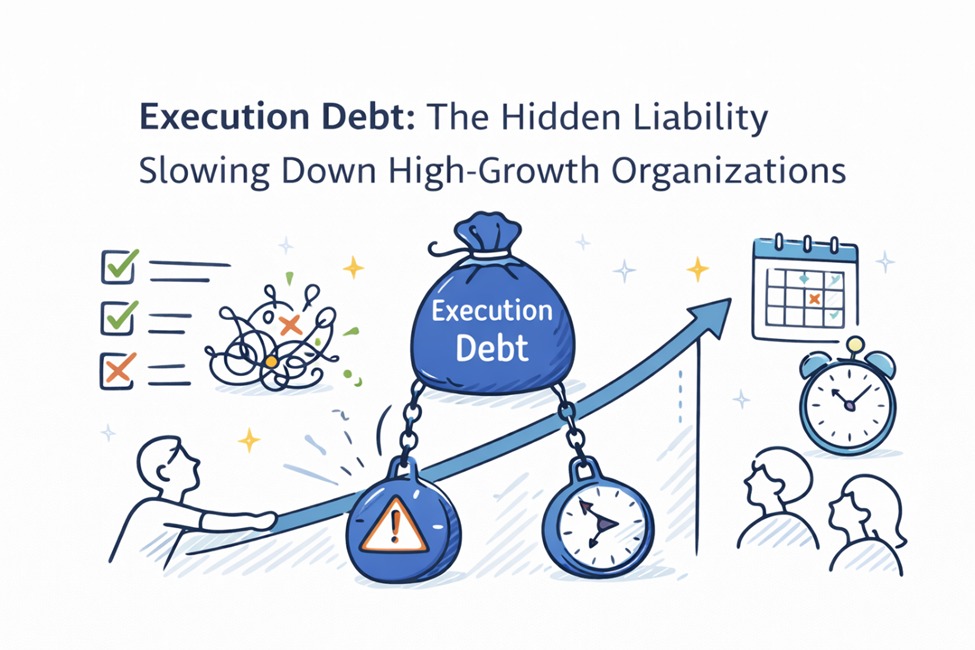
Execution debt is the invisible burden created when initiatives move faster than the organization’s ability to track, govern and align them. Projects overlap without coordination, ownership becomes blurred, and decisions made in leadership meetings fail to translate into real execution outcomes. Over time, this debt compounds silently. Teams become busier but strategic progress slows. Leaders sense that something is wrong, yet traditional dashboards and status reports fail to reveal the real issue.
Understanding execution debt is critical because it behaves much like technical debt in software systems. It starts small, often invisible but gradually becomes a structural constraint that slows the organization’s ability to execute strategy effectively.
Learn more about how execution visibility affects strategic progress:
https://initiatives.app/why-status-reports-lie-and-what-real-time-initiative-visibility-looks-like/
Why Fast-Growing Organizations Are Most Vulnerable
Growth Creates Complexity Faster Than Governance
Ironically, the companies most vulnerable to execution debt are the ones growing the fastest. As organizations expand, the number of initiatives increases dramatically across departments, regions and leadership functions. Digital transformation programs, product launches, operational improvements, regulatory initiatives and technology modernization efforts all run simultaneously. Each initiative may be valuable individually, yet collectively they create an execution environment that becomes difficult to monitor.
In many enterprises, initiatives are tracked in spreadsheets, presentations, or isolated project management tools. Strategy discussions happen in leadership meetings, while execution occurs in separate systems managed by delivery teams. The result is a structural disconnect between strategic intent and operational reality. Leaders believe progress is happening, but they lack a real-time view of how initiatives interact with each other.
Execution debt begins accumulating at the moment visibility disappears.
Explore how organizations close the visibility gap between strategy and execution:
https://initiatives.app/why-qbrs-fail-continuous-initiative-governance/
Fragmented Visibility Across Teams and Initiatives
Another driver of execution debt is fragmented information. In most enterprises, strategic initiatives are discussed in executive meetings, tracked by PMOs, executed by delivery teams, and reported through dashboards built weeks later. Each layer introduces delays and distortions in information.
When leadership finally reviews execution status, the data is already outdated. Risks appear suddenly instead of gradually. Dependencies between initiatives remain hidden until deadlines begin slipping. What leaders see during review meetings is often a filtered narrative rather than a true picture of execution health.
This fragmentation creates a dangerous illusion of control. Teams work harder to prepare updates, yet the organization loses the ability to understand execution in real time.
Understand how organizations are redesigning initiative governance to reduce fragmentation:
https://initiatives.app/kpis-vs-kris-new-language-of-leadership/
The Real Cost of Execution Debt
Strategic Drift Begins Quietly
Execution debt rarely produces immediate failure. Instead, it manifests gradually through strategic drift. Initiatives originally aligned with strategic priorities slowly diverge as teams adapt to operational pressures, shifting timelines or resource constraints. Because visibility is limited, these changes remain unnoticed until leadership realizes that outcomes no longer match expectations.
Strategic drift often appears as missed targets, delayed transformation programs, or initiatives that consume significant resources without producing meaningful results. By the time leaders recognize the problem, the organization may already be deeply invested in execution paths that are difficult to reverse.
This is why modern organizations are shifting toward continuous initiative visibility rather than relying solely on periodic review meetings.
Explore how real-time alignment prevents strategic drift:
https://initiatives.app/gcc-strategic-drift-real-time-alignment/
Leadership Time Gets Consumed by Status Reporting
Execution debt also creates a hidden productivity drain within leadership teams. When visibility is poor, leaders spend significant time requesting updates, preparing review presentations, and reconciling conflicting information from different departments. Meetings become dominated by status clarification rather than strategic decision-making.
Instead of discussing how to accelerate outcomes, leadership teams spend their energy understanding what is actually happening across initiatives. The organization becomes trapped in a cycle where reporting consumes more time than execution improvement.
This phenomenon explains why many strategy reviews feel exhausting yet inconclusive. The discussion never reaches the level of strategic insight needed to drive meaningful change.
Discover how modern organizations replace static reviews with continuous execution visibility.
Eliminating Execution Debt Through Real-Time Governance
Moving From Reporting to Execution Intelligence
The most effective way to eliminate execution debt is to replace fragmented reporting with execution intelligence. Instead of collecting updates from different tools and compiling them into presentations, organizations need a single environment where initiatives, ownership, risks, and progress signals are visible in real time.
When execution intelligence becomes available, leadership discussions shift dramatically. Leaders no longer ask basic status questions. They focus on strategic alignment, prioritization decisions and risk mitigation. Execution conversations become proactive rather than reactive.
Modern initiative governance platforms are designed specifically for this purpose. They bring together strategy discussions, initiative tracking, decision context, and execution signals within a unified system.
👉 Discover how organizations eliminate execution blind spots and manage initiatives continuously
https://initiatives.app/why-qbrs-fail-continuous-initiative-governance/
Connecting Strategy Directly With Execution Systems
Another critical step in reducing execution debt is connecting strategy directly with the systems where work actually happens. In many organizations, strategy lives in presentations while execution happens in collaboration tools like Microsoft Teams. When these environments remain disconnected, visibility gaps persist.
Embedding initiative governance directly into collaboration environments dramatically improves execution transparency. Teams can see strategic priorities in context, leaders can observe progress continuously, and decisions become easier because the data reflects real execution activity.
Organizations adopting this model report faster decision cycles, better cross-team coordination, and fewer late-stage surprises.
👉 Learn how modern organizations run initiative governance inside collaboration environments
https://initiatives.app/continuous-initiative-governance/
The Leadership Imperative: Recognizing Execution Debt Early
Execution debt is rarely visible on financial statements, yet its impact on organizational performance can be profound. Companies that fail to recognize it often struggle with stalled transformation programs, misaligned initiatives and leadership teams overwhelmed by reporting overhead. The organizations that succeed in today’s high-velocity business environment are the ones that treat execution visibility as a strategic capability rather than an operational afterthought.
Forward-thinking leaders are increasingly recognizing that strategy cannot be separated from execution systems. Strategic decisions must live in the same environment where teams collaborate, initiatives progress and governance occurs. When this integration happens, organizations gain the ability to observe execution continuously and correct course before problems escalate.
Leaders such as Vishwas Mahajan frequently emphasize that the next generation of enterprise governance will not depend on more meetings or better presentations, but on real-time execution intelligence embedded directly into daily workflows. You can explore more perspectives on execution governance here:
https://www.linkedin.com/in/vishmahajan/
👉 See how organizations transform fragmented initiative management into a real-time execution system
https://initiatives.app/interlinking-initiatives-managing-dependencies-avoiding-redundancy/
The Future of Strategy Execution
Execution debt is not inevitable. It is the result of outdated governance models struggling to keep up with the speed of modern organizations. As enterprises adopt real-time collaboration environments and integrated initiative management platforms, the ability to observe and govern execution continuously becomes possible.
The future of strategy execution will belong to organizations that replace fragmented updates with continuous visibility, static reviews with dynamic governance, and isolated initiatives with interconnected execution systems. When leaders can see how strategy unfolds across the organization in real time, execution debt disappears—and strategic momentum returns.
Explore how continuous initiative visibility transforms strategy execution:
https://initiatives.app/why-status-reports-lie-and-what-real-time-initiative-visibility-looks-like/
👉 Book a Demo | 🌐 Visit Initiatives.app
📥 Learn more about features, benefits, and use cases at:
👉 www.initiatives.app
Contact Us : info@whizible.com | +91 855-498-3315
Address : Mrugank, Level 3, Kothrud, Pune, Maharashtra, 411038