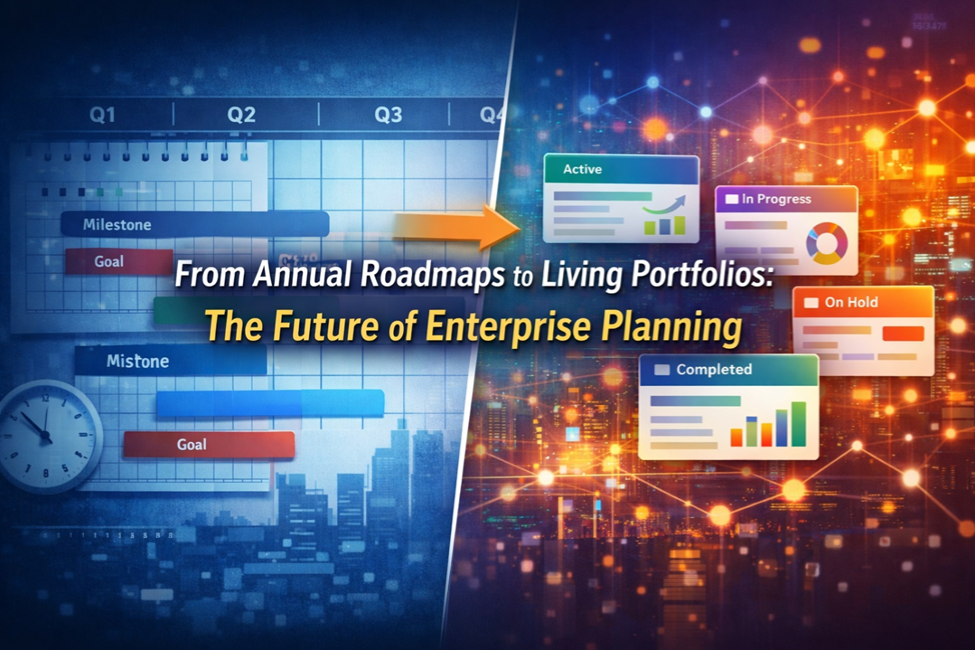
For decades, enterprise planning has followed a familiar ritual. Leadership teams gather once a year, align on strategic priorities, define a roadmap, allocate budgets and cascade plans downstream with the expectation that execution will neatly follow intention. Yet in today’s volatile, interconnected and fast-moving business environment, this model is increasingly disconnected from reality. Markets shift mid-quarter, regulatory mandates emerge overnight, customer expectations evolve continuously, and technology dependencies grow more complex by the day. Annual roadmaps, once considered strategic anchors, now often become static artifacts that fail to reflect what is actually happening on the ground. Organizations that continue to plan in rigid annual cycles find themselves reacting too late, reallocating resources inefficiently, and struggling to maintain strategic coherence across teams.
If your enterprise roadmap feels outdated within months of approval, explore how continuous initiative visibility can reshape planning at scale with Initiatives.app. https://initiatives.app/blog/why-strategy-execution-breaks-down
Why Annual Roadmaps Are Failing Modern Enterprises
The fundamental flaw in annual planning is not poor intent but structural rigidity. Annual roadmaps assume a predictable environment, stable priorities, and linear execution, none of which exist in modern enterprises. As initiatives multiply across departments, dependencies increase between technology, operations, compliance and customer experience. What begins as a clean plan soon fragments into disconnected project updates, spreadsheets, slide decks, and status emails.
Leadership loses real-time visibility, teams lose clarity on priorities, and decision-making becomes reactive rather than proactive. The result is strategic drift where organizations believe they are executing strategy while, in reality, they are merely managing activity.
Learn how leading organizations are preventing strategic drift by shifting from static plans to dynamic execution visibility using Initiatives.app.
https://initiatives.app/gcc-strategic-drift-real-time-alignment
The Illusion of Control in Static Planning
Annual roadmaps create an illusion of control because they offer certainty on paper, not in practice. They lock assumptions too early, leaving little room for course correction when conditions change. When teams inevitably request changes new initiatives, scope adjustments, reprioritization these changes are managed informally, often outside the original plan. Over time, the roadmap becomes irrelevant, yet leadership continues to reference it as a source of truth.
This disconnect between planned strategy and actual execution erodes trust in planning itself. Enterprises don’t fail because they lack strategy; they fail because they lack mechanisms to continuously align strategy with execution.
https://initiatives.app/blog/bridging-strategy-and-execution
The Shift Toward Living Portfolios
Forward-looking enterprises are moving away from fixed roadmaps toward living portfolios dynamic collections of initiatives that evolve in real time. A living portfolio reflects not just what was planned, but what is currently active, blocked, delayed, accelerated, or deprioritized. It recognizes that strategy is not a one-time decision but an ongoing conversation between intent and reality. In this model, initiatives are continuously evaluated based on value, risk, dependency and alignment to strategic objectives. This allows leadership to make informed trade-offs without waiting for quarterly or annual review cycles.
See how enterprises are managing living portfolios directly inside Microsoft Teams using Initiatives.app.
https://initiatives.app/blog/microsoft-teams-strategy-execution-hub
From Project Lists to Strategic Signals
Living portfolios transform initiatives from isolated projects into strategic signals. Each initiative communicates something important—where resources are being consumed, where bottlenecks are forming, and where strategic bets are paying off or failing fast. Instead of asking teams for updates, leaders can observe execution patterns directly and intervene early. This shift fundamentally changes governance from oversight to insight. Decisions are no longer based on lagging reports but on real-time execution intelligence.
https://initiatives.app/blog/real-time-governance-without-micromanagement
Enterprise Planning as a Continuous System
Rethinking enterprise planning requires treating it as a system rather than an event. Continuous planning integrates ideation, prioritization, funding, execution, and review into a single flow. Ideas don’t wait for the next planning cycle; they are evaluated in context of existing commitments. Resources are reallocated based on evolving priorities rather than sunk costs. This approach demands transparency across initiatives, teams, and outcomes something traditional tools were never designed to support.
Discover how continuous planning becomes operational when initiatives, dependencies, and decisions live in one execution system with Initiatives.app.
https://initiatives.app/blog/from-ideas-to-outcomes
The Role of Leadership in Living Portfolios
Leadership behavior must evolve alongside planning models. In a living portfolio environment, leaders shift from approving plans to enabling flow. Their focus moves toward removing systemic constraints, resolving cross-functional conflicts, and reinforcing strategic intent through ongoing prioritization. This requires a mindset change from asking “Are we on plan?” to asking “Are we investing in the right outcomes right now?” Leaders who embrace this shift create organizations that adapt faster without losing strategic direction.
https://www.linkedin.com/in/vishmahajan/
https://initiatives.app/blog/cio-guide-prioritizing-digital-initiatives
Technology as the Enabler, Not the Driver
While technology plays a critical role in enabling living portfolios, tools alone are not the solution. What matters is how technology embeds planning into daily execution. Platforms that operate outside the flow of work struggle with adoption and accuracy. Modern enterprises need planning systems that live where teams already collaborate, discuss, and decide. When initiatives are visible within daily workflows, planning becomes continuous by design rather than enforced by process.
https://initiatives.app/blog/aligning-strategy-and-execution-without-platform-hopping
Planning Inside the Flow of Work
Embedding planning inside collaboration tools changes behavior. Discussions around scope changes, dependencies or risks happen in context, not in after-the-fact reviews. Decisions are documented implicitly through action rather than explicitly through reports. Over time, this creates a living institutional memory of why certain trade-offs were made, which is invaluable for governance and learning.
Explore how embedding initiative governance inside Teams changes execution outcomes with Initiatives.app.
https://initiatives.app/blog/initiative-governance-best-practices
Measuring Success in a Living Portfolio Model
Success in a living portfolio model is not measured by adherence to an original plan but by responsiveness and outcomes. Metrics evolve from milestone completion to value realization, risk reduction and strategic alignment.
Enterprises begin to ask better questions: Which initiatives are driving outcomes? Where are we over-invested? What should we stop doing? This level of clarity is impossible without a unified view of execution across the enterprise.
https://initiatives.app/blog/kpis-vs-kris-new-language-of-leadership
From Predictability to Resilience
The goal of modern enterprise planning is no longer predictability alone but resilience. Living portfolios enable organizations to absorb shocks, pivot intelligently, and sustain momentum even in uncertain conditions. Instead of being surprised by execution realities, leaders stay continuously informed and ready to act. This is the difference between organizations that merely survive change and those that turn change into a competitive advantage.
If resilience is a priority for your enterprise, see how living portfolios are built in practice using Initiatives.app.
https://initiatives.app/blog/why-digital-initiatives-fail-and-how-to-fix-them
Conclusion: Planning That Moves at the Speed of Reality
The shift from annual roadmaps to living portfolios represents a fundamental rethinking of enterprise planning. It acknowledges that strategy is dynamic, execution is complex, and visibility is non-negotiable. Organizations that embrace this shift gain more than flexibility they gain strategic coherence in motion. As enterprises continue to navigate uncertainty, the ability to plan continuously, govern intelligently and execute transparently will define the next generation of high-performing organizations.
Start your journey from static plans to living portfolios by exploring how Initiatives.app enables continuous enterprise planning inside the flow of work.
https://initiatives.app
👉 Book a Demo | 🌐 Visit Initiatives.app
📥 Learn more about features, benefits, and use cases at:
👉 www.initiatives.app
Contact Us : info@whizible.com | +91 855-498-3315
Address : Mrugank, Level 3, Kothrud, Pune, Maharashtra, 411038