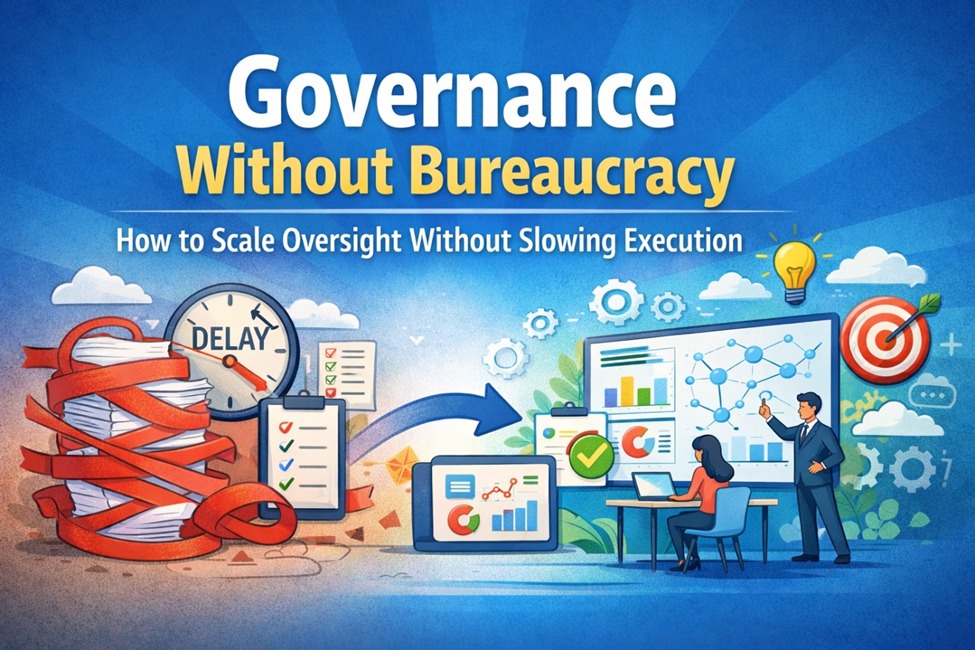
As organizations scale, governance becomes unavoidable but so does friction. What begins as a mechanism for control, compliance and alignment often evolves into a system of approvals, checkpoints, and reporting layers that slow down execution instead of enabling it. Leadership teams find themselves caught in a paradox: the more they try to control execution, the more they inadvertently delay it.
The real challenge is not governance itself, is the way governance is implemented. Traditional governance models were built for predictability, not speed. They assume stable environments, linear execution and limited complexity. But modern enterprises operate in dynamic ecosystems where priorities shift weekly, dependencies evolve continuously and execution needs to adapt in real time.
This is where the concept of governance without bureaucracy becomes critical. The goal is no longer to enforce control through layers but to enable oversight through visibility. It is about replacing friction with intelligence and replacing process-heavy control with real-time alignment.
The Hidden Cost of Traditional Governance Models
When Control Turns Into Constraint
In many organizations, governance manifests as review cycles, approval chains, status meetings, and documentation requirements. While each of these elements serves a purpose, collectively they create an execution drag that is rarely measured but deeply felt. Teams spend more time preparing updates than making progress. Leaders receive reports that are already outdated. Decisions are delayed because the information needed to make them is fragmented or incomplete.
This creates a dangerous illusion of control. On paper, everything appears governed there are reports, dashboards and meetings. But in reality, execution is drifting. Risks are identified late, dependencies are missed and corrective actions come after the damage is already done.
The core problem is that traditional governance relies on lagging indicators. It tells you what has already happened, not what is happening right now.
The Execution Governance Disconnect
Another critical issue is the disconnect between governance layers and execution layers. Governance typically sits above execution, disconnected from the systems where actual work happens. This results in multiple versions of truth one in project tools, another in spreadsheets and yet another in executive dashboards.
This fragmentation forces teams to manually consolidate data, increasing errors and reducing trust in the numbers. As a result, governance becomes reactive rather than proactive.
Why Scaling Organizations Struggle the Most
High-growth organizations face an amplified version of this problem. As the number of initiatives increases, so does the complexity of managing them. Dependencies multiply, cross-functional coordination becomes harder and the margin for error shrinks.
To cope with this complexity, organizations often add more governance layers more approvals, more reporting, more oversight structures. But instead of solving the problem, this approach compounds it. Execution slows down, decision-making becomes bottlenecked and teams lose autonomy.
The irony is that governance, which is meant to enable scale, ends up becoming the very thing that prevents it.
Rethinking Governance: From Control to Continuous Visibility
The Shift from Periodic Reviews to Real-Time Insight
The first step toward governance without bureaucracy is shifting from periodic reviews to continuous visibility. Instead of relying on weekly or monthly updates, organizations need systems that provide real-time insights into execution.
When leaders can see progress, risks, dependencies, and performance as they happen, the need for heavy reporting structures diminishes. Decisions can be made faster, interventions can happen earlier and execution can remain uninterrupted.
This is the foundation of modern governance visibility over reporting.
👉 Explore how real-time execution visibility transforms governance: https://initiatives.app/execution-intelligence-vs-traditional-pmo-models/
👉 Learn more from industry perspectives: https://www.linkedin.com/in/vishmahajan/
Embedding Governance Into Execution Workflows
Traditional governance operates outside execution. Modern governance is embedded within it. This means governance is no longer a separate activity, it becomes a natural outcome of how work is tracked and managed.
When tasks, timelines, dependencies, and outcomes are captured within a unified system, governance happens automatically. There is no need for separate reporting cycles because the system itself becomes the source of truth.
This eliminates duplication, reduces manual effort and ensures that governance is always aligned with reality.
👉 Discover how embedded governance eliminates reporting overhead: https://initiatives.app/why-qbrs-fail-continuous-initiative-governance/
👉 Broader leadership insights here: https://www.linkedin.com/in/vishmahajan/
The Pillars of Governance Without Bureaucracy
1. Single Version of Truth
One of the biggest enablers of frictionless governance is a unified data model. When all execution data projects, initiatives, tasks, risks and outcomes exists in a single system, the need for reconciliation disappears.
This ensures that every stakeholder, from execution teams to CXOs, is working with the same information. It eliminates confusion, builds trust and accelerates decision-making.
👉 Read more on unified execution visibility: https://initiatives.app/kpis-vs-kris-new-language-of-leadership/
👉 External perspective: https://www.linkedin.com/in/vishmahajan/
2. Outcome-Driven Governance Instead of Activity Tracking
Traditional governance focuses on activities tasks completed, hours logged, milestones achieved. But modern organizations need to focus on outcomes business impact, value delivered, strategic alignment.
By shifting the focus from activity to outcomes, governance becomes more meaningful and less intrusive. Teams are not micromanaged; they are guided toward results.
👉 Explore outcome-based governance frameworks: https://initiatives.app/kpis-vs-kris-why-measuring-outcomes-matters-more-than-tracking-activity/
👉 Leadership insights: https://www.linkedin.com/in/vishmahajan/
3. Exception-Based Intervention
In a well-governed system, leaders do not need to monitor everything they only need to focus on exceptions. This means identifying deviations from plan, emerging risks or critical dependencies that require attention.
By automating the identification of these exceptions, organizations can reduce unnecessary oversight while ensuring that critical issues are addressed promptly.
👉 Learn how continuous governance replaces periodic reviews: https://initiatives.app/gcc-strategic-drift-real-time-alignment/
👉 External reading: https://www.linkedin.com/in/vishmahajan/
4. Real-Time Alignment Across Teams
Alignment is not a one-time activity, it is an ongoing process. As priorities change, governance systems must ensure that all teams remain aligned with the latest strategy.
Real-time alignment ensures that execution stays connected to strategic objectives, even as conditions evolve.
👉 Understand alignment in dynamic environments: https://initiatives.app/why-qbrs-fail-continuous-initiative-governance/
👉 External insight: https://www.linkedin.com/in/vishmahajan/
The Role of Technology in Enabling Frictionless Governance
Governance without bureaucracy is not just a mindset shift, it is a technological shift. Legacy tools were not designed for real-time, integrated execution. They require manual inputs, fragmented data flows and periodic consolidation.
Modern platforms like Initiatives.app redefine governance by embedding it directly into execution environments like Microsoft Teams. This ensures that governance is not an external layer but an intrinsic part of how work happens.
With real-time dashboards, automated tracking, and unified data models, leaders gain continuous visibility without disrupting teams. Governance becomes invisible yet powerful.
👉 See how modern platforms enable execution intelligence: https://initiatives.app/execution-intelligence-vs-traditional-pmo-models/
👉 External leadership perspective: https://www.linkedin.com/in/vishmahajan/
Breaking the Trade-Off Between Speed and Control
For years, organizations have believed that speed and control are mutually exclusive. Faster execution meant less oversight, and stronger governance meant slower delivery.
But this trade-off no longer holds true. With the right systems and approaches, organizations can achieve both speed and control simultaneously.
The key lies in shifting from process-driven governance to intelligence-driven governance. Instead of enforcing rules, organizations enable visibility. Instead of controlling actions, they guide outcomes.
From Governance to Governance Intelligence
The future of governance is not about adding more layers, it is about making governance smarter. This is where governance intelligence comes into play.
Governance intelligence combines real-time data, contextual insights, and automated alerts to create a system that is both proactive and adaptive. It allows organizations to anticipate risks, respond to changes, and maintain alignment without slowing down execution.
👉 Dive deeper into governance intelligence: https://initiatives.app/execution-intelligence-vs-traditional-pmo-models/
👉 External viewpoint: https://www.linkedin.com/in/vishmahajan/
Conclusion: Scaling Without Slowing Down
Governance is not the enemy of execution bureaucracy is. The challenge for modern organizations is not to reduce governance, but to redefine it.
By embracing real-time visibility, embedding governance into workflows and focusing on outcomes rather than activities, organizations can scale oversight without creating friction.
The organizations that succeed will be those that move beyond traditional models and adopt a new paradigm governance without bureaucracy, powered by execution intelligence.
Ready to Transform Governance Without Slowing Execution?
If your organization is struggling with fragmented visibility, delayed decisions, or governance overhead, it’s time to rethink your approach.
👉 Explore how Initiatives.app enables real-time governance: https://initiatives.app
👉 Or connect for a deeper perspective: https://www.linkedin.com/in/vishmahajan/
👉 Book a Demo | 🌐 Visit Initiatives.app
📥 Learn more about features, benefits, and use cases at:
👉 www.initiatives.app
Contact Us : info@whizible.com | +91 855-498-3315
Address : Mrugank, Level 3, Kothrud, Pune, Maharashtra, 411038