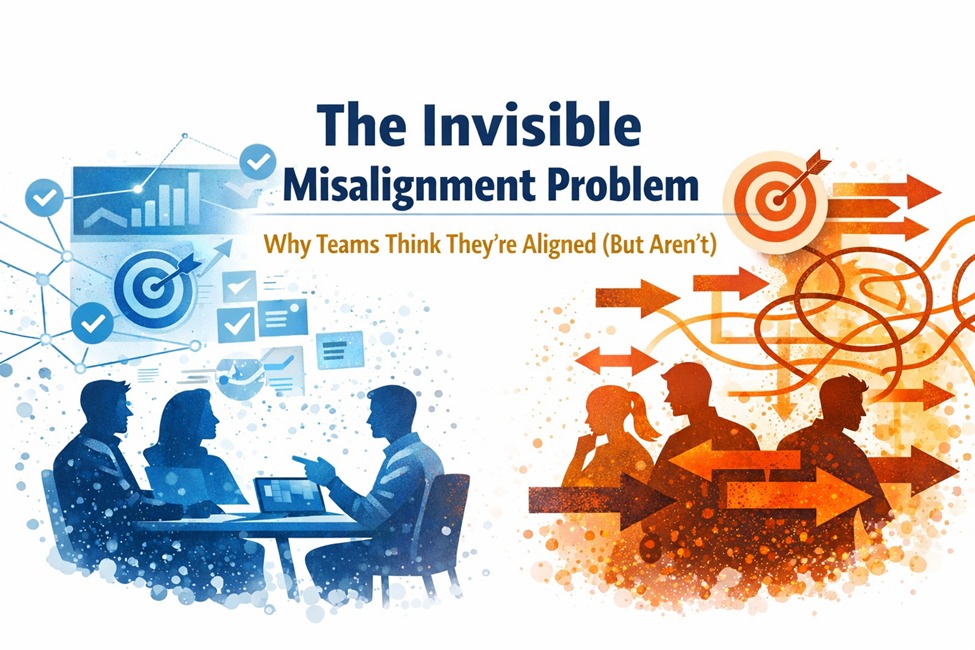
In most organizations, leaders rarely question whether teams are aligned. Strategy presentations are delivered, OKRs are circulated, leadership meetings conclude with consensus and everyone walks away believing the organization is moving in the same direction. Yet months later, outcomes reveal a different reality. Projects drift away from priorities, teams pursue overlapping initiatives, budgets get consumed without strategic impact and executives struggle to understand why progress feels slower than expected.
This is the Invisible Misalignment Problem a condition where organizations believe they are aligned while operational behavior tells a different story. Unlike obvious execution failures, invisible misalignment is subtle and systemic. It hides behind polished dashboards, well-written strategy documents, and well-intentioned teams. Because everyone assumes alignment exists, the root cause often goes unnoticed until it begins to impact performance, delivery timelines and leadership confidence.
Modern enterprises increasingly recognize that alignment is not a communication problem, it is an execution infrastructure problem. Without continuous visibility into initiatives, ownership, and outcomes, organizations cannot ensure that strategy and day-to-day work remain connected. Understanding why invisible misalignment occurs and how to fix it has become one of the most important leadership challenges of the modern digital enterprise.
The Illusion of Alignment in Modern Organizations
Why Alignment Often Looks Better Than It Actually Is
Many organizations measure alignment based on meetings, documents and leadership communication rather than actual execution behavior. Strategy decks are presented during quarterly reviews, objectives are shared through email or internal portals, and leadership assumes that everyone has internalized the same priorities. In reality, alignment begins to fragment the moment teams translate strategy into operational work.
Different departments interpret strategic priorities differently. A product team may view growth as launching new features, while a sales team interprets growth as expanding markets. Meanwhile, operations might prioritize cost optimizatio and technology teams may focus on infrastructure modernization. None of these interpretations are wrong, but without a unified execution framework, they gradually diverge.
This divergence creates an illusion of alignment a situation where teams believe they are contributing to the same strategy but are actually moving in slightly different directions. Over time, these small deviations compound into significant strategic drift.
Solution: Establish Real-Time Initiative Visibility
Organizations can eliminate this illusion by creating a single execution layer where strategic initiatives, ownership, and progress are visible across the organization. When leaders and teams can see how initiatives connect to strategic goals in real time, alignment shifts from assumption to evidence.
Platforms designed for initiative governance enable organizations to continuously track how initiatives support strategic outcomes rather than relying on periodic reviews.
https://initiatives.app/running-strategy-reviews-in-microsoft-teams-a-practical-execution-framework/
https://www.linkedin.com/in/vishmahajan/
Why Misalignment Happens Even in Well-Managed Organizations
Strategy Communication Does Not Equal Strategic Clarity
Most leaders assume that if a strategy is communicated clearly, alignment will naturally follow. However, communication alone does not ensure consistent interpretation. Once strategic objectives reach different departments, they are filtered through departmental goals, resource constraints and local decision-making.
For example, a strategy focused on “customer experience improvement” may lead one team to prioritize customer support automation while another invests in analytics dashboards. Both actions appear aligned with the strategy, but they may not contribute equally to the intended outcome.
The result is fragmented execution, where every team is busy but the organization struggles to produce coherent strategic progress.
Solution: Translate Strategy Into Executable Initiatives
Organizations must move beyond high-level strategic goals and translate them into clearly defined initiatives with ownership, timelines and measurable outcomes. When strategy becomes operationalized through initiatives rather than abstract objectives, teams gain clarity on how their work contributes to larger outcomes.
This transformation from strategic intent to executable initiatives creates a shared understanding across departments.
https://initiatives.app/kpis-vs-kris-why-measuring-outcomes-matters-more-than-tracking-activity/
https://www.linkedin.com/in/vishmahajan/
The Hidden Impact of Misalignment on Execution
The Cost Organizations Rarely Measure
Invisible misalignment does not usually show up as a single failure. Instead, it manifests through small inefficiencies that accumulate across the organization. Duplicate initiatives appear in different departments. Teams unknowingly pursue competing priorities. Projects continue long after their strategic relevance has faded.
The most damaging consequence is that leadership loses the ability to see how strategy translates into action. Without a clear view of initiative progress and dependencies, decision-making becomes reactive rather than proactive.
Over time, the organization becomes trapped in a cycle of activity without impact. Teams remain busy, yet leadership struggles to connect operational work with strategic outcomes.
Solution: Introduce Initiative Governance
The antidote to invisible misalignment is initiative governance a structured framework that ensures initiatives remain connected to strategic priorities throughout their lifecycle.
Initiative governance provides visibility into which initiatives exist, who owns them, how they contribute to strategic objectives, and whether they are progressing as expected. By managing initiatives rather than isolated projects, organizations can ensure that operational activity consistently aligns with strategic direction.
https://initiatives.app/why-qbrs-fail-continuous-initiative-governance/
https://www.linkedin.com/in/vishmahajan/
Why Quarterly Reviews Fail to Fix Alignment
Alignment Cannot Be a Quarterly Exercise
Many organizations rely on quarterly business reviews (QBRs) to assess strategic progress. While these reviews are useful for reflection, they are insufficient for maintaining alignment in fast-moving environments.
Between quarterly reviews, dozens of operational decisions are made. Teams adjust priorities, projects evolve and market conditions change. By the time leadership reviews progress, misalignment may have already accumulated across multiple initiatives.
Quarterly reviews therefore become diagnostic exercises rather than alignment mechanisms.
Solution: Move From Periodic Reviews to Continuous Alignment
Modern organizations require a system where strategic initiatives are monitored continuously rather than quarterly. Continuous alignment enables leadership to identify drift early and correct it before it escalates into strategic failure.
Platforms that integrate initiative tracking directly into collaboration environments such as Microsoft Teams allow leaders to maintain visibility without disrupting daily workflows.
https://initiatives.app/gcc-strategic-drift-real-time-alignment/
https://www.linkedin.com/in/vishmahajan/
The Role of Leadership in Preventing Misalignment
Alignment Is a Leadership System, Not a Leadership Message
Leaders often attempt to solve misalignment through increased communication—more meetings, more updates, more strategy presentations. While communication is important, it cannot replace a structured system for strategic execution.
Alignment must be embedded into the organization’s operating model, ensuring that every initiative, decision and resource allocation connects back to strategic priorities.
Without such a system, leaders are forced to rely on fragmented reports and manual updates, making it difficult to understand whether the organization is truly aligned.
Solution: Build an Execution Infrastructure
To eliminate invisible misalignment, organizations must build an execution infrastructure that connects strategy, initiatives, ownership, and outcomes. This infrastructure ensures that alignment is maintained automatically rather than through manual oversight.
When strategic initiatives are tracked through a centralized platform, leaders gain the ability to see alignment across departments, identify risks early, and ensure that organizational energy remains focused on the most important priorities.
https://initiatives.app/kpis-vs-kris-new-language-of-leadership/
https://www.linkedin.com/in/vishmahajan/
The Future of Strategic Alignment
From Static Strategy to Dynamic Execution
The pace of modern business demands a new approach to alignment. Strategy can no longer be treated as a static document that is revisited quarterly. Instead, strategy must become a dynamic execution process that evolves alongside market conditions and organizational priorities.
Organizations that succeed in maintaining alignment will be those that integrate strategic oversight directly into daily operations. By doing so, they transform alignment from a periodic conversation into a continuous organizational capability.
This shift allows leaders to move from reactive firefighting to proactive execution management.
Solution: Adopt a Strategy Execution Platform
A strategy execution platform enables organizations to connect strategic objectives, initiatives, and operational work within a unified framework. Such platforms provide visibility into initiative progress, highlight dependencies, and allow leadership to ensure that teams remain aligned with evolving priorities.
By embedding execution intelligence directly into collaboration workflows, organizations can ensure that alignment is maintained without creating additional administrative overhead.
https://www.linkedin.com/in/vishmahajan/
Conclusion: Alignment Must Be Designed, Not Assumed
The invisible misalignment problem is one of the most underestimated challenges in modern organizations. Because teams appear busy and engaged, leaders often assume that alignment exists. Yet without structured visibility into initiatives and outcomes, even the most capable organizations can drift away from their strategic priorities.
True alignment requires more than communication, it requires execution infrastructure. When organizations adopt systems that connect strategy to initiatives and initiatives to outcomes, alignment becomes measurable, visible and sustainable.
As enterprises continue to grow more complex, the ability to maintain real-time strategic alignment will become a defining leadership capability. Organizations that solve the invisible misalignment problem will not only execute faster but will also transform strategy from a periodic conversation into a continuous competitive advantage.
👉 Book a Demo | 🌐 Visit Initiatives.app
📥 Learn more about features, benefits, and use cases at:
👉 www.initiatives.app
Contact Us : info@whizible.com | +91 855-498-3315
Address : Mrugank, Level 3, Kothrud, Pune, Maharashtra, 411038