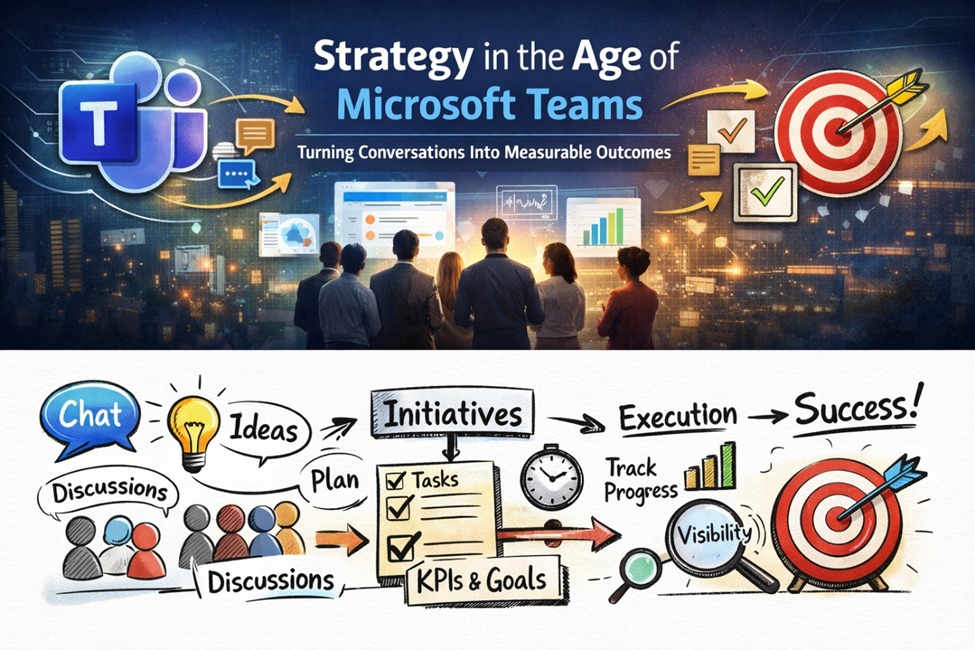
In today’s enterprise environment, strategy is no longer confined to boardrooms, presentations or quarterly reviews. It lives inside conversations messages exchanged in Microsoft Teams, discussions across channels, spontaneous decisions in meetings and quick approvals buried inside chat threads. While collaboration has accelerated decision-making, it has also introduced a silent but critical challenge: strategy is increasingly becoming fragmented, undocumented and disconnected from execution.
Organizations believe they are moving faster because conversations are happening in real time. But speed without structure often leads to dilution of intent. Strategic ideas are discussed, refined and even agreed upon but rarely translated into trackable initiatives with measurable outcomes. What remains is a digital trail of conversations with no accountability, no ownership and no clear impact on business results.
This is the paradox of modern collaboration. Microsoft Teams has become the operating system of enterprise communication but not yet the operating system of strategy execution.
The Problem Conversations Are Not Execution
When Strategy Gets Lost in Chats
Every organization today is rich in conversations but poor in conversion. Teams channels are filled with discussions about priorities, risks, customer escalations and new ideas. Leaders assume that because something was discussed, it is being executed. But in reality, most of these discussions never move beyond the chat window.
The core issue is simple: conversations are not structured. They lack transformation into defined initiatives, tasks, timelines, and measurable KPIs. Without this transformation, strategy remains abstract.
This creates a dangerous illusion of progress. Everyone feels aligned because everyone was part of the conversation but no one is accountable for the outcome.
The Visibility Gap Between Discussion and Delivery
Another major challenge is the absence of visibility. Once a conversation happens, there is no centralized system that tracks whether the decision taken has been implemented, delayed, or abandoned. This creates a disconnect between leadership expectations and ground-level execution.
Leaders continue to rely on status reports, review meetings, and dashboards that are often manually compiled and lagging behind reality. Meanwhile, the actual execution signals remain buried inside Microsoft Teams conversations.
The result? Strategy becomes reactive instead of proactive.
The Cost of Unstructured Collaboration
Unstructured collaboration doesn’t just create inefficiency, it creates execution debt. Teams revisit the same discussions, duplicate efforts across departments, and struggle with unclear ownership. Over time, this leads to missed deadlines, resource misalignment and erosion of trust in strategic initiatives.
The organization doesn’t fail because of lack of ideas, it fails because ideas never become outcomes.
The Shift From Collaboration Tool to Execution Engine
Rethinking Microsoft Teams as a Strategy Platform
Microsoft Teams was designed as a collaboration tool, but forward-thinking organizations are beginning to treat it as something much more powerful a potential execution engine. The idea is not to replace conversations but to structure them, capture them and convert them into actionable entities.
This shift requires a fundamental change in mindset. Instead of viewing Teams as a place where work is discussed, it must become a place where work is initiated, tracked and measured.
The Missing Layer Structured Execution
What’s missing today is a layer that sits on top of conversations and transforms them into structured execution. This layer ensures that every strategic discussion results in:
- A defined initiative
- Clear ownership
- Measurable outcomes
- Timeline accountability
- Continuous visibility
Without this layer, organizations remain trapped in a cycle of discussion without delivery.
The Solution Turning Conversations Into Outcomes
Capturing Strategy at the Point of Conversation
The first step toward solving this challenge is capturing strategy where it originates inside Microsoft Teams. Instead of relying on manual documentation after meetings, organizations need a system that allows users to convert conversations into initiatives in real time.
Imagine a scenario where a discussion in a Teams channel about improving customer onboarding instantly becomes a structured initiative with defined goals, owners, and timelines. This eliminates the gap between intent and action.
This is where platforms like Initiatives.app play a critical role by embedding execution directly into collaboration environments, ensuring that no strategic conversation is lost.
👉 https://initiatives.app/from-spreadsheets-to-strategic-execution-the-future-of-initiative-management/
👉 https://www.linkedin.com/in/vishmahajan/
Bringing Accountability Into Conversations
Once conversations are captured as initiatives, the next step is accountability. Every initiative must have a clear owner, defined milestones
and measurable KPIs. This ensures that strategy is no longer a shared responsibility, it becomes an owned commitment.
Accountability transforms passive discussions into active execution. It creates clarity across teams and eliminates ambiguity around who is responsible for what.
By integrating accountability frameworks within Microsoft Teams, organizations can ensure that every discussion leads to a defined outcome rather than remaining an open-ended conversation.
👉 https://initiatives.app/why-qbrs-fail-continuous-initiative-governance/
👉 https://www.linkedin.com/in/vishmahajan/
Real-Time Visibility Into Execution
Visibility is the backbone of effective strategy execution. Leaders need to know, at any given moment, the status of every strategic initiative without relying on periodic updates or manual reports.
By converting conversations into structured initiatives, organizations can create a real-time execution layer where progress is continuously tracked and updated. This enables proactive decision-making and early identification of risks.
Instead of asking, “What is the status?” leaders can now see it instantly.
This shift from reactive reporting to real-time visibility is what differentiates high-performing organizations from the rest.
👉 https://initiatives.app/gcc-strategic-drift-real-time-alignment/
👉 https://www.linkedin.com/in/vishmahajan/
Aligning Strategy With Measurable Outcomes
The ultimate goal of any strategy is not discussion, it is measurable impact. Every initiative must be tied to a clear business outcome, whether it is revenue growth, cost optimization, customer satisfaction or operational efficiency.
This requires redefining how success is measured. Instead of tracking activity (tasks completed, meetings conducted), organizations must focus on outcomes (business results achieved).
By embedding outcome tracking into Microsoft Teams workflows, organizations can ensure that strategy is always aligned with business impact.
This is where the shift from KPIs to KRIs becomes critical moving from tracking effort to measuring results.
👉 https://initiatives.app/kpis-vs-kris-new-language-of-leadership/
👉 https://www.linkedin.com/in/vishmahajan/
The Outcome A New Operating Model for Strategy Execution
From Fragmented Conversations to Unified Execution
When conversations are systematically converted into initiatives, organizations move from fragmented collaboration to unified execution. Every discussion contributes to a larger strategic objective and every team operates with clarity and alignment.
This eliminates silos and creates a single version of truth across the organization.
From Reactive Management to Proactive Governance
With real-time visibility and structured execution, leaders no longer need to chase updates or conduct frequent review meetings. Governance becomes proactive, driven by live data rather than retrospective analysis.
This significantly reduces decision latency and improves overall organizational agility.
From Effort Tracking to Outcome Measurement
The most significant transformation is cultural. Organizations shift from measuring effort to measuring impact. Success is no longer defined by how busy teams are, but by the outcomes they deliver.
This creates a performance-driven environment where strategy is not just planned, it is realized.
Conclusion The Future of Strategy Is Embedded in Work
The future of strategy execution lies not in adding more tools, but in integrating execution into the tools that teams already use. Microsoft Teams is already the center of enterprise collaboration. The next step is to make it the center of enterprise execution.
Organizations that succeed in this transformation will not just move faster they will move with clarity, accountability and measurable impact.
Because in the age of Microsoft Teams, strategy is no longer what you say in meetings.
Strategy is what gets executed after the conversation ends.
🚀 Turn Your Teams Conversations Into Real Business Outcomes
If your organization is still relying on scattered conversations to drive strategy, it’s time to rethink your execution model.
👉 Explore how you can transform Microsoft Teams into a strategy execution engine:
https://initiatives.app/
👉 Learn from industry perspectives on execution intelligence:
https://www.linkedin.com/in/vishmahajan/
👉 Book a Demo | 🌐 Visit Initiatives.app
📥 Learn more about features, benefits, and use cases at:
👉 www.initiatives.app
Contact Us : info@whizible.com | +91 855-498-3315
Address : Mrugank, Level 3, Kothrud, Pune, Maharashtra, 411038