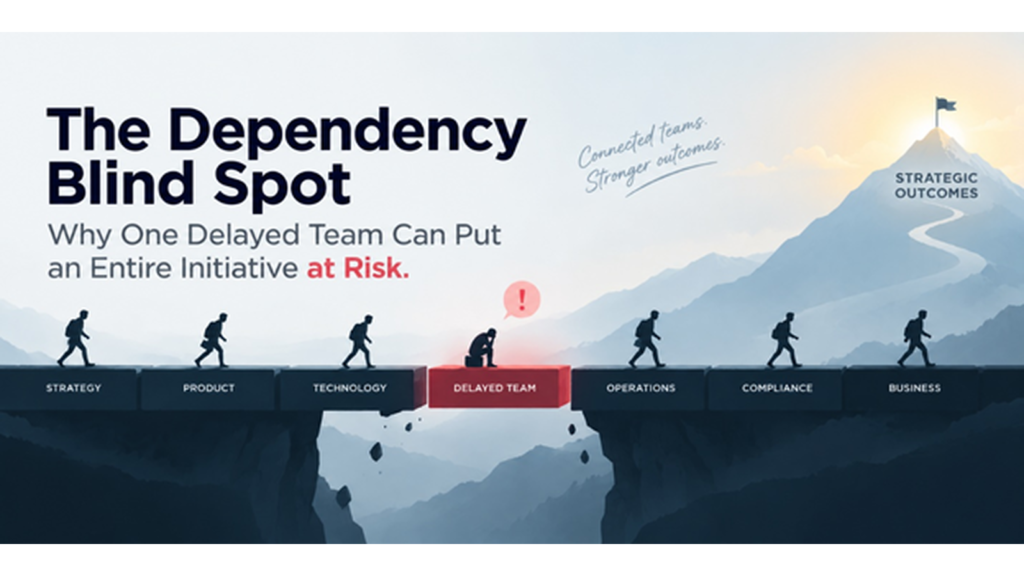
Strategic initiatives rarely depend on one team. Technology, finance, operations, compliance, business functions, and external partners often contribute to the same outcome. This creates a hidden execution risk: one team can be delayed while every other team still appears to be on track.
The problem is not simply the delay. It is the chain reaction that follows when dependencies are not visible early enough.
Problem 1: Teams Look Green While the Initiative Is at Risk.
Most organizations track individual workstreams well. Each team has milestones, owners, deadlines, and status updates. But initiatives move through interconnected work, not isolated plans.
A technology team may be ready for deployment but waiting for compliance approval. Operations may be prepared but dependent on technology. Individually, both teams can report healthy status while the overall initiative is already slipping.
Solution: Make Dependencies Part of Initiative Governance.
Organizations need visibility not only into what each team is delivering, but also what each team is waiting for. Critical dependencies should have owners, due dates, affected milestones, and downstream impact clearly connected.
This makes dependencies visible before they become blockers.
Related reading: The Cost of Invisible Dependencies in Strategic Initiatives
Problem 2: Small Delays Create Disproportionate Impact.
A four-day approval delay may sound manageable. But if it shifts testing, postpones business validation, affects vendor availability, and moves deployment, those four days can quickly become a much larger initiative delay.
By the time the overall status changes from green to amber, several downstream activities may already be affected.
Solution: Treat Dependency Changes as Early-Warning Signals.
A dependency delay should immediately show what milestone is affected, which teams are exposed, and whether intervention is required.
The objective is not to escalate every delay. It is to identify which delays can create the largest downstream consequences.
Related reading: Why Strategic Initiatives Go Off Track Before Leadership Sees the Warning Signs
Problem 3: Dependency Ownership Falls Between Teams.
Cross-functional dependencies often create accountability gaps. One team believes its work is complete, another is waiting for additional input, and the initiative owner only discovers the problem when a milestone starts slipping.
Everyone may be completing their own tasks, yet nobody owns the handoff between teams.
Solution: Create Explicit Dependency Accountability.
Every critical dependency should answer five questions: What is required? Who owns it? Who depends on it? When is it required? What happens if it slips?
Clear ownership turns dependency management from informal follow-up into structured execution governance.
Explore how Initiatives.app approaches connected initiative governance, and follow Dr. Vishwas Mahajan on LinkedIn for perspectives on enterprise execution and governance.
From Dependency Tracking to Dependency Intelligence
The goal should not be another dependency spreadsheet. Leadership needs to understand how dependencies connect with milestones, risks, decisions, approvals, and outcomes.
When these relationships are continuously visible, teams can respond before one delayed handoff becomes an initiative-wide problem.
Conclusion
Strategic initiatives rarely go off track because every team fails simultaneously. More often, the problem begins with one unresolved dependency whose downstream impact remains invisible for too long.
The real risk is therefore not simply a delayed team. It is discovering the consequences of that delay too late.
Connected governance helps organizations see those consequences earlier—giving initiative owners and leadership more time to intervene before a dependency becomes a strategic execution problem.
Learn more at Initiatives.app.
👉 Book a Demo | 🌐 Visit Initiatives.app
📥 Learn more about features, benefits, and use cases at:
👉 www.initiatives.app
Contact Us : info@whizible.com | +91 855-498-3315
Address : Mrugank, Level 3, Kothrud, Pune, Maharashtra, 411038