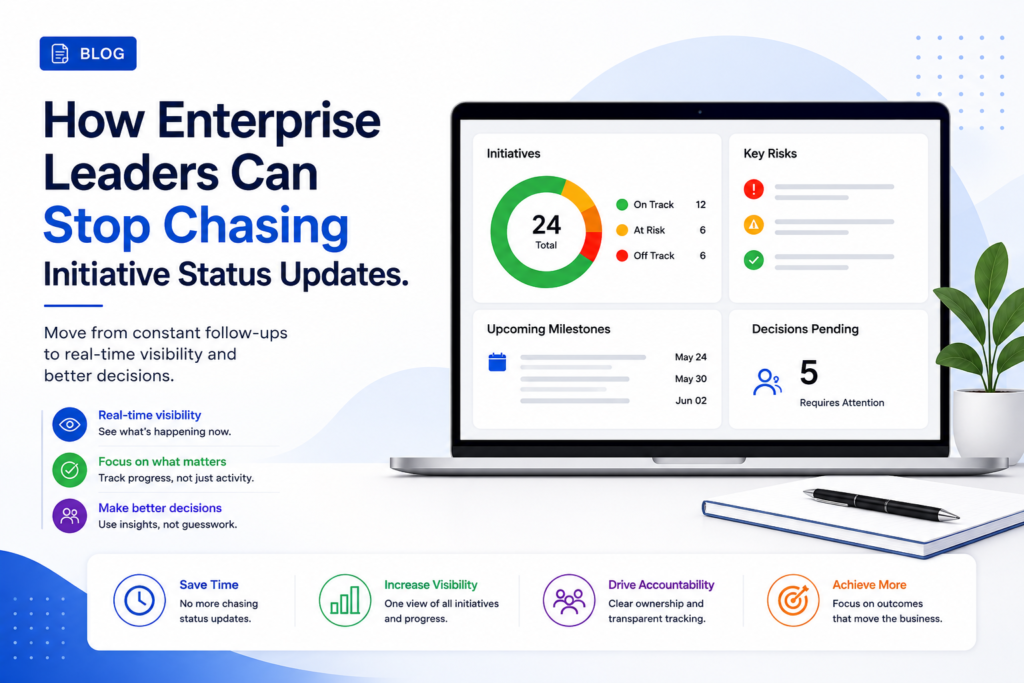
Enterprise leaders should spend their time making decisions, resolving strategic risks, and guiding business outcomes not repeatedly asking teams, “What is the latest status?”
Yet in many organizations, initiative governance still depends on manual follow-ups. Updates are collected through emails, spreadsheets, presentations, meetings, and chat conversations. A PMO may spend hours consolidating information before a leadership review, only for parts of that information to already be outdated when the meeting begins.
The underlying problem is not a lack of reporting. It is a lack of continuous execution visibility. When leadership cannot see initiative health without asking someone to prepare an update, governance becomes reactive. The goal should therefore be to make initiative status continuously visible so leaders can focus on the decisions behind the status.
Problem 1: Initiative Status Is Fragmented Across Too Many Channels
A strategic initiative rarely operates within one team or one system. Business teams may maintain spreadsheets, technology teams may use project tools, finance may track budgets separately, and important decisions may remain buried in email or Microsoft Teams conversations.
Individually, each system may serve its purpose. Collectively, however, they create a fragmented view of execution.
This fragmentation forces leaders and PMOs to reconstruct the truth before every review. One team may report an initiative as “on track,” while another is waiting for an approval or dependency that could affect the same timeline. Leadership sees the summarized status, but not necessarily the conditions underneath it.
Solution: Create a Connected View of Initiative Execution
Enterprise governance needs a shared execution layer where initiative progress, ownership, priorities, risks, dependencies, approvals, and decisions can be viewed together. Instead of asking different teams for individual updates, leaders should be able to see the current execution position directly.
This is the shift from collecting status to observing execution. A connected governance model gives leaders one consistent context for understanding what is moving, what is blocked, and what requires intervention.
Related reading: The Governance Gap Between Strategy Planning and Real Execution
Leadership perspective: Dr. Vishwas Mahajan on LinkedIn
Problem 2: Periodic Reporting Makes Leadership Visibility Outdated
Weekly status reports, monthly steering committees, and quarterly business reviews create structured governance cycles, but they also introduce an unavoidable delay between what is happening and when leadership sees it.
An initiative can change significantly between two reporting cycles. A critical approval may remain pending, a dependency may slip, a priority may change, or an owner may miss an important milestone. If these issues become visible only during the next scheduled review, leadership is managing the past rather than influencing the present.
Solution: Move from Periodic Updates to Continuous Governance
Leaders need live execution signals rather than another layer of reporting. Initiative health, delayed milestones, unresolved risks, dependencies, pending decisions, and ownership gaps should become visible as execution progresses.
Continuous governance does not mean executives need to monitor every task. It means the organization creates enough visibility for leaders to know where attention is required without repeatedly asking for updates.
This changes the leadership conversation from “What happened?” to “What decision do we need to make now?”
Related reading: Why Continuous Initiative Governance Beats Quarterly Reviews for Enterprise Execution
Leadership perspective: Dr. Vishwas Mahajan on LinkedIn
Problem 3: Status Reports Show Progress but Often Hide Execution Risk
Traditional status reporting tends to simplify complex initiatives into percentages, milestone dates, and red-amber-green indicators. These measures are useful, but they can create a false sense of certainty.
An initiative can remain “green” while an important dependency is becoming unstable. A project can report 70% completion while a critical decision remains unresolved. Teams can appear busy while the initiative itself gradually moves away from its intended business outcome.
The real question for leadership is therefore not simply, “What percentage is complete?” It is, “What could prevent this initiative from delivering the expected outcome?”
Solution: Track Execution Signals, Not Just Reported Status
Modern initiative governance should surface the conditions behind progress. Leaders need visibility into risk movement, dependency health, pending approvals, ownership, changes, and strategic alignment—not just a manually declared status.
When these execution signals are continuously visible, leaders can intervene earlier. Governance becomes less about explaining what happened and more about preventing what could happen next.
Related reading: Why Status Reports Lie: Real-Time Initiative Visibility for Modern Enterprises
Leadership perspective: Dr. Vishwas Mahajan on LinkedIn
Problem 4: Chasing Updates Creates Work Without Improving Execution
Manual status collection has a hidden organizational cost. Initiative owners prepare updates, managers validate them, PMOs consolidate them, and leadership reviews them. The same information may then be reformatted for different stakeholders.
The organization becomes efficient at reporting execution rather than improving execution.
Repeated follow-ups also weaken accountability. If people know someone will eventually ask for an update, governance becomes dependent on reminders rather than an embedded operating process.
Solution: Make Accountability Part of the Initiative Workflow
Ownership should be visible from the beginning of an initiative. Decisions, milestones, risks, dependencies, and actions should have clearly identified owners and remain connected to the initiative throughout execution.
Platforms such as Initiatives.app are designed around this governance model, helping enterprises connect initiative tracking, ownership, prioritization, approvals, and execution visibility. When accountability is embedded into the workflow, leadership does not need to create visibility manually before every review.
Related reading: From Planning to Performance: How Enterprises Keep Strategic Initiatives on Track
Leadership perspective: Dr. Vishwas Mahajan on LinkedIn
From Status Chasing to Decision-Driven Leadership
The purpose of enterprise governance should never be to generate more status reports. It should be to help the organization make better decisions while there is still time to influence outcomes.
When initiative information is fragmented and periodic, leaders are forced to chase updates. When execution becomes continuously visible, the governance model changes. Leaders can identify exceptions, understand risks, resolve dependencies, question strategic drift, and make decisions without interrupting teams simply to discover what is happening.
The best indicator of mature initiative governance may therefore be surprisingly simple:
Leaders stop asking for status because the status is already visible.
The conversation can finally move to what matters: What needs attention? What decision is required? And are our strategic initiatives producing the outcomes we expected?
To explore how enterprises can build this kind of connected execution visibility, visit Initiatives.app or read How Leaders Can Track Strategic Initiatives Without Chasing Updates.
For more perspectives on strategy execution and enterprise governance, follow Dr. Vishwas Mahajan on LinkedIn.
👉 Book a Demo | 🌐 Visit Initiatives.app
📥 Learn more about features, benefits, and use cases at:
👉 www.initiatives.app
Contact Us : info@whizible.com | +91 855-498-3315
Address : Mrugank, Level 3, Kothrud, Pune, Maharashtra, 411038